

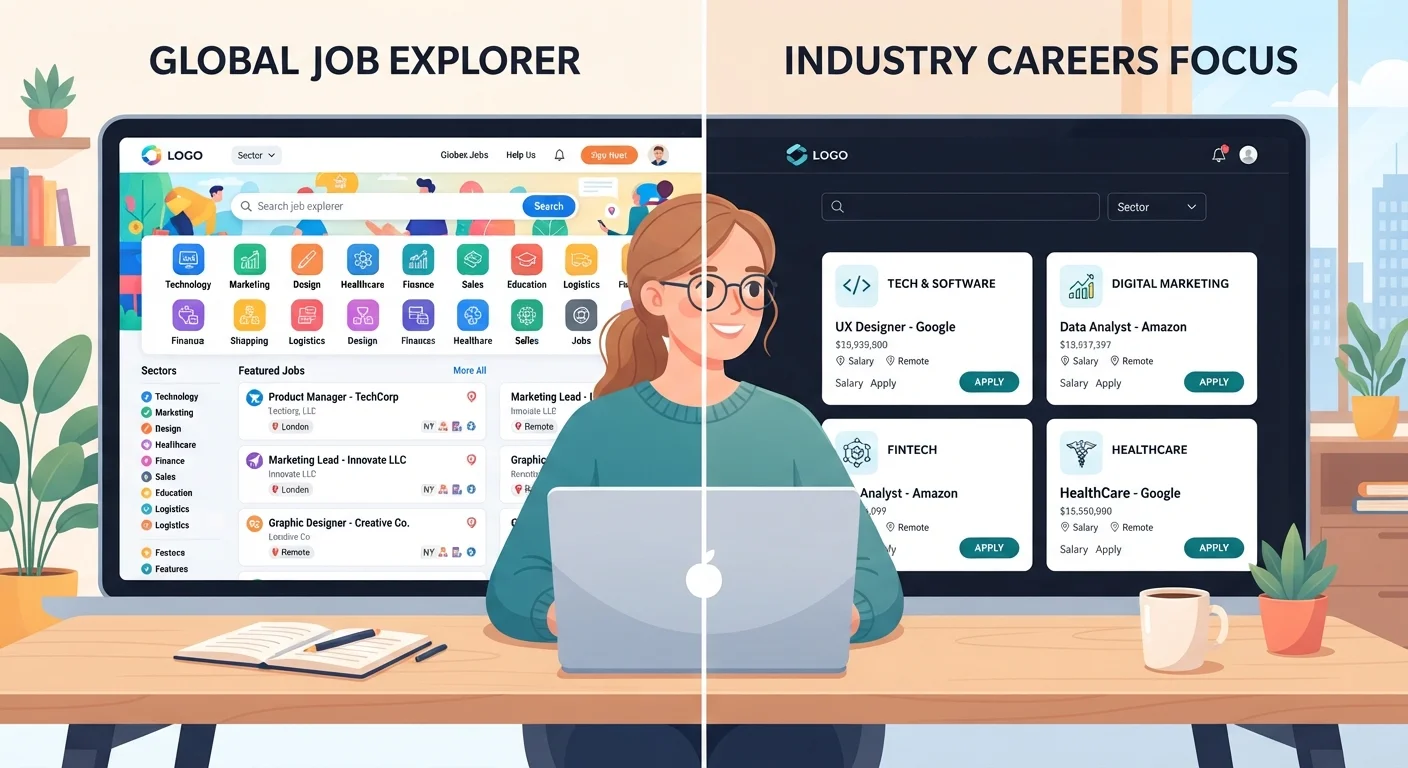
Our Verdict
Neither general platforms nor niche job boards win outright—the strongest job searches use both deliberately. General boards are valuable for volume, market awareness, and early-career exploration, while industry-specific platforms deliver relevance, reduced noise, and access to employers who prioritize domain expertise. Matching the right platform to your goals at each stage of a search is the key distinction.
| Best for | Recommended |
|---|---|
| Early-career job seekers exploring multiple fields | General job boards |
| Experienced professionals in specialized industries | Industry-specific listings |
| Job seekers who want maximum market coverage | Both platforms used together |
| Those pivoting into a new industry or role type | General job boards with niche board supplementation |
What Each Type of Job Board Actually Offers
General job boards aggregate listings across hundreds of industries, making them useful for getting a broad snapshot of the market. They typically offer large listing volumes, built-in resume upload tools, email alerts, and employer review features. For job seekers who are early in their careers or still clarifying their direction, this breadth can be genuinely useful.
Industry-specific job boards, by contrast, serve a defined professional community. A board focused on healthcare, engineering, legal work, or creative fields will attract employers who are actively targeting candidates with specialized backgrounds. The listing count is smaller, but the signal-to-noise ratio is often much higher.
Understanding what each type is designed to do helps you set realistic expectations. Before diving into either, it helps to be fluent in common hiring terminology—see our guide to key job search terms for a quick-reference glossary.
| General Job Boards | Industry-Specific Boards | |
|---|---|---|
| Listing volume | Very high — thousands of roles | Lower — focused on one field |
| Applicant competition | High — open to all candidates | Lower — self-selecting audience |
| Employer targeting | Broad — all industries | Precise — domain-specific employers |
| Best career stage | Entry-level to mid-career | Mid-career to senior specialist |
| Resume optimization needed | High — ATS filters common | Moderate — fewer automated screens |
| Market intelligence value | High — broad salary and title data | Moderate — field-specific benchmarks |
| Cost to job seekers | Usually free to apply | Free or association-membership gated |
Where General Platforms Excel—and Where They Fall Short
The volume advantage of general boards is real. They cast a wide net that can surface roles you didn't know to search for, and their alert systems make passive monitoring easy. For career changers exploring what's feasible across industries, this breadth serves a diagnostic function.
The tradeoff is competition. Popular listings on general boards regularly attract hundreds of applicants, and many of those applications are submitted by people without strong matches to the role. This volume can work against you: applicant tracking systems (ATS) are often used to manage overflow, which means your resume needs to be carefully tailored to pass automated filters before a human ever reads it. Our article on tailoring your resume for each application offers a practical system for doing this without starting from scratch each time.
General boards also sometimes surface outdated listings or roles that were already filled internally—a frustrating but common reality covered in depth in our piece on the hidden job market.
Optimize Your Profile, Not Just Your Application
Many general job boards allow recruiters to search candidate profiles directly—meaning a well-optimized profile can generate inbound interest without you actively applying. Use the same keywords that appear in target job descriptions to make your profile discoverable. Treat your profile as a living document and update it whenever your skills or goals shift.
The Case for Niche Industry Boards
Industry-specific platforms reduce one of the most draining parts of any job search: irrelevance. When you're a licensed nurse, a UX designer, or a civil engineer, sifting through warehouse supervisor roles and marketing coordinator listings wastes time and erodes focus. Niche boards filter that out structurally.
Employers who post on specialized boards are signaling something important: they want candidates from within the professional community. That shared context often means job descriptions are more precise, compensation ranges are more field-realistic, and the hiring managers involved have domain knowledge. This can make interviews more substantive and offers more competitive.
Professional associations frequently operate their own job boards as a member benefit, which adds another layer of vetting—roles posted through associations tend to come from employers already engaged with the professional community. Our overview of professional associations and what membership offers explores when those communities are worth joining.
How to Use Both Platforms Together Strategically
The most effective job searches treat platforms as complementary tools, not competing options. A practical approach looks like this:
- Use general boards for market intelligence. Review salary ranges, common job titles, and which companies are hiring in your field. This shapes your positioning even if you apply elsewhere.
- Apply on niche boards for quality matches. Prioritize these listings when your background aligns closely—competition is lower and employer expectations are clearer.
- Set alerts on both. Automation makes it possible to monitor dozens of boards without daily manual searches.
- Don't let boards replace direct outreach. Research consistently suggests that proactive contact with hiring managers yields callbacks at a different rate than passive applications alone. See our comparison of applying online vs. reaching out directly for what the evidence shows.
Job boards are one component of a broader strategy. For context on how hiring has evolved and which foundational tactics still matter, The Modern Job Search is a useful companion read.
The content on this site is for informational purposes only and is not a substitute for professional advice. Always consult a qualified professional for guidance specific to your situation.