

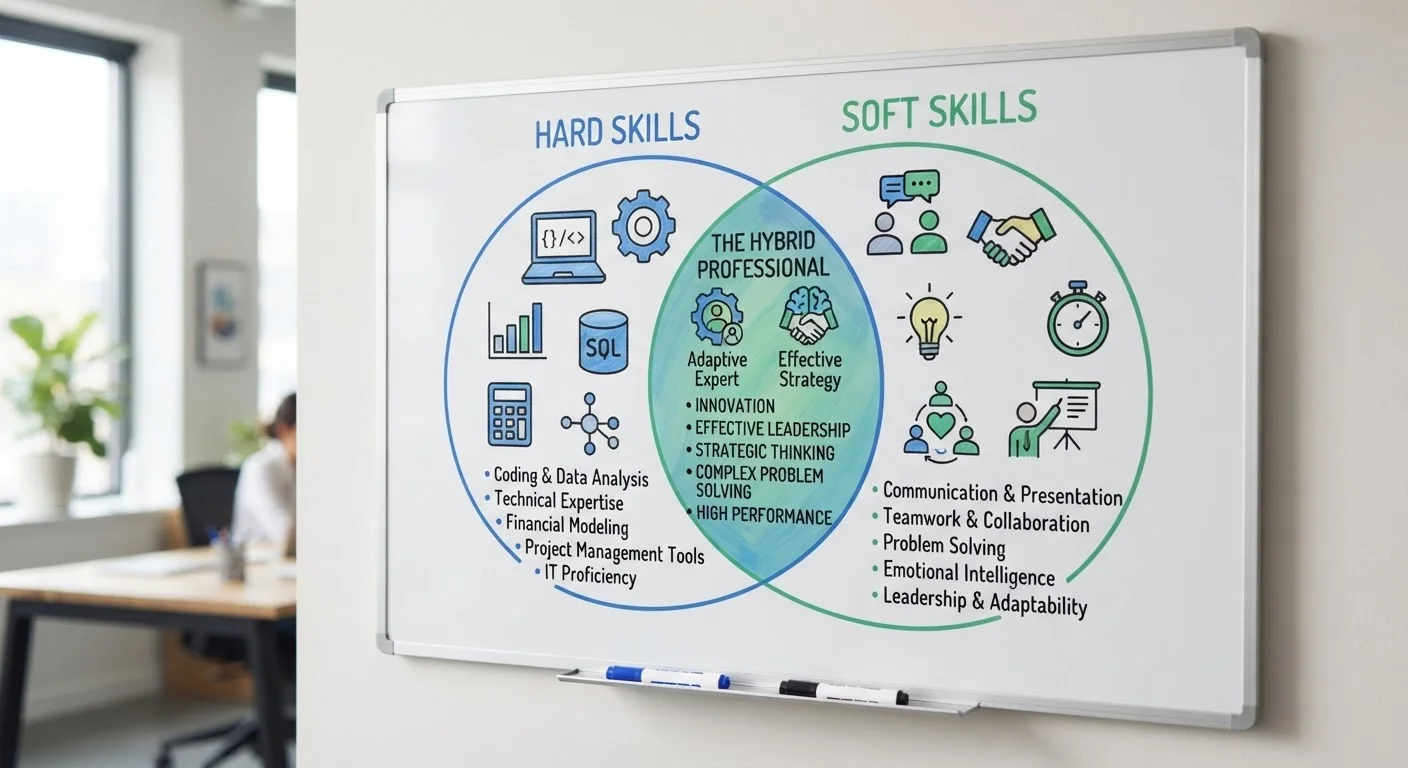
Where the Labels Come From — and What They Actually Mean
The hard/soft framework has its roots in mid-twentieth century military and industrial training, where trainers needed a shorthand to distinguish technical job tasks from behavioral ones. The vocabulary stuck, but the workplace it describes has changed dramatically.
Today, hard skills refers to competencies with a clear learning path: accounting principles, Python programming, medical coding, welding certification. They are trainable, assessable, and usually tied to a credential, portfolio, or performance benchmark. Soft skills — a category that includes communication, emotional intelligence, time management, and leadership — describe how someone operates within teams, under pressure, or across ambiguous situations.
The problem is that calling these skills 'soft' implies they are secondary, easier to develop, or less rigorous. None of those assumptions holds up under scrutiny. Leading a cross-functional team through a product crisis, or mediating a conflict between colleagues with competing priorities, demands skills that are every bit as complex as any technical discipline.
A Note on Terminology
Some organizations and researchers have moved away from the hard/soft framework entirely, preferring terms like 'technical skills' and 'durable skills' or 'power skills.' The World Economic Forum and several workforce research groups use 'human skills' to signal that interpersonal competencies are not peripheral — they are central to how work gets done. You may encounter all of these terms when reading job postings or professional development resources.
Why the Hard/Soft Divide Can Work Against You
When professionals internalize the idea that soft skills are secondary, two things tend to happen. First, they underinvest in developing them, assuming aptitude is innate. Second, they undersell them on applications — listing vague adjectives instead of documented accomplishments.
Hiring research consistently shows that interpersonal competencies are among the most common reasons candidates fail to advance after the technical screening round. A candidate who clears a coding assessment but struggles to articulate their decision-making process — or demonstrate collaborative instincts — often loses ground to someone slightly less technically polished but far more communicatively confident.
The same dynamic plays out in promotions. Technical ability gets you hired, but other capabilities drive advancement — a pattern explored in detail in complementary research on what employers actually reward on the job.
92%
Hiring managers prioritizing soft skills
According to LinkedIn's Global Talent Trends research, the vast majority of talent professionals say soft skills matter as much as or more than hard skills when evaluating candidates.
89%
New hire failures tied to soft skill gaps
A study by Leadership IQ found that the majority of employee performance issues stem from attitudinal and interpersonal factors rather than technical deficiencies.
Top 3
Most in-demand skills are interpersonal
World Economic Forum Future of Jobs reports consistently place critical thinking, creativity, and communication among the highest-demand competencies regardless of industry.
How to Develop Both — With Intention
Neither skill category develops through osmosis. Hard skills require structured learning: coursework, certification programs, or applied practice under expert feedback. Whether you pursue a formal degree or self-directed study, the mechanics matter. Structured and self-paced learning each have distinct trade-offs for working professionals, and choosing the right format for your schedule and learning style can significantly affect results.
Soft skills demand a different kind of rigor. They develop through experience, but only when that experience includes reflection and feedback. Strategies that tend to work:
- Seek regular, specific feedback from managers and peers — not just annual reviews.
- Take on stretch assignments that put you in unfamiliar social or organizational dynamics.
- Study communication and influence as disciplines, not personality traits. Frameworks like nonviolent communication or active listening are learnable techniques.
- Use retrospectives after difficult projects or conversations to identify what you'd do differently.
There are also skills that professionals consistently underrate — capabilities that sit somewhere between the hard/soft binary and quietly drive career trajectories. Explore the overlooked competencies that shape long-term professional success.
Turn Soft Skills Into Verifiable Evidence
Before your next interview or resume update, audit your recent work for examples where interpersonal skills drove a measurable result. Did your communication prevent a project delay? Did your conflict-resolution approach keep a client relationship intact? Write these as outcome-focused statements — they carry far more weight than generic trait claims and give interviewers concrete material to explore.
Reframing Skills When You're Navigating a Transition
The hard/soft distinction creates another friction point when professionals change roles or industries: they assume their existing skills won't translate because they don't match the job description's technical requirements word-for-word. This underestimates transferability.
A project manager moving from construction to healthcare brings scheduling discipline, stakeholder management, and risk mitigation — competencies that cross industries even if the vocabulary differs. The challenge is framing, not capability. If you're switching fields, here's how to reframe existing skills so hiring managers in your target industry take notice.
When building your skill narrative for applications or interviews, treat both hard and soft competencies as evidence-based claims. Pair each skill with a concrete outcome: not 'strong communicator,' but 'led weekly stakeholder briefings that reduced scope-change requests by consolidating feedback cycles.' Specificity is what separates credible from forgettable.
Ultimately, the most useful reframe isn't hard versus soft — it's what you can do versus how you do it. Both dimensions define professional effectiveness, and neither is optional.
Frequently Asked Questions
Hard skills are task-specific competencies you can learn through training, such as using a spreadsheet tool or speaking a foreign language. Soft skills describe how you work — your ability to communicate clearly, manage conflict, or think critically. In practice, most jobs require both operating together.
They can be, because soft skills often involve self-awareness, emotional regulation, and interpersonal dynamics that don't follow a step-by-step curriculum. That said, they are learnable with intentional practice — mentorship, feedback, and real-world experience all help. Neither category develops passively.
It depends on the role and the stage of the hiring decision. Technical skills typically clear the initial screening, while interpersonal skills often determine final hiring choices and promotion decisions. Research from LinkedIn and others consistently finds that a lack of soft skills is a top reason new hires underperform.
Avoid simply listing traits like 'team player' or 'good communicator.' Instead, illustrate them through accomplishments — describe a situation where your communication or leadership produced a measurable outcome. Concrete evidence is far more persuasive than self-applied labels.
Yes, though less directly than hard skills. Employers assess soft skills through structured behavioral interviews, reference checks, group exercises, and situational judgment tests. The challenge is consistency, not impossibility.
Generally, yes. Specific technical tools and platforms can become obsolete as industries evolve — a programming language popular a decade ago may now be rarely used. Soft skills like critical thinking, persuasion, and adaptability tend to remain relevant across roles, industries, and eras.
The content on this site is for informational purposes only and is not a substitute for professional advice. Always consult a qualified professional for guidance specific to your situation.