

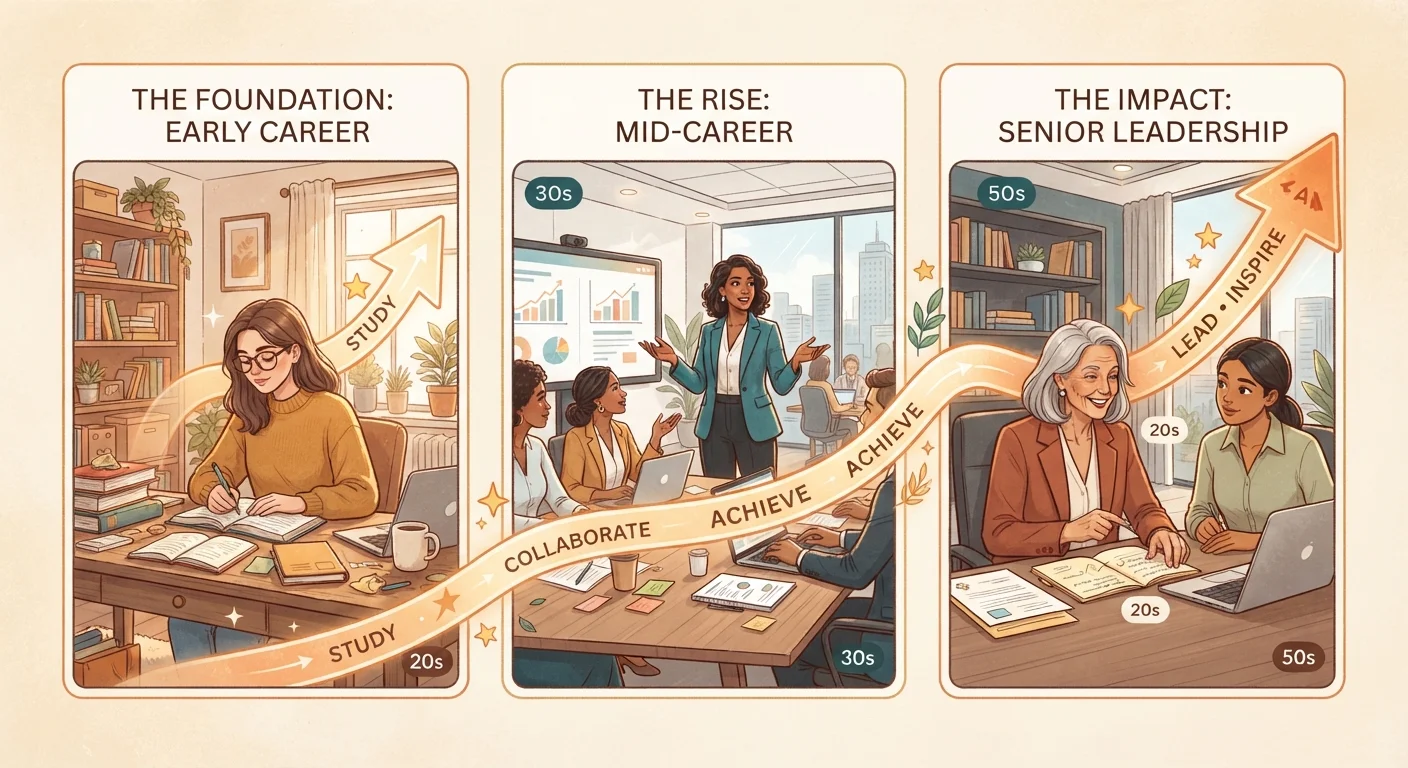
What a Professional Development Plan Actually Is
A professional development plan (PDP) is a structured, written commitment to growing specific skills, knowledge, and capabilities over a defined period. It answers three questions: Where am I now? Where do I want to go? How will I close the gap?
Unlike a general wish list, an effective PDP ties learning activities directly to career goals and includes measurable milestones. Before exploring what a plan looks like at each career stage, it helps to understand the vocabulary used in workplace learning. Our plain-language guide to career development terminology covers concepts like competency frameworks and CPD (Continuing Professional Development) that you'll encounter as you build your plan.
94%
Employees who'd stay longer for learning investment
LinkedIn's Workplace Learning Report found that 94% of employees say they would stay at a company longer if it invested in their learning and development.
40%
Workers who feel their skills are becoming outdated
A Pew Research Center survey found that roughly 4 in 10 workers believe their job skills will need significant updating within the next five years.
5x
More likely to adapt when employees have development plans
Research from Bersin by Deloitte indicates organizations with strong learning cultures are significantly more agile and better positioned for change.
Early Career (0–5 Years): Building the Foundation
In the first few years of a career, the priority is breadth over depth. You're learning how industries, teams, and organizations actually function — often quite differently from how coursework described them.
Key focus areas
- Technical basics: Gain hands-on competency in the core tools and methods of your field.
- Soft skills: Communication, time management, and receiving feedback are often the real differentiators in early roles.
- Mentorship: Identify one or two experienced colleagues who can provide honest guidance on your performance and career path.
- Credentials: Entry-level certifications relevant to your field signal commitment and fill skill gaps cost-effectively.
What the plan looks like
A typical early-career PDP might cover a 12-month window and include two to three skills to develop, one course or certification, and a quarterly check-in with a manager or mentor. Keep it simple enough to execute while working full-time. For a deeper framework, see our guide on building a personal learning plan aligned to your goals.
In your first two years, say yes to more projects than feels comfortable — even slightly outside your role. This breadth of exposure helps you identify where your genuine strengths and interests align before committing to a specialization.
Early-career professionals who take on stretch assignments tend to build richer skill profiles and get visibility that purely passive learners miss.
At the mid-career stage, ask your manager explicitly: 'What would make me an obvious candidate for the next level?' The answer reveals the gap between your perception of your performance and what decision-makers actually value.
Many mid-career plateaus stem not from skill deficits but from misalignment between what the professional is developing and what leadership is actually evaluating for promotion.
Mid-Career (5–15 Years): Deepening Expertise and Expanding Influence
Mid-career is where many professionals plateau — not from a lack of ambition, but from continuing to develop the same skills that got them to this point. Growth at this stage requires a deliberate shift in strategy.
Key focus areas
- Specialization or T-shaped skills: Either deepen expertise in a high-value niche or combine one core specialty with broad adjacent knowledge.
- Leadership fundamentals: Even if you're not managing people yet, skills like project ownership, stakeholder communication, and influencing without authority are increasingly important.
- Cross-functional exposure: Volunteer for projects outside your immediate team. Understanding how other parts of the organization work makes you more valuable and promotable.
- External visibility: Speaking at industry events, writing for professional publications, or contributing to professional associations builds reputation beyond your current employer.
Mid-career is also a common time to reconsider direction. If you're weighing a field change, our resource on navigating a career pivot provides a realistic roadmap. It's also worth examining assumptions you may hold about how advancement works — many of them don't hold up to scrutiny. See career development myths that keep professionals stuck for a clear-eyed look at what actually drives progress.
Senior Career (15+ Years): Leading, Shaping, and Sustaining Growth
Development doesn't stop at seniority — it changes character. Senior professionals often shift from being individual contributors to shaping how entire teams and organizations develop capability.
Key focus areas
- Executive presence and strategic communication: The ability to frame complex ideas concisely for different audiences — boards, clients, junior staff — becomes a core competency.
- Mentoring and sponsorship: Actively developing others is itself a leadership skill and a significant source of professional satisfaction at this stage.
- Staying current: In fast-moving fields, senior professionals risk their expertise becoming outdated. Structured learning — executive programs, peer learning groups, or targeted self-study — keeps thinking sharp.
- Legacy and transition planning: What knowledge or systems do you want to leave behind? What roles or boards do you want to move toward?
At this stage, formal education may be less relevant than peer learning and experience-based development. Our comparison of formal education vs. self-directed learning explores how senior professionals are approaching this trade-off today.
“The most dangerous phrase in professional development is 'I already know how to do that.' Mastery is a moving target, and the professionals who thrive long-term are those who stay genuinely curious about what they don't yet know.”
— Beverly Kaye, Author and workplace learning researcher, known for work on employee development and retention
The Elements Every Plan Should Include, Regardless of Stage
Regardless of where you are in your career, a practical PDP contains the same core components:
- Current-state assessment: An honest inventory of your existing skills, strengths, and gaps — ideally informed by feedback from colleagues or a formal review process.
- Clear goals: Specific, time-bound outcomes (e.g., "Lead a cross-functional project by Q3" rather than "improve leadership skills").
- Development activities: The specific actions — courses, projects, conversations, reading — that will move you toward each goal.
- Resources and support: Who or what will help you execute? This includes budget, time, access to mentors, and organizational support.
- Review cadence: A scheduled, recurring check-in — monthly or quarterly — to assess progress and adjust as circumstances change.
Professionals at every level benefit from treating their PDP as a living document rather than an annual filing exercise. The habits and skills that drive workplace success often come down to exactly this kind of deliberate, continuous attention to growth.
Putting Your Plan Into Action
The most common reason professional development plans fail is that they stay on paper. Here's how to build momentum from day one:
- Start with one goal, not five. Identify the single highest-leverage skill or credential to pursue in the next 90 days. Completing one thing builds more confidence than partially pursuing several.
- Make learning visible. Share your plan — or at least its goals — with your manager. This creates accountability and signals initiative, which many organizations reward.
- Schedule time before the week fills up. Block development time on your calendar as a recurring appointment. Even 30 minutes per week compounds meaningfully over a year.
- Connect learning to current work. The fastest way to develop a skill is to apply it immediately. Look for low-stakes opportunities to practice in your current role before high-stakes situations arise.
Professional development is not a single destination — it's an ongoing practice that adapts as your career, industry, and goals evolve. Starting simply and reviewing regularly is far more effective than waiting to build a perfect plan.
For job seekers who want to connect their development plan to a concrete job search strategy, our job search skills hub covers how to translate credentials and skills into compelling applications.
The content on this site is for informational purposes only and is not a substitute for professional advice. Always consult a qualified professional for guidance specific to your situation.