

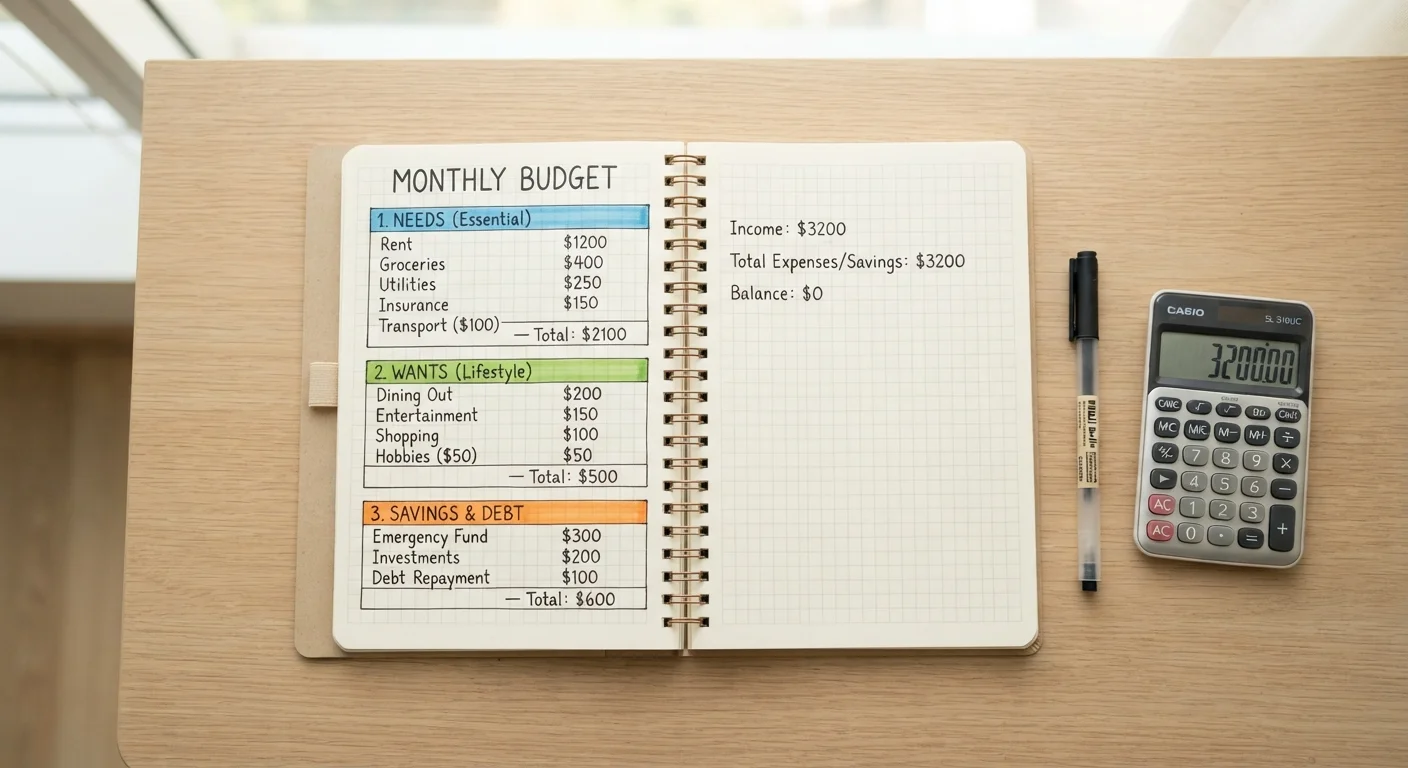
Breaking Down the Three Categories
The 50/30/20 rule organizes every dollar of your after-tax income into three broad buckets. Understanding what belongs in each one is the foundation of making the framework work.
50% — Needs
Needs are non-negotiable expenses: costs you must cover to maintain housing, health, and employment. Common examples include rent or mortgage payments, electricity, gas, water, groceries, health insurance, car payments (if a car is essential for work), and the minimum required payments on any debts. If skipping a payment would result in eviction, job loss, or serious harm, it's likely a need.
30% — Wants
Wants are discretionary expenses — things that improve your quality of life but aren't survival requirements. Streaming services, dining out, gym memberships, vacations, and clothing beyond the basics fall here. This category is where lifestyle choices live. It's also where most overspending starts, which is why monitoring it matters.
20% — Savings and Debt Payoff
This category covers financial progress: building an emergency fund, contributing to retirement accounts, investing, or paying more than the minimum on loans and credit cards. Minimum debt payments count as needs (50%), but any extra you apply toward debt reduction belongs here. See complementary guidance on balancing debt payoff with savings goals for more on prioritizing within this bucket.
Minimum Debt Payments Belong in Needs
A common point of confusion is where to put debt payments. Required minimum payments — on credit cards, student loans, or car loans — count as needs because skipping them causes immediate financial harm. Only additional payments beyond the minimum belong in the 20% savings and debt payoff category.
Why the Needs vs. Wants Line Matters So Much
The most common stumbling block with the 50/30/20 rule is honest categorization. A streaming subscription feels necessary if you've had it for years. A car that's larger than you need might feel essential. These gray areas are real and worth thinking through carefully.
A practical test: ask whether you could cancel or significantly reduce the expense within 30 days without affecting your ability to work or maintain basic living conditions. If yes, it's most likely a want. If canceling would create genuine hardship, it's a need.
Our reference on needs, wants, and the gray areas between them provides a structured framework for working through these distinctions. Getting this step right determines whether the percentages reflect your actual financial behavior — or just an optimistic version of it.
Start With One Month of Real Data
Before adjusting your percentages, spend one full month tracking every expense without changing behavior. This baseline gives you an honest picture of where your money actually goes — which is often different from where you think it goes. Accurate data leads to realistic budget targets.
When the Rule Works Well — and When It Doesn't
The 50/30/20 framework is deliberately simple. That simplicity is its biggest advantage for people who feel overwhelmed by detailed budgeting. It requires no complex spreadsheets, and it establishes a reasonable savings habit automatically.
It works particularly well for:
- People new to budgeting who want a quick starting structure
- Those with relatively stable, predictable monthly income
- Households whose fixed costs fall naturally around or below 50% of net income
However, the framework shows its limits in certain situations. In high-cost metropolitan areas, housing alone can consume 40% or more of take-home pay, leaving little room for other needs before the 50% ceiling is reached. Lower-income households may find that essential expenses structurally exceed 50%, making the standard split unrealistic without income changes or expense reductions.
For couples or roommates managing shared finances, agreeing on which categories joint expenses fall into requires an extra conversation. Resources like budgeting as a household can help align expectations when two people spend differently.
Putting It Into Practice
Applying the 50/30/20 rule takes three concrete steps:
- Calculate your monthly net income. Add up all take-home pay after taxes. Include side income conservatively.
- Multiply by each percentage. Take your monthly net income and calculate 50%, 30%, and 20% to set spending and saving targets for each bucket.
- Compare to your actual spending. Pull up the last two or three months of bank and credit card statements. Categorize each expense as a need, want, or savings contribution. The gaps between your targets and reality show where adjustments are needed.
If your needs category is running over 50%, examine which fixed costs could be reduced — not overnight, but over time. If the 20% savings target feels out of reach, starting at 10% and gradually increasing is more effective than giving up on the framework entirely.
For a deeper look at how to organize spending within these buckets, the budget categories reference guide provides a practical breakdown of common expense types and where they typically belong.
The 50/30/20 rule is one of several approaches worth knowing. If you want to compare it against a more granular method, zero-based budgeting vs. the percentage method lays out the tradeoffs clearly so you can choose what fits your life.
~34%
Average U.S. household share spent on housing
According to the U.S. Bureau of Labor Statistics Consumer Expenditure Survey, housing consistently represents the largest single spending category for American households.
57%
Americans living paycheck to paycheck
Multiple surveys over recent years have consistently found that a majority of U.S. adults report having little to no financial cushion between paychecks, underscoring why a structured savings habit matters.
20%
Recommended savings and debt payoff rate
The 20% target aligns with widely cited personal finance guidance, including recommendations from many nonprofit credit counseling organizations.
This article is for general informational and educational purposes only and does not constitute personalized financial advice. Consider consulting a qualified financial professional for guidance tailored to your specific situation.
Frequently Asked Questions
The rule applies to net income — your take-home pay after federal and state taxes and any mandatory payroll deductions. Using gross income would overstate how much you actually have available to spend and save.
Needs are expenses required to live and maintain employment — rent or mortgage, utilities, groceries, basic transportation, insurance premiums, and minimum debt payments. Anything you could eliminate without serious consequence is generally a want. The line isn't always obvious, and <a href="/money-basics/budgeting-basics/needs-wants-and-the-gray-area-between-them">drawing that line clearly</a> takes honest reflection.
Yes. The 20% category covers savings, investments, and debt payments above your required minimums. Minimum debt payments are typically counted in the 50% needs category. Any extra you put toward debt accelerates payoff and falls under the 20%.
This is common, especially in high-cost cities or for lower-income households. The framework is a guideline, not a mandate. You might temporarily reduce the wants percentage or adjust your savings rate until income increases or fixed costs decrease.
It requires more effort with irregular income. A practical approach is to base the percentages on a conservative estimate of your average monthly income, then adjust contributions in higher-earning months.
Zero-based budgeting assigns every dollar to a specific category, requiring more detail and discipline. The 50/30/20 method trades precision for simplicity. See how they compare in our <a href="/money-basics/budgeting-basics/zero-based-budgeting-vs-the-percentage-method-which-fits-your-life">zero-based vs. percentage method breakdown</a>.
The content on this site is for informational purposes only and is not a substitute for professional advice. Always consult a qualified professional for guidance specific to your situation.