

Start here
Why Month One Is Different
Foundation
Step 1: Find Your Real Take-Home Income
Build it
Step 2: List Every Expense — Fixed and Variable
Apply it
Step 3: Build Your First Spending Plan
Stay on track
Step 4: Track As You Go
Level up
Step 5: Review and Adjust at Month's End
Why Month One Is Different
Starting a budget for the first time is less about restriction and more about discovery. In month one, you are not trying to be perfect — you are building a picture of where your money actually goes. Most people are surprised by what they find.
Think of your first budget as a rough draft. Its job is to give you a starting point, not to lock you into rigid rules. By the end of 30 days, you will have real data, a working plan, and a clear sense of what needs adjusting. That foundation is worth more than any perfect spreadsheet you never finish.
Give Yourself Permission to Revise
Your first budget will not be accurate, and that is completely normal. The numbers you assign to categories in week one are educated guesses. Real spending data is what turns those guesses into a reliable plan, so track honestly and revise without self-judgment.
Step 1: Find Your Real Take-Home Income
Before you allocate a single dollar, you need to know exactly how much money lands in your account each month. Use your net income — the amount after taxes, insurance premiums, and any other payroll deductions — not your gross salary. Budgeting from gross income is one of the most common first-timer mistakes, and it leads to plans that don't survive contact with reality.
- If you are paid the same amount every paycheck, multiply one paycheck by the number of checks you receive per month.
- If your income varies, review the last three months and use the lowest figure as your baseline.
- Include all reliable income sources: a side job, freelance work, or regular transfers from a second account.
Net income
The money you actually receive after taxes and other payroll deductions are removed from your paycheck. This is the figure your budget should be built around.
Fixed expense
A cost that stays the same every month, such as rent or a car loan payment. These are usually the hardest to change quickly.
Variable expense
A cost that fluctuates from month to month, such as groceries or dining out. These are typically the first place to look when trimming a budget.
50/30/20 guideline
A simple budgeting framework that suggests directing roughly half your take-home pay to needs, 30% to wants, and 20% to savings and debt repayment.
Irregular expense
A bill that does not arrive every month — like an annual insurance premium or vehicle registration. Setting aside a small amount each month prevents these from becoming surprises.
Step 2: List Every Expense — Fixed and Variable
Pull up two or three recent bank and credit card statements and write down every expense you see. Group them into two buckets:
- Fixed expenses
- Costs that are the same every month — rent, car payment, insurance premiums, loan minimums. These are non-negotiable in the short term.
- Variable expenses
- Costs that change — groceries, dining out, gas, entertainment, clothing. These are where most budget flexibility lives.
Do not skip small recurring charges. Streaming subscriptions, gym memberships, and app fees add up quickly. For a detailed breakdown of which expenses belong in which categories, see the budget categories reference guide.
Step 3: Build Your First Spending Plan
Now subtract your total expenses from your take-home income. If the result is positive, you have room to save or pay down debt. If it is negative, your expenses exceed your income — and you need to find cuts before the month begins, not after.
A widely used starting framework is the 50/30/20 guideline: roughly 50% of take-home pay toward needs, 30% toward wants, and 20% toward savings and debt repayment. Treat this as a rough compass, not a rigid rule. Your actual numbers will depend on your cost of living and financial goals.
Assign a dollar limit to each variable category. Write it down or enter it in a spreadsheet. If you are also working on building better habits at the grocery store, the smart shopping guide for first-time budgeters has practical strategies that pair well with this step.
Don't Cut So Deep You Quit
First-time budgeters sometimes slash every discretionary category to zero in an attempt to save as much as possible. This approach tends to fail within two to three weeks because it leaves no room for normal life. Build a realistic plan that includes modest amounts for the things you actually spend on — then tighten gradually.
Step 4: Track As You Go
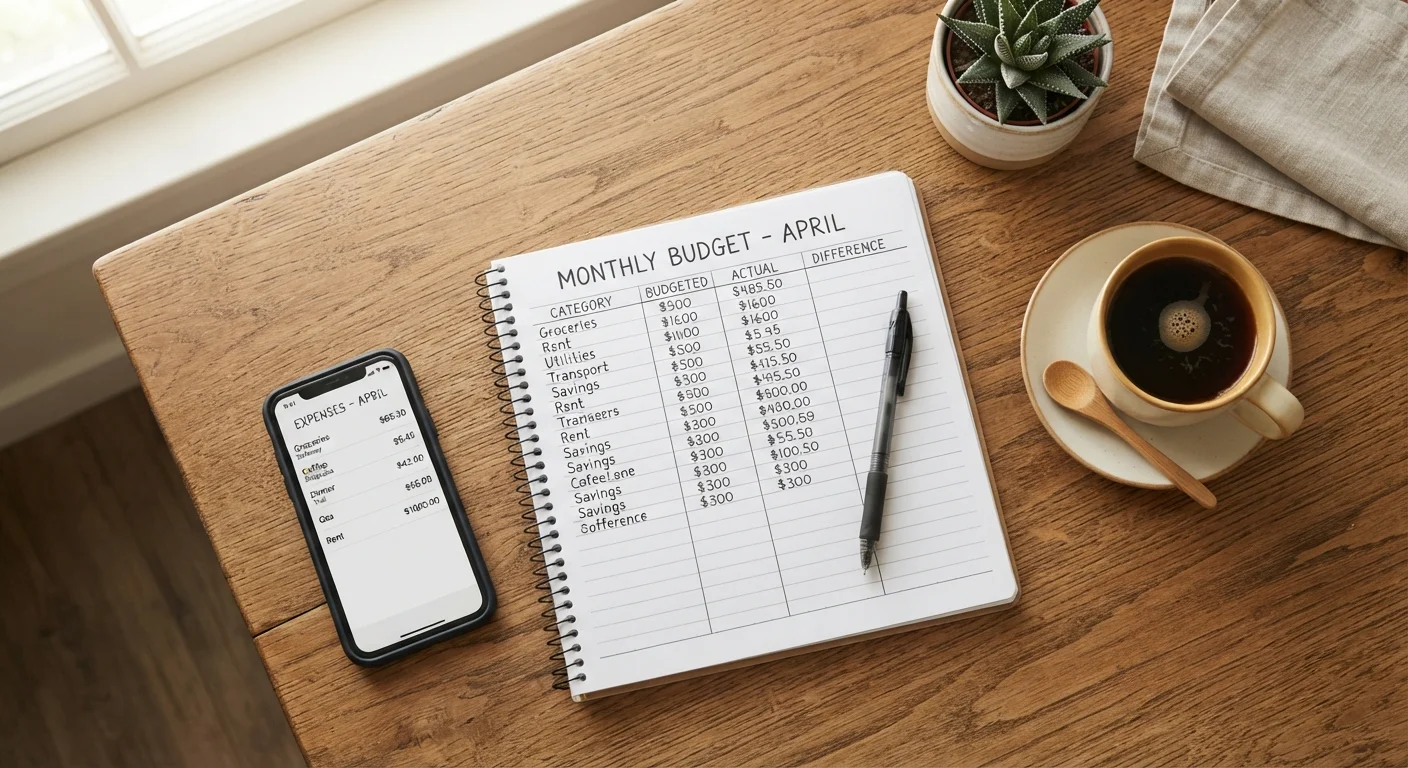
A budget you only look at once a month is not a budget — it is a wish list. Check in at least once a week during your first month to compare actual spending against your plan. This does not mean logging every coffee purchase in real time. A quick weekly review of your bank account is often enough.
For a more structured approach to monitoring without it consuming your week, the spending tracking guide offers low-friction methods that work for most lifestyles. The goal is awareness, not micromanagement.
Step 5: Review and Adjust at Month's End
At the end of 30 days, sit down for 20 minutes with your original plan and your actual spending side by side. Ask three questions:
- Which categories went over, and why?
- Which categories had money left — because I planned well, or because I just got lucky?
- What one change would make next month's plan more realistic?
This review is the step most beginners skip, and it is the step that separates people who improve from people who give up. Use what you learn to update your category limits for month two. For a structured checklist to make this process repeatable, the monthly budget reset checklist walks through each item to cover before the next cycle starts.
If you want to understand what tends to derail budgets after the first month — and how to avoid those pitfalls — why budgets fall apart in month two is worth reading before you get there.
This article is for general informational and educational purposes only and does not constitute personalized financial advice. Consider speaking with a qualified financial professional about decisions specific to your situation.
Frequently Asked Questions
Most people can complete an initial budget in 30 to 60 minutes if they have recent bank statements on hand. The first month requires a little more attention as you learn your real spending patterns, but the process gets faster each cycle.
Use your lowest expected monthly income as your baseline rather than an average. This conservative approach keeps you from over-committing. In months when you earn more, you can direct the extra toward savings or debt.
No — a notebook or a simple spreadsheet works just as well as any app. The tool matters far less than the habit. Choose whichever format you'll actually open each week.
First, identify which category absorbed the overage. Then decide whether to reduce spending elsewhere to compensate or adjust that category's limit next month. Going over occasionally is normal; the review process is how you correct it.
Yes. Treating savings as a non-negotiable line item — rather than whatever is left over — is one of the most effective habits in personal finance. Even a small, consistent amount builds momentum over time.
Add up your known irregular expenses for the year and divide by 12. Set that monthly amount aside in a dedicated savings account or budget line labeled 'irregular expenses' so the money is ready when those bills arrive.
The content on this site is for informational purposes only and is not a substitute for professional advice. Always consult a qualified professional for guidance specific to your situation.