

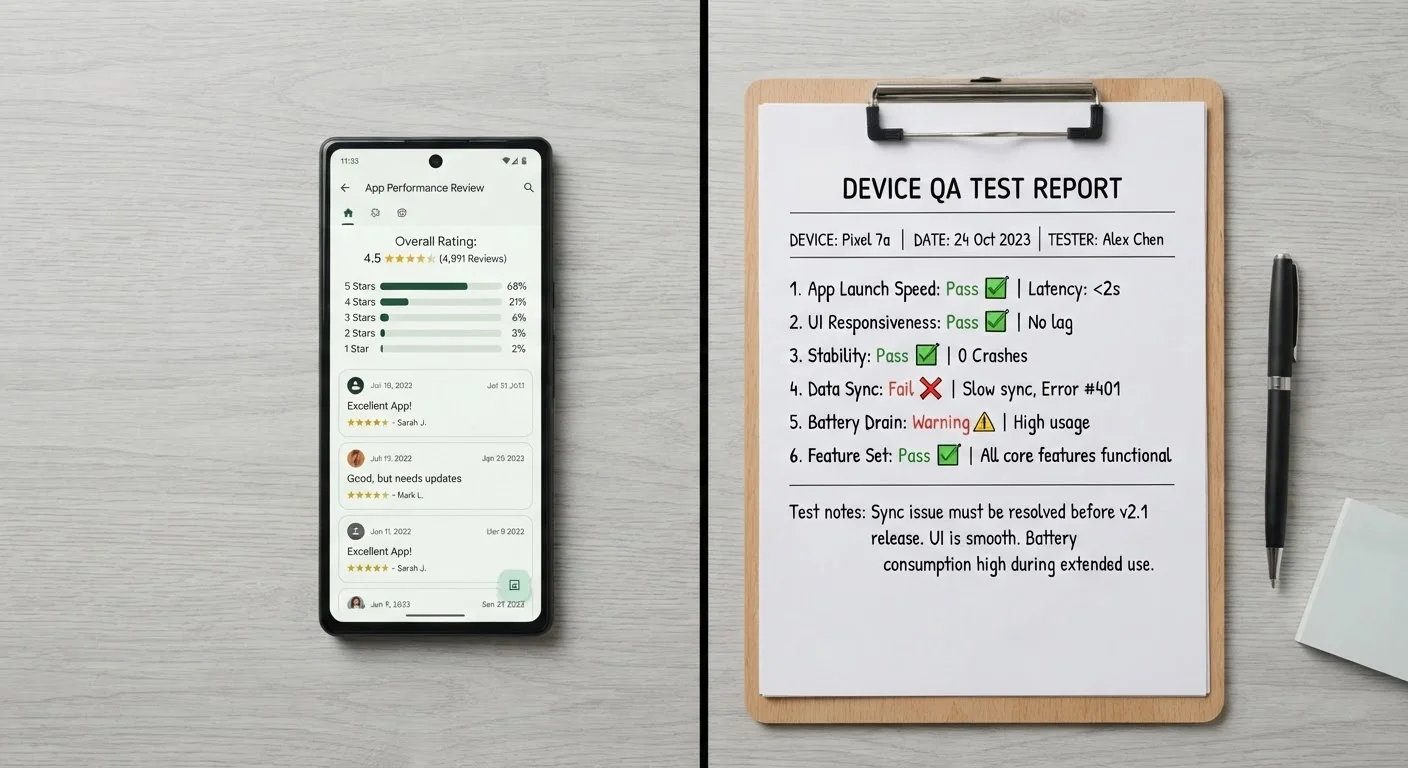
Option A
User Reviews
The real-world, high-volume signal from everyday owners.
Best for: Understanding how a product performs across diverse, everyday conditions over time.
Option B
Expert Reviews
The controlled, criteria-driven assessment from trained testers.
Best for: Evaluating precise technical performance, safety, or specialized specifications before purchase.
What Each Review Type Is Actually Measuring
User reviews and expert reviews don't compete — they measure fundamentally different things. Understanding that distinction is the first step to using both effectively.
User reviews are a form of aggregated real-world feedback. When hundreds of people report that a blender leaks after three months, that pattern is meaningful regardless of any individual reviewer's credibility. The signal value comes from volume and consistency, not from any single voice. These reviews capture how a product behaves outside controlled conditions — in humid apartments, by people who don't read manuals, after years of wear.
Expert reviews are structured evaluations performed by someone with domain knowledge, repeatable methodology, and comparison context. A trained reviewer testing noise-canceling headphones has access to standardized test tones, competing models, and years of category familiarity. That context makes their comparative judgments more reliable for technical performance claims.
The catch: expert reviewers often test pre-production or press samples under ideal conditions. And user reviewers are subject to selection bias — the people most motivated to post are often those with extreme experiences, positive or negative. For a deeper look at what separates reliable reviews from manipulated ones, see what makes a product review trustworthy.
| Criterion | User Reviews | Expert Reviews |
|---|---|---|
| Sample size | Potentially thousands of owners | Typically one or a small team |
| Testing conditions | Real-world, uncontrolled | Controlled, standardized |
| Long-term durability insight | Strong — many report over time | Weak — short evaluation windows |
| Technical precision | Low — impression-based | High — measured benchmarks |
| Bias risk | Incentivized reviews, selection bias | Affiliate pressure, press samples |
| New product coverage | Thin — patterns take time | Available at launch |
| Lifestyle fit signal | Strong — diverse user contexts | Limited — single reviewer's context |
When User Reviews Carry More Weight
User reviews earn their value in situations where lived experience outperforms laboratory conditions.
Durability and longevity are the clearest example. A jacket's waterproofing after two winters of commuting, a mattress's feel after 18 months of use, a phone case's scratch resistance after a year in a bag with keys — none of these are things a short expert evaluation cycle can credibly assess. Scan user reviews specifically for time-stamped feedback from owners past the six-month mark.
Fit, comfort, and lifestyle compatibility are also domains where crowd input wins. Whether running shoes cause blisters, whether a backpack distributes weight well for people with shorter torsos, or whether a pet stroller maneuvers easily on gravel — these questions require diverse human bodies and living situations, not a single tester's experience.
The discipline here is reading user reviews critically. One-star reviews often contain the most actionable detail — look for recurring complaints about the same flaw across multiple reviewers, which signals a genuine product issue rather than a single bad experience. Also be alert to review manipulation; platforms have documented problems with incentivized or fake submissions.
82%
Consumers who read reviews before buying
According to a survey by the Spiegel Research Center, the vast majority of shoppers consult online reviews before making a purchase decision.
~30%
Estimated share of online reviews that may be fake
Research published by the University of Baltimore estimated that a significant portion of online product reviews show signs of manipulation or inauthenticity.
When Expert Reviews Carry More Weight
Expert reviews justify their role when precision, safety, or technical comparison is the deciding factor in a purchase.
For categories like car safety ratings, kitchen appliances, power tools, or medical devices, standardized testing protocols produce data that no individual user can replicate. Whether a car seat meets crash-test benchmarks or a circular saw maintains blade speed under load are questions that require instrumented measurement, not impressions.
New product categories also call for expert input first. When a product type is new to the market, there isn't enough user review history for reliable patterns to emerge. Expert reviews fill that knowledge gap early, even if they can't speak to long-term reliability.
One important caveat: always check whether the expert reviewer discloses potential conflicts of interest. Publications funded primarily through affiliate commissions have a structural incentive to favor products they can monetize. For a frank breakdown of how those business models affect review content, see how affiliate links and sponsored placements shape product content. Independent testing organizations with transparent methodology tend to offer the most trustworthy expert assessments.
Building a Research Strategy That Uses Both
The most practical approach treats expert and user reviews as complementary filters in a two-stage process.
Stage one: use expert reviews to set a technical baseline. Identify which products in your category meet minimum performance and safety thresholds. This narrows your shortlist without requiring you to evaluate every model yourself. Expert testing is efficient for this role — it lets you eliminate clearly underperforming options quickly.
Stage two: use user reviews to pressure-test your shortlist. Once you have two or three technically viable options, shift to user feedback to find durability issues, lifestyle fit problems, and real-world quirks that expert tests didn't surface. Sort by most recent and most critical rather than defaulting to the highlighted positive reviews. For a broader look at how crowd-sourced and lab-style evaluation each reveal different product truths, see how crowd wisdom and controlled testing compare.
The goal isn't to trust one source over the other — it's to know what question each source can actually answer, and to build your judgment from there.
The content on this site is for informational purposes only and is not a substitute for professional advice. Always consult a qualified professional for guidance specific to your situation.