

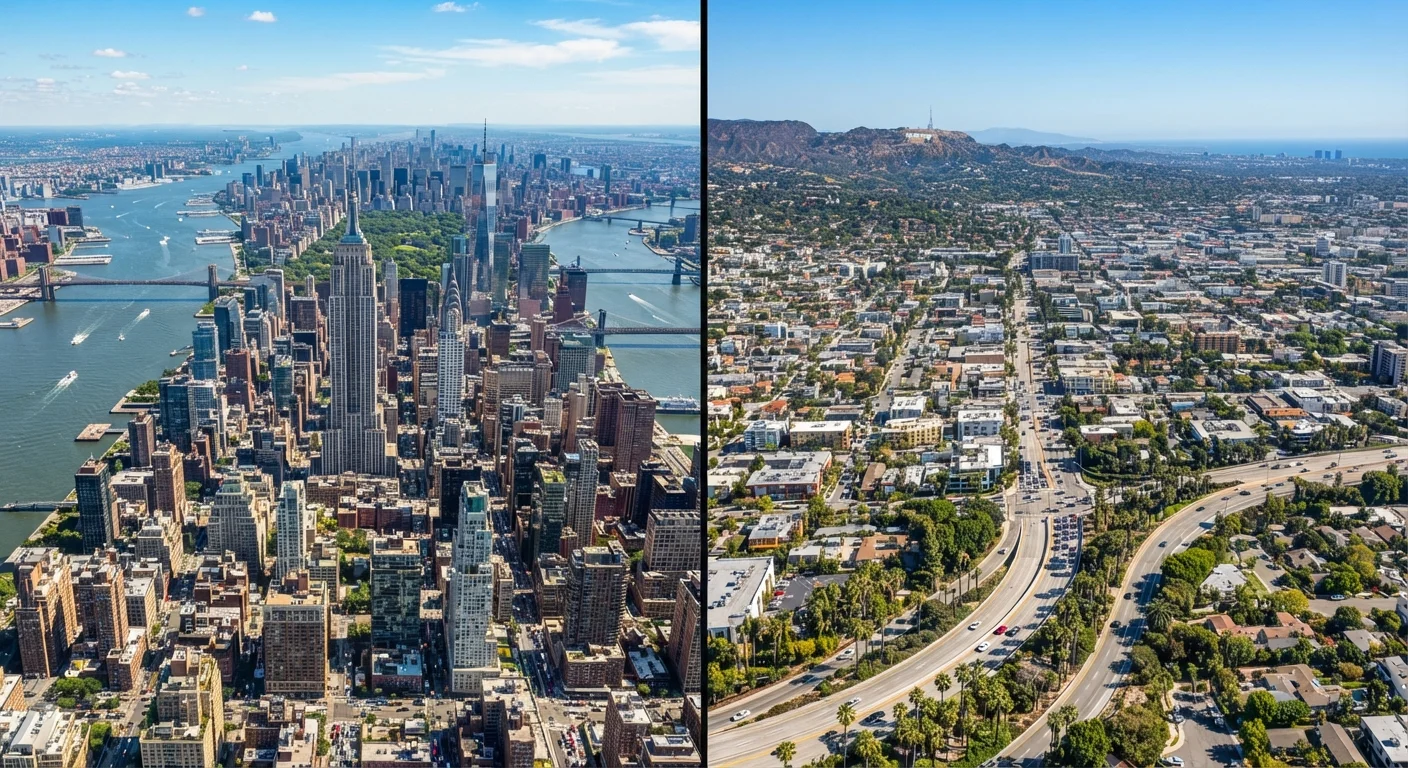
Option A
New York City
The dense, walkable, transit-powered metropolis.
Best for: Travelers who want to cover a lot of ground on foot and by subway, absorbing neighborhoods, food halls, and cultural institutions at a fast clip.
Option B
Los Angeles
The sprawling, car-centric city of distinct districts and outdoor living.
Best for: Travelers who prefer a more relaxed, self-directed pace — hopping between neighborhoods by car, mixing beaches, hiking, and cultural stops along the way.
Getting Around: Transit vs. the Open Road
The single biggest difference between visiting New York City and Los Angeles is how you move through them. In NYC, the subway is the backbone of any itinerary. A single MetroCard tap connects Midtown Manhattan to Astoria, Red Hook, or the Bronx. Most visitors never need a car, and many find that driving in Manhattan actively slows them down.
Los Angeles operates on a fundamentally different logic. While the city does have a Metro rail system with expanding coverage, the sprawl between key neighborhoods — say, Venice Beach to Pasadena — makes a rental car nearly essential for most visitors. Traffic patterns vary significantly by time of day and day of week, which means itinerary planning in LA needs to account for realistic drive times, not just map distances.
Understanding your travel style before booking matters here: if you're uncomfortable driving in an unfamiliar city, NYC is the more accessible choice. If driving is second nature, LA opens up considerably.
| Criterion | New York City | Los Angeles |
|---|---|---|
| Primary transportation | Subway and walking | Car or rideshare |
| Neighborhood accessibility | Mostly walkable between areas | Requires driving between districts |
| Typical climate | Four distinct seasons | Mild year-round, dry summers |
| Hotel cost range | Generally higher, especially Manhattan | Varies widely by neighborhood |
| Outdoor recreation | Parks, waterfronts, limited beaches | Beaches, hiking, mountains nearby |
| Cultural institutions | Extremely dense concentration | Spread across the metro area |
| Food scene character | Dense, hyper-diverse by block | California-influenced, strong Asian and Mexican |
Neighborhoods: Dense Stack vs. Sprawling Districts
New York's neighborhoods are layered and walkable. In a single afternoon, you can move from the cafes of the West Village through SoHo into Chinatown — all on foot, with each block shifting the architectural and cultural texture. That density is part of the city's appeal, but it also means crowds, narrow sidewalks, and constant noise.
Los Angeles is more accurately understood as a collection of distinct cities-within-a-city separated by freeways. Hollywood, Koreatown, Leimert Park, and Brentwood each have genuine character, but you won't stumble between them accidentally. Visiting LA requires choosing which neighborhoods fit your interests and mapping a realistic route — something many first-time visitors underestimate.
302 sq mi
Area of New York City
NYC's five boroughs cover approximately 302 square miles, with Manhattan being the densest at roughly 28 square miles.
503 sq mi
Area of City of Los Angeles
The City of Los Angeles spans over 500 square miles — and the broader LA metro area is significantly larger still.
3.5M+
Average weekday NYC subway riders
According to the MTA, the NYC subway system serves millions of riders on a typical weekday, making it the busiest rapid transit system in the US.
Travelers who want depth over breadth may actually find LA more rewarding once they accept its structure. For those who prefer serendipitous discovery, NYC's walkability is hard to beat. If neither of these high-profile cities fits your travel style, smaller American destinations offer a very different kind of engagement.
Food, Cost, and Practical Expectations
Both cities offer extraordinary food scenes. NYC's strength lies in density and diversity — you can find excellent Sichuan, West African, and Dominican food within blocks of each other in many neighborhoods. LA's food culture skews toward California-influenced cuisine, exceptional Mexican and Korean options, and outdoor dining year-round. Neither city is cheap, but the cost structure differs.
Hotel rates in Manhattan tend to be among the highest of any US city, particularly in central locations. LA hotel pricing varies more dramatically by neighborhood and proximity to the coast. Food costs in both cities cover a wide range — street food and food halls offer relative value, while sit-down restaurants in prime areas can be expensive in either destination.
Americans accustomed to driving everywhere sometimes apply similar assumptions to European travel, and the same mismatch can happen between NYC and LA. Common planning assumptions about walkability and transit don't transfer evenly between US cities either — and NYC is genuinely unusual in the American context, not the norm.
This article provides general travel information for planning purposes. Prices, transit coverage, and neighborhood conditions change over time — verify current details through official city tourism resources and transportation authority websites before your trip.
The content on this site is for informational purposes only and is not a substitute for professional advice. Always consult a qualified professional for guidance specific to your situation.