

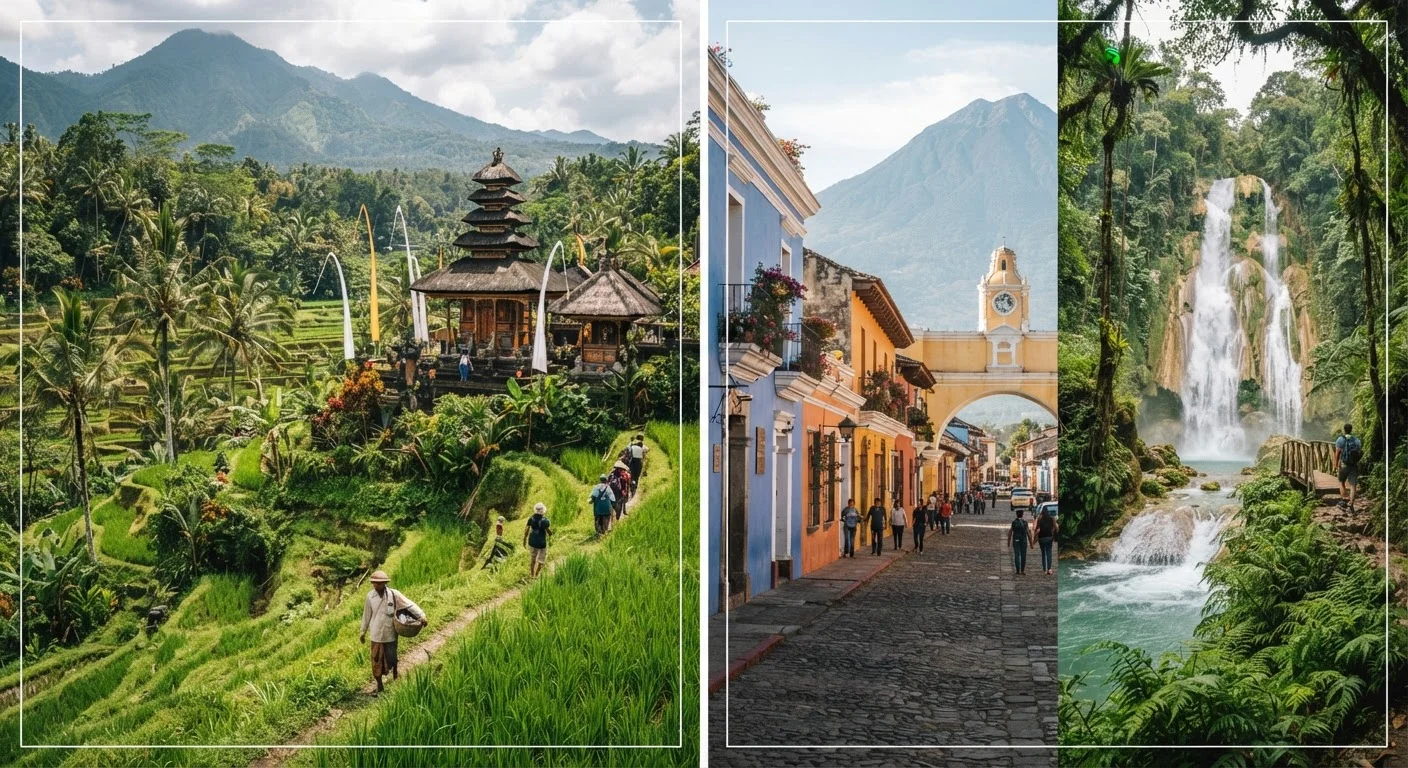
Option A
Southeast Asia
The immersive, ultra-affordable long-haul classic.
Best for: Travelers who prioritize low daily costs, cultural depth, and a well-established backpacker infrastructure.
Option B
Central America
The accessible, adventure-rich choice closer to home.
Best for: First-timers who want shorter flights, Spanish-speaking destinations, and a mix of nature and beach in a compact region.
Getting There: Flight Time and Logistics
For most Americans, the first practical question is how long it takes to get there. Central America wins on convenience. Flights from major US hubs like Miami, Houston, or Los Angeles to San José, Costa Rica or Guatemala City typically run 3–6 hours, with many direct options available. That means you can leave on a Friday evening and be exploring by Saturday morning.
Southeast Asia is a different proposition. Flights from the US to Bangkok, Hanoi, or Bali typically take 16–22 hours with at least one connection. That's a significant chunk of a standard American vacation. Budget at least a day on each end for transit, and plan for real jet lag — most of Southeast Asia sits 11–14 hours ahead of US Eastern time.
If you're newer to independent international travel, see our guide to planning your first international trip from the US for a grounded overview of what to prepare before either trip.
| Criterion | Southeast Asia | Central America |
|---|---|---|
| Flight time from US | 16–22 hours (with connections) | 3–6 hours (often direct) |
| Typical daily budget | Lower (especially Vietnam, Cambodia) | Moderate (varies by country) |
| Primary language | Multiple (Thai, Vietnamese, etc.) | Spanish (English in Belize) |
| Time zone difference from ET | 11–14 hours ahead | 1–2 hours behind to same |
| Visa requirements for Americans | Varies widely by country | Mostly visa-free (90 days) |
| Cultural immersion depth | Extensive — ancient temples, distinct traditions | Rich — Mayan history, colonial cities, nature |
| Adventure/nature options | Strong (beaches, trekking, islands) | Strong (volcanoes, rainforests, surf) |
| Tourist infrastructure | Very developed in key corridors | Developed, especially Costa Rica |
Costs: Daily Budget Comparison
Southeast Asia has a longstanding reputation as one of the most affordable regions in the world for travelers. In countries like Vietnam, Cambodia, and Thailand, a daily budget covering a guesthouse, local meals, and transport can stretch remarkably far compared to US prices. Street food culture is pervasive, and domestic travel between cities is inexpensive.
Central America is more mid-range. Costa Rica in particular has seen notable price increases in tourism infrastructure, and while budget travel is still very possible — especially in Guatemala or Nicaragua — you'll generally spend more per day than in mainland Southeast Asia. That said, costs are still well below Western Europe or the Caribbean for comparable experiences.
For broader budget travel strategies, the Travel on a Budget hub has practical frameworks for stretching your spending across either region.
~6 hrs
Average US-to-Central America flight time
Most US gateway cities have direct or one-stop service to major Central American hubs, according to general airline routing data.
190+
Countries Americans can visit visa-free
The US passport ranks among the most powerful globally, enabling visa-free or visa-on-arrival access to most of both regions, per the Henley Passport Index.
7
Countries in Central America
Guatemala, Belize, Honduras, El Salvador, Nicaragua, Costa Rica, and Panama each offer distinct landscapes and experiences in a geographically compact region.
Culture, Language, and Navigation
Central America's biggest practical advantage for many American travelers is language. Spanish is the official language in every country except Belize, and basic conversational Spanish goes a long way. Menus, signs, and local interactions are far more accessible if you have even rudimentary Spanish skills. English is also widely spoken in tourist corridors.
Southeast Asia is linguistically diverse — Thai, Vietnamese, Khmer, Bahasa Indonesia, and many others are spoken across the region. In major tourist areas, English signage and English-speaking staff are common, but venturing beyond the well-trodden paths requires more patience and resourcefulness. That said, the cultural richness on offer — ancient temples, living spiritual traditions, distinct culinary heritage — is extraordinary and often cited as a transformative experience by first-time visitors.
Planning your route thoughtfully makes a big difference in both regions. Our guide on itinerary planning vs. spontaneous travel can help you decide how structured your approach should be.
Safety, Health, and Entry Requirements
Both regions require careful pre-trip research. Safety conditions vary significantly by country and even by specific area within a country. Neither region should be treated as a monolith — some Central American countries have areas with elevated risk, while others are considered quite safe for tourists. Similarly, Southeast Asia ranges from highly tourist-friendly destinations to areas with specific cautions.
Health considerations also differ. Some Southeast Asian countries may recommend vaccinations not typically required for Central America travel — but requirements and recommendations change. Always consult a travel medicine clinic or your healthcare provider well in advance of departure, and check current guidance from the CDC and the US State Department for both regions.
Visa rules vary by destination and passport. Many Central American countries offer Americans visa-free entry for 90 days. In Southeast Asia, rules range from visa-free (e.g., Thailand) to visa-on-arrival to requiring advance applications. Verify current requirements directly with each country's embassy or consulate before booking.
Always Verify Official Entry and Safety Information
Travel advisories, visa rules, and health requirements can change without notice. Before booking, check the US State Department's travel advisory page and the CDC's traveler health notices for your specific destination. Do not rely solely on travel blogs or booking sites for this information — go directly to official government sources.
Before finalizing your plans, use our destination research checklist to cover entry requirements, health considerations, and local laws for whichever region you choose.
The content on this site is for informational purposes only and is not a substitute for professional advice. Always consult a qualified professional for guidance specific to your situation.