

What a Declarations Page Actually Is
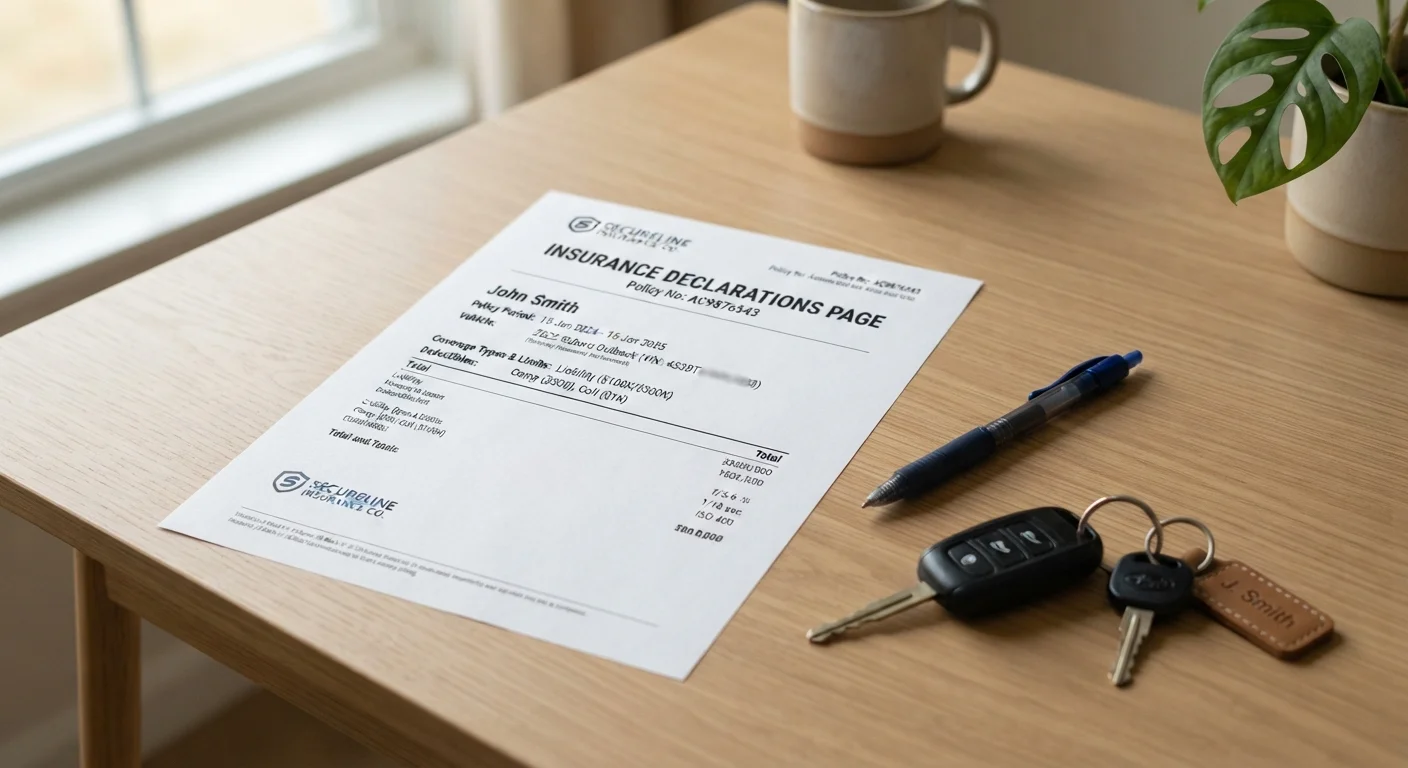
Think of your auto insurance declarations page as the cover sheet for your entire policy. In one or two pages, it summarizes who is insured, what vehicles are covered, what types of protection you have, and how much you're paying. It does not replace the full policy document, which contains the fine print that governs exactly how claims are handled.
Most drivers only look at the dec page when they need to show proof of insurance — but it's worth reviewing carefully at each renewal. If your coverage limits are lower than you thought, or a driver has accidentally been left off, you want to catch that before a claim, not after.
The Dec Page Is Not Your Full Policy
The declarations page summarizes your coverage but does not contain every exclusion, condition, or definition that governs your policy. Always refer to the full policy document — sometimes called the policy jacket — for the complete terms. When in doubt about what is or isn't covered, ask your agent directly.
What you will need
Auto Insurance Declarations Page
The document you will read through and verify during this process.
Vehicle Registration or Title
Useful for cross-checking your VIN, vehicle year, make, and model against what the dec page lists.
Insurer's App or Online Portal
Allows you to access and download a current digital copy of your declarations page if you don't have a paper version.
How to Read It, Section by Section
Follow these steps with your declarations page in front of you. The layout varies by insurer, but the core information appears in roughly the same order across most policies.
Locate and Open Your Declarations Page
Your insurer mails a declarations page — often called a dec page — at the start of each policy period, typically every six or twelve months. If you went paperless, check your email or your insurer's app. The dec page is usually the first one or two pages labeled "Policy Declarations" or "Auto Insurance Declarations."
Confirm Your Personal and Vehicle Information
At the top of the page you'll see your name, mailing address, and the policy number. Below that is a section listing each covered vehicle with its year, make, model, and VIN. Cross-check the VIN against your registration or the sticker on your driver-side door jamb. Even a single wrong digit can cause problems during a claim.
Also check that all drivers in your household who regularly use the vehicle are listed. Unlisted regular drivers can sometimes be used to deny or reduce a claim, depending on your policy terms and state rules.
Read the Policy Period and Effective Dates
The dec page will clearly state the policy period — for example, "06/01/2024 to 12/01/2024." Coverage only applies during this window. Make a note of the expiration date so you're not caught unaware if your auto-pay fails or your insurer doesn't renew.
Review Each Coverage Type and Its Limits
This is the most important section. You'll see coverage types listed in rows — such as Bodily Injury Liability, Property Damage Liability, Collision, Comprehensive, Uninsured Motorist, and possibly others. Next to each is a coverage limit, which is the maximum your insurer will pay for a covered claim.
Liability limits are often written as split limits (e.g., 100/300/100), which means $100,000 per person for bodily injury, $300,000 per accident for bodily injury, and $100,000 for property damage. For a plain-language breakdown of what these coverage types actually protect, see our guide to liability, collision, and comprehensive coverage.
Check Your Deductibles
For coverages like collision and comprehensive, you'll see a deductible — the dollar amount you pay out of pocket before your insurer pays the rest of a claim. Common amounts are $250, $500, or $1,000. A higher deductible typically lowers your premium, but means more out-of-pocket cost after an incident. For a deeper look at how this trade-off works, see our article on how deductibles work in auto insurance.
Verify Your Premium and Discounts
The dec page shows your total premium — what you owe for the policy period — broken down by coverage. You may also see a list of applied discounts, such as multi-vehicle, good driver, or anti-theft device credits. Confirm these match what you were quoted. If a discount you expected isn't there, follow up with your agent.
Understanding what drives your premium can help you plan ahead. Our field guide to auto insurance quotes explains the key factors insurers use to set your rate.
Errors Can Affect Your Coverage
If your declarations page lists the wrong vehicle, address, or driver, it could complicate or delay a claim. Insurance is regulated at the state level, and coverage terms vary by provider, so never assume the page is accurate just because you received it. Review it every time you renew, and contact your insurer immediately if anything looks off.
Keep a Digital Copy Handy
Most insurers let you download your declarations page through their app or online portal. Saving a PDF to your phone means you can pull it up quickly if you're involved in an accident or need to verify coverage at a rental counter. Just make sure it's the current policy period's version.
Once you've confirmed every line item, you'll have a clear picture of your actual coverage — not just what you assumed you had. If you're weighing whether your collision and comprehensive coverages make sense for your vehicle's current value, our article on when you need both comprehensive and collision can help you think it through.
This article provides general information about auto insurance and is not personalized insurance, legal, or financial advice. Coverage terms, limits, exclusions, and regulations vary by provider and state. Always read your full policy document and consult a licensed insurance agent or adviser for guidance specific to your situation.
The content on this site is for informational purposes only and is not a substitute for professional advice. Always consult a qualified professional for guidance specific to your situation.