

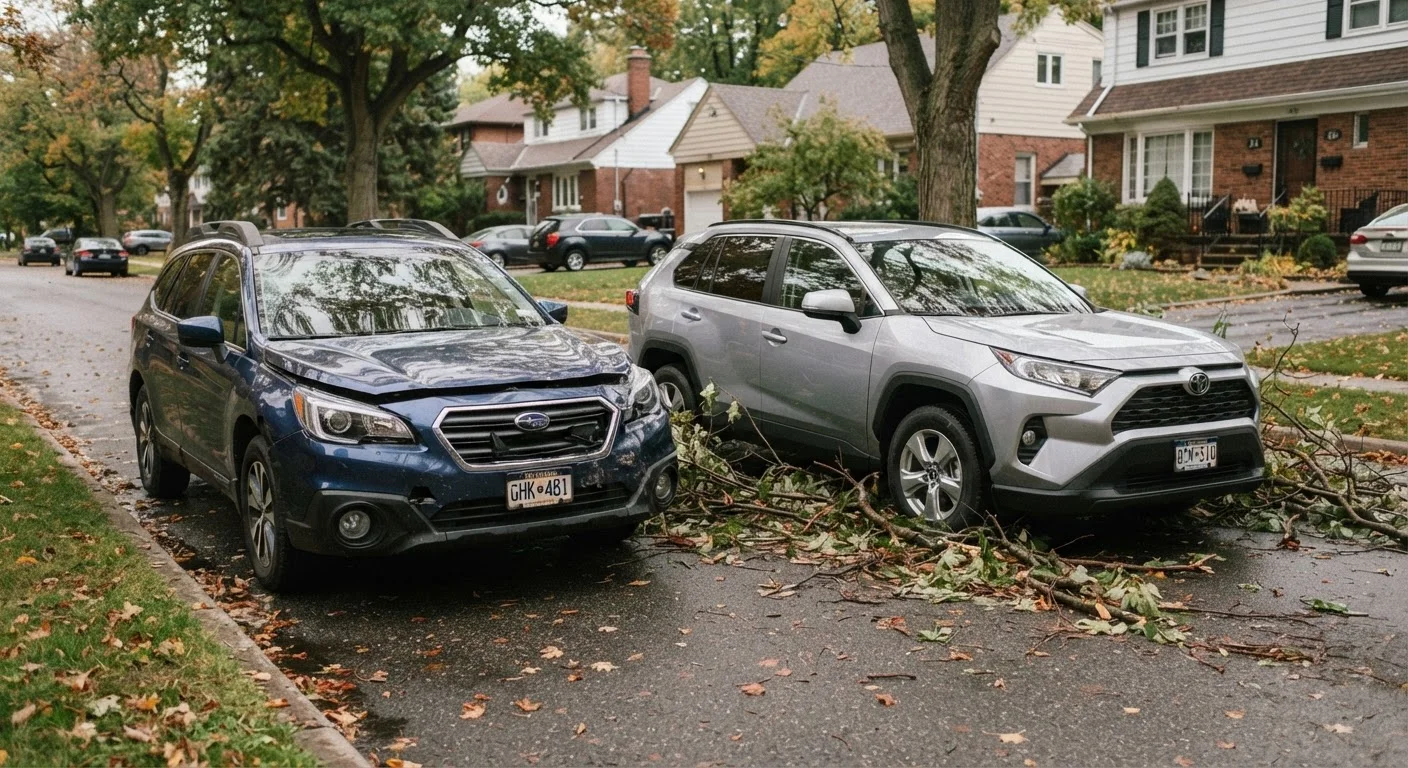
Option A
Comprehensive Coverage
Protection against events outside your control.
Best for: Drivers who want coverage for theft, weather, fire, and other non-collision events that can damage or total a vehicle.
Option B
Collision Coverage
Protection when your car hits — or gets hit by — something.
Best for: Drivers who want their insurer to help pay for repairs after an accident, regardless of who was at fault.
What Each Coverage Actually Does
These two types of coverage are often sold together, which can make them feel interchangeable. They're not — they cover entirely different situations.
Comprehensive coverage pays for damage caused by events that aren't a collision with another vehicle or object. Think theft, vandalism, fire, flooding, hail, falling trees, or hitting an animal. If a storm drops a branch on your hood or someone breaks your window overnight, comprehensive is what steps in.
Collision coverage applies when your vehicle makes contact with something — another car, a guardrail, a telephone pole, or the ground after a rollover. It doesn't matter who caused the accident; collision coverage addresses damage to your own vehicle regardless of fault.
For a broader look at how these fit alongside liability coverage, see what each auto coverage type actually covers.
| Criterion | Comprehensive | Collision |
|---|---|---|
| What triggers it | Non-collision events (theft, weather, animals, fire) | Contact with another vehicle or object |
| Fault matters? | No — event-based, not fault-based | No — covers your car regardless of fault |
| Required by law? | No | No |
| Required by lenders? | Usually yes, on financed/leased vehicles | Usually yes, on financed/leased vehicles |
| Payout basis | Actual cash value minus deductible | Actual cash value minus deductible |
| Typical deductible range | $100–$1,500 | $250–$2,000 |
| Generally lower premium? | Yes — typically lower than collision | No — usually higher premium |
When Lenders Make the Decision For You
If you're financing or leasing a vehicle, the question of whether to carry comprehensive and collision often isn't yours to make. Most lenders and leasing companies require both as a condition of the agreement. Their reasoning is straightforward: they have a financial stake in the vehicle, and they want it protected.
Once you own the car outright, the requirement disappears — but that doesn't mean dropping coverage is automatically the right move.
What "Actual Cash Value" Means
When an insurer settles a claim under comprehensive or collision coverage, they pay based on the vehicle's actual cash value — what it would sell for on the open market at the time of loss, not what you paid for it or what it would cost to replace it new. Depreciation plays a significant role. A three-year-old car may have lost 40–50% of its original purchase price in ACV terms, which directly affects how much a claim payout covers.
Your declarations page will list both coverages if they're active on your policy, along with the deductible for each. If you're unsure what you're currently carrying, reading your declarations page is a good starting point.
The Financial Calculation: Is Keeping Coverage Worth It?
The core question for paid-off vehicles is straightforward: if you filed a claim, would the payout actually cover meaningful costs after your deductible?
Insurers pay out based on a vehicle's actual cash value (ACV) — what the car is worth on the open market at the time of loss, accounting for age and depreciation. A car worth $4,000 with a $1,500 deductible means your maximum payout is $2,500. If you're paying $700 a year in premiums for that coverage, you're paying a significant share of the potential benefit just to maintain the policy.
A rough rule of thumb many drivers use: if your annual premium for a coverage type exceeds 10% of your vehicle's ACV, it may be worth reevaluating. That's a starting point for thinking, not a financial guarantee — your own situation, risk tolerance, and savings cushion all matter. For more on how deductibles affect this math, see how deductibles work in auto insurance.
If you still owe money on the car, also consider whether gap insurance applies to your situation — it covers the difference between what you owe and what your insurer pays if the car is totaled.
~$192/yr
Average comprehensive premium (U.S.)
According to the National Association of Insurance Commissioners, the average annual expenditure for comprehensive coverage has typically been well under $200 for most drivers.
~$400/yr
Average collision premium (U.S.)
Collision coverage consistently runs higher than comprehensive, reflecting the greater frequency of vehicle accident claims compared to non-collision losses.
~50%
Depreciation in first 3 years
Many vehicles lose roughly half their original value within three years of purchase, directly reducing the potential payout from a comprehensive or collision claim.
Making the Call: Keep One, Both, or Neither?
There's no single right answer, but a few factors point in a clear direction:
- Keep both if your car is financed, leased, relatively new, or has significant market value.
- Consider dropping collision if your car's ACV is low, you have savings to cover repairs, and you drive carefully in low-risk conditions.
- Consider dropping comprehensive if you live somewhere with minimal weather risk, low theft rates, and your car's value doesn't justify the premium.
- Reconsider both if the combined annual premium approaches what you'd realistically get from a claim after the deductible.
Keep in mind that dropping coverage isn't a permanent decision. Circumstances change — a move to a high-hail region or taking out a new loan can make reinstating coverage the sensible move. For a broader view on managing insurance costs over time, keeping car costs manageable over the life of a vehicle covers practical strategies worth knowing.
This article is for general informational purposes only and does not constitute personalized insurance or financial advice. Coverage terms, costs, and requirements vary by provider, state, and individual circumstances. Consult a licensed insurance agent to evaluate your specific situation.
The content on this site is for informational purposes only and is not a substitute for professional advice. Always consult a qualified professional for guidance specific to your situation.