

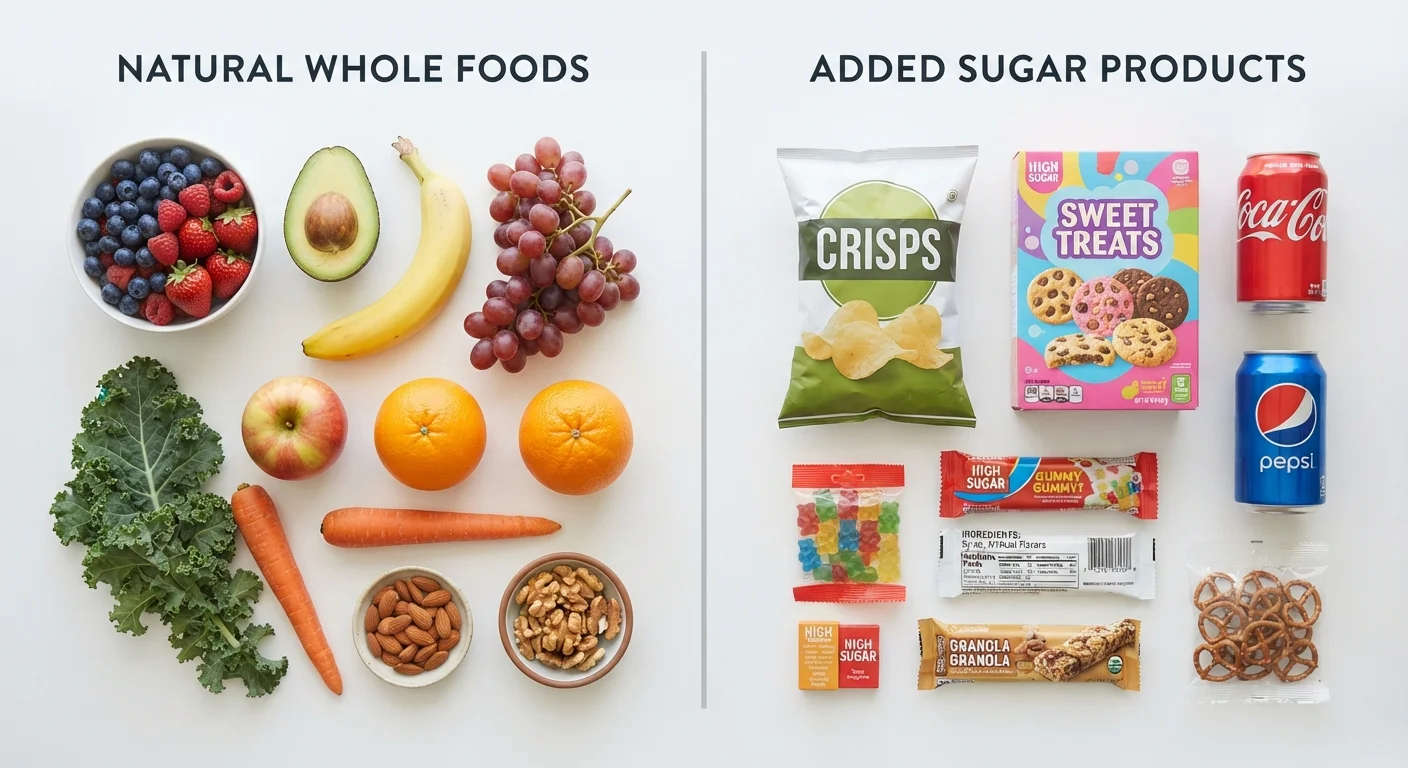
Option A
Natural Sugar
The sugar that comes built into whole foods.
Best for: People consuming whole fruits, vegetables, dairy, and minimally processed foods as part of a balanced diet.
Option B
Added Sugar
Sugars introduced during manufacturing or preparation.
Best for: Understanding the hidden sugar load in packaged, processed, and sweetened foods and beverages.
The Chemistry: Are They Actually Different?
At the molecular level, a glucose molecule from a ripe banana and a glucose molecule from a can of soda are chemically identical. The same is true for fructose and sucrose. This is a common source of confusion — and it is technically accurate. So why do nutrition scientists and public health authorities treat them so differently?
The answer lies in the food matrix — the full package of nutrients, fiber, and compounds that surround a sugar molecule in its original food source. Natural sugars exist within a complex structure that fundamentally changes how the body processes them. Added sugars, by contrast, are typically delivered with little else of nutritional value.
| Criterion | Natural Sugar | Added Sugar |
|---|---|---|
| Source | Whole fruits, vegetables, dairy | Syrups, sweeteners added during processing |
| Chemical structure | Identical molecules (e.g., fructose, glucose) | Identical molecules (e.g., fructose, glucose) |
| Fiber present | Yes, in whole-food sources | Rarely |
| Micronutrient package | Vitamins, minerals, antioxidants | Minimal to none |
| Blood sugar response | Moderated by fiber and food matrix | Often more rapid absorption |
| Dietary guideline limits | Not restricted in whole-food context | Under 10% of total daily calories (U.S. DGA) |
| Label disclosure | Listed under Total Sugars | Separately listed as Added Sugars |
Natural Sugar: Built-In Nutritional Context
When you eat a piece of fruit, the fructose inside comes alongside dietary fiber, water, antioxidants, vitamins, and minerals. The fiber physically slows digestion, which moderates the rate at which sugar enters the bloodstream and produces a gentler rise in blood glucose. Dairy foods like plain milk or unsweetened yogurt contain lactose — a natural sugar — along with protein, calcium, and other micronutrients.
This nutrient co-packaging matters. Research consistently shows that consuming whole fruits, for example, is associated with favorable health outcomes, even though they contain sugar. The food matrix appears to do significant work that an isolated sugar molecule simply cannot replicate. Whole foods are discussed in greater depth in our guide to whole foods vs. processed foods.
17 tsp
Average daily added sugar intake for U.S. adults
According to CDC analyses of national dietary survey data, American adults consume roughly 17 teaspoons of added sugar per day — nearly double the recommended limit.
<10%
Recommended added sugar limit (% of daily calories)
The Dietary Guidelines for Americans set this threshold specifically for added sugars, while placing no equivalent restriction on naturally occurring sugars in whole foods.
~50%
Share of added sugar from beverages in U.S. diets
Research using National Health and Nutrition Examination Survey data indicates that sugar-sweetened beverages are the single largest source of added sugars for American adults.
Added Sugar: Calories Without the Context
Added sugars are sugars and syrups introduced to foods during processing, preparation, or at the table. Common forms include high-fructose corn syrup, cane sugar, honey, agave nectar, and fruit juice concentrates. They appear in obvious places like soft drinks and desserts, but also in less expected products such as bread, salad dressings, flavored yogurts, and pasta sauces.
Unlike natural sugars, added sugars rarely arrive with significant fiber or micronutrients. They deliver energy — calories — without the accompanying nutritional scaffolding. Diets consistently high in added sugars have been associated in epidemiological research with increased risk of weight gain, type 2 diabetes, cardiovascular disease, and dental caries. The U.S. Food and Drug Administration now requires Nutrition Facts labels to list Added Sugars separately from total sugars, which helps consumers make more informed comparisons.
Honey and Maple Syrup Are Still Added Sugars
Many consumers assume that 'natural' sweeteners like honey, maple syrup, or agave are nutritionally distinct from refined cane sugar. While they contain trace minerals, the amounts are nutritionally insignificant at typical serving sizes. Dietary guidelines classify all of these as added sugars, and their impact on blood glucose and caloric intake is comparable to table sugar. Their 'natural' origin does not meaningfully change their nutritional profile in the amounts commonly consumed.
What Current Dietary Guidance Says
The Dietary Guidelines for Americans recommend that added sugars account for less than 10% of total daily caloric intake. The American Heart Association suggests even lower thresholds, particularly for children and women. Importantly, these limits apply specifically to added sugars — not to the naturally occurring sugars found in fruits, vegetables, and dairy, which current guidelines do not recommend restricting in the context of a whole-food diet.
Practically speaking, this means a plain apple is nutritionally very different from apple-flavored candy, even if both contain fructose. Context — the full food — is what dietary guidance is evaluating, not the sugar molecule in isolation. If you have specific concerns about sugar intake related to a health condition, consulting a registered dietitian or your physician is the most appropriate next step.
This article is for general informational and educational purposes only and does not constitute medical or dietary advice. Always consult a qualified healthcare professional before making changes to your diet, particularly if you have a medical condition.
The content on this site is for informational purposes only and is not a substitute for professional advice. Always consult a qualified professional for guidance specific to your situation.