

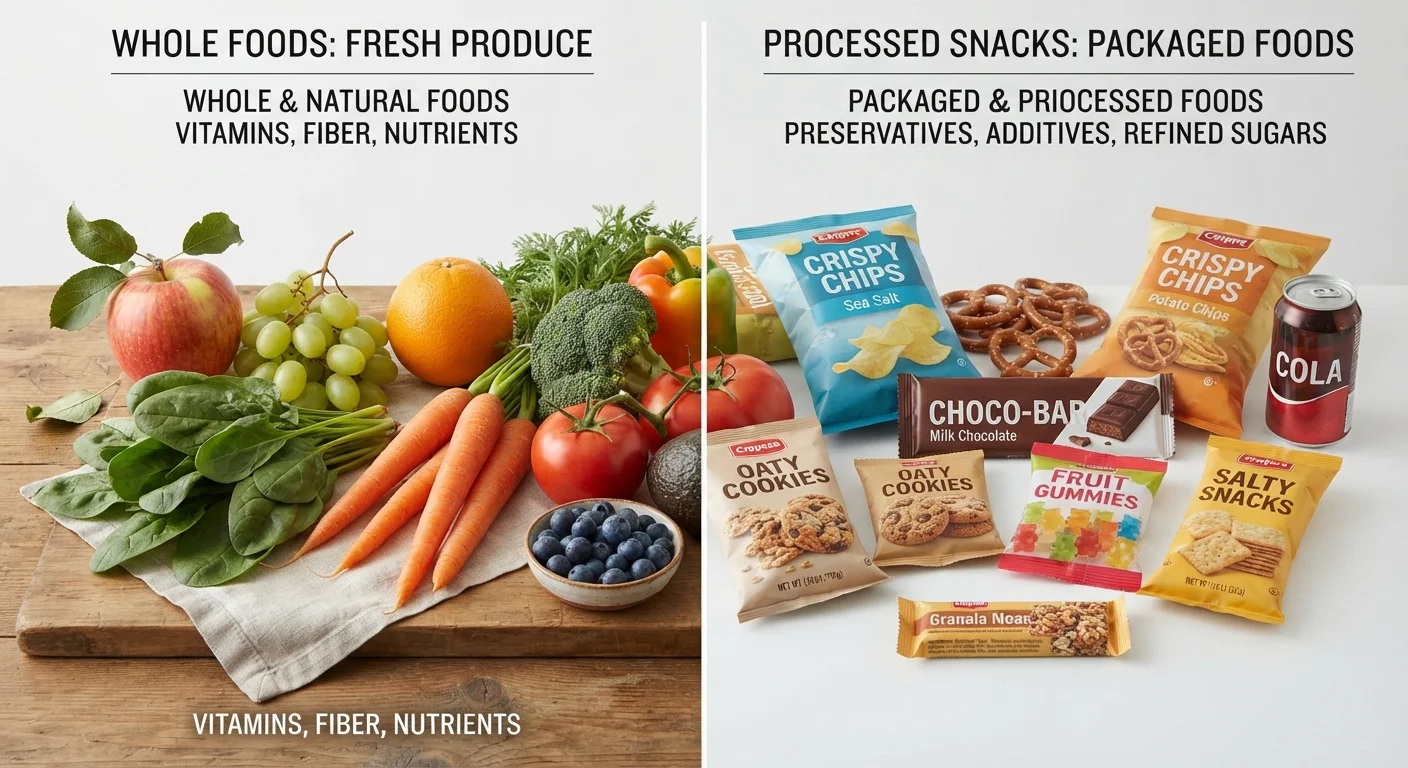
Option A
Whole Foods
Foods close to their natural state, minimally altered before eating.
Best for: People seeking nutrient-dense eating with fewer additives and a broad range of fiber, vitamins, and minerals.
Option B
Processed Foods
A wide spectrum from lightly prepared to industrially reformulated products.
Best for: Understanding where convenience foods fall on the processing scale and what that means for overall dietary quality.
Defining the Spectrum: What 'Processed' Actually Means
The word "processed" covers enormous ground — from a bag of pre-washed spinach to a fluorescent cheese puff. Nutrition researchers commonly use the NOVA classification system, developed by researchers at the University of São Paulo, to organize foods into four groups based on the extent and purpose of their industrial processing.
Group 1 includes unprocessed or minimally processed foods: fresh fruits, vegetables, plain meat, eggs, and plain milk. Group 2 covers processed culinary ingredients — oils, flour, salt, and sugar used in cooking. Group 3 encompasses processed foods: items like canned tomatoes, cheese, cured meats, and simple breads made from recognizable ingredients. Group 4 — ultra-processed foods (UPFs) — are industrial formulations that typically contain substances rarely found in a home kitchen: emulsifiers, artificial flavors, color stabilizers, and hydrogenated fats.
The key distinction researchers draw is not between "fresh" and "packaged" but between foods made from real ingredients and those formulated primarily from industrial derivatives. Understanding that framing changes how you read a label.
| Criterion | Whole Foods | Processed Foods (Ultra-Processed End) |
|---|---|---|
| Ingredient list | One ingredient or very few whole ingredients | Long list with additives, emulsifiers, flavors |
| Fiber content | Naturally high in many varieties | Often low or removed during processing |
| Added sugars | None naturally; any sugars are intrinsic | Frequently added in significant amounts |
| Sodium levels | Naturally low | Often high for preservation and palatability |
| Micronutrient profile | Broad, naturally occurring vitamins and minerals | May be fortified but overall narrower |
| Shelf stability | Generally short; requires refrigeration | Long shelf life by design |
| Cost and convenience | Can vary; perishability adds planning needs | Often lower cost and more convenient |
| Research associations | Generally favorable in dietary pattern studies | UPFs linked to higher disease risk in observational data |
What Research Says About Ultra-Processed Foods
The body of evidence linking ultra-processed food consumption to adverse health outcomes has grown substantially over the past decade. Large observational studies — including cohorts published in journals such as The BMJ and JAMA Internal Medicine — have found associations between high UPF intake and elevated risks of cardiovascular disease, type 2 diabetes, obesity, and certain cancers. A notable 2019 randomized controlled trial by Kevin Hall and colleagues at the U.S. National Institutes of Health found that participants assigned to an ultra-processed diet consumed significantly more calories and gained weight compared with those eating an unprocessed diet, even when both diets were matched for total available nutrients.
Importantly, researchers note that causality is difficult to establish in nutrition science. People who eat more ultra-processed foods may also have other lifestyle factors at play. Still, the consistency and strength of associations across diverse populations is notable.
57%
Share of U.S. calorie intake from ultra-processed foods
Research published in BMJ Open estimated that ultra-processed foods account for roughly 57% of total daily caloric intake among U.S. adults.
500 kcal/day
Extra daily calories consumed on ultra-processed diet
A 2019 NIH randomized controlled trial found participants eating an ultra-processed diet consumed approximately 500 more calories per day than those on an unprocessed diet.
10% increase
UPF intake linked to cardiovascular disease risk
A large French cohort study (NutriNet-Santé) found each 10-percentage-point increase in UPF consumption was associated with a roughly 12% higher cardiovascular disease risk.
What seems to matter nutritionally is that UPFs are often energy-dense, low in fiber, high in added sugar and sodium, and engineered to encourage overconsumption. For context on how added sugars specifically factor in, see our article on added sugar vs. natural sugar.
What Whole Foods Offer — and Where Processing Has a Role
Whole foods are generally richer in dietary fiber, phytochemicals (plant compounds with potential health-protective effects), and a broader range of micronutrients than their heavily processed counterparts. Fiber, in particular, is consistently associated in research with improved gut health, satiety, and lower cardiovascular risk — and it is commonly stripped away during industrial processing.
However, not all processing is detrimental. Fermentation improves the bioavailability of certain nutrients. Canning preserves vegetables close to their fresh nutritional profile. Pasteurization makes dairy safe. Freezing vegetables at peak ripeness can lock in nutrients effectively. The goal is not to avoid processing categorically but to distinguish between processing that preserves and processing that strips and reformulates.
For a broader look at how dietary patterns built largely around whole foods perform in research, see our piece on eating patterns that nutrition research consistently supports. And if you are weighing plant-based versus omnivore approaches, our companion article on plant-based vs. omnivore diets explores those trade-offs in detail.
This article is for general informational and educational purposes only and is not a substitute for professional medical or dietary advice. Consult a registered dietitian or qualified healthcare provider before making significant changes to your diet.
The content on this site is for informational purposes only and is not a substitute for professional advice. Always consult a qualified professional for guidance specific to your situation.