

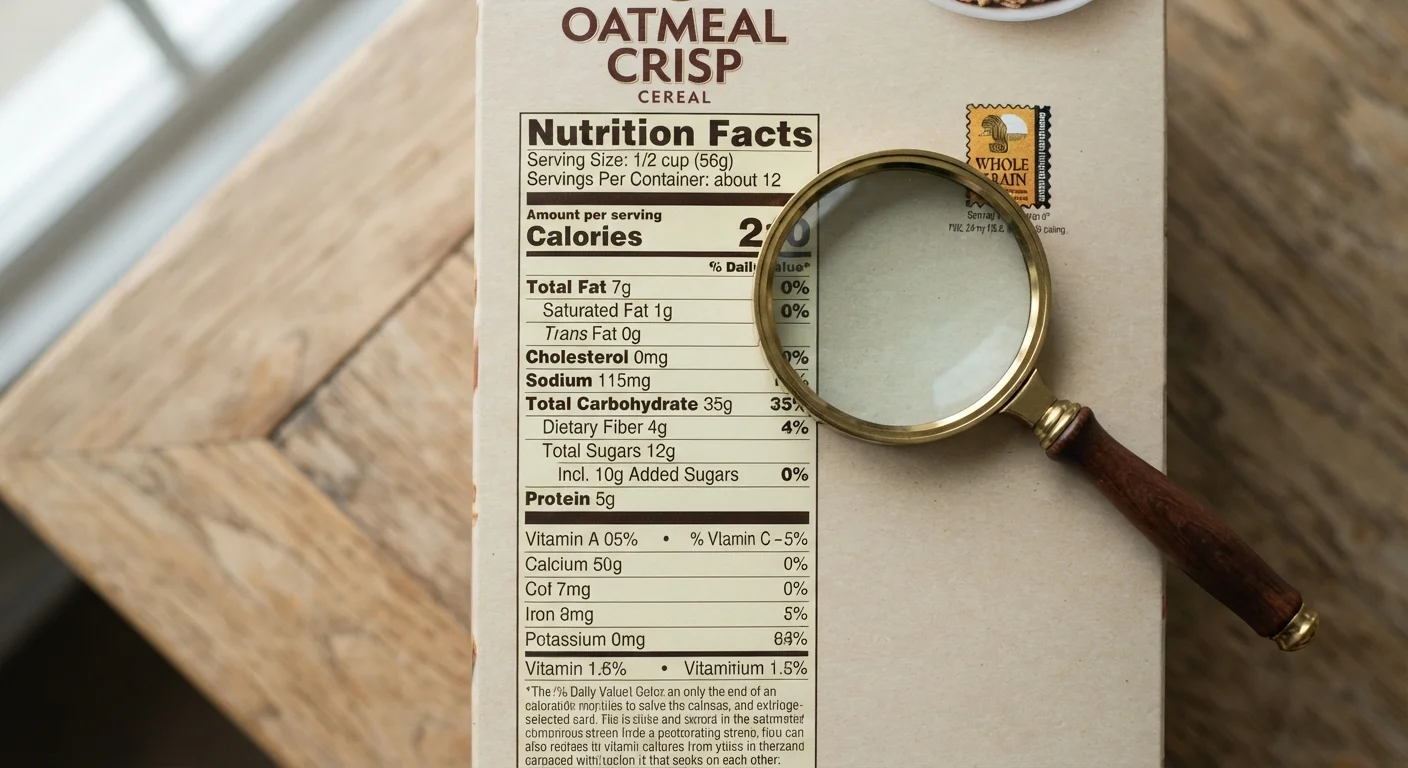
Why the Nutrition Label Exists and What It Covers
The Nutrition Facts label is a federally standardized tool governed by the U.S. Food and Drug Administration (FDA). It was updated significantly in 2016 to reflect current nutrition science, including the addition of a separate line for added sugars and updated %DV footnotes. Nearly all packaged foods sold in the U.S. are required to carry one.
The label is designed to give consumers a standardized snapshot of a food's nutritional profile so that comparisons are meaningful. Understanding how to read it fluently connects directly to the broader concept of nutrient density — evaluating how much nutrition you actually get from what you eat.
What you will need
Nutrition Facts Panel
The standardized FDA-mandated label that lists calories, macronutrients, micronutrients, and %DV for a given serving.
Ingredient List
Found below or beside the Nutrition Facts panel; reveals every ingredient in descending order by weight.
Smartphone or calculator
Useful for quickly multiplying nutrient values when a package contains multiple servings.
How to Read the Label Step by Step
Follow these steps each time you pick up a new packaged food. With practice, scanning a label takes less than a minute.
Start with serving size and servings per container
Every number on a Nutrition Facts label applies to one serving, not the entire package. Find the serving size at the very top of the panel — it appears in a familiar unit (e.g., "1 cup" or "3 crackers") alongside the gram weight. Directly below that you'll see servings per container.
If a bag lists 2.5 servings and you eat the whole bag, multiply every value on the label by 2.5. Overlooking this step is one of the most common ways calorie and nutrient intake gets underestimated.
Note the calorie count — but don't stop there
Calories are displayed prominently because energy intake matters — but they are only one data point. A food can be low in calories and still be low in nutritional value, or high in calories and rich in beneficial nutrients. As explored in our guide on calorie counting's limitations, calories alone don't reflect how nourishing a food actually is.
Use the calorie number as a reference point, then move on to evaluate what those calories are delivering.
Decode the macronutrients section
Below calories, the label lists total fat, total carbohydrate, and protein. Each breaks down further:
- Total Fat → Saturated Fat and Trans Fat are called out separately. Saturated fat is linked to cardiovascular risk at high intake levels; trans fat should be as close to zero as possible.
- Total Carbohydrate → Includes Dietary Fiber and Total Sugars. Within Total Sugars, Added Sugars are listed separately — these are sugars added during processing, distinct from naturally occurring sugars in fruit or dairy.
- Protein → Listed as a flat gram amount with no %DV, since protein needs vary significantly by individual.
Understand Percent Daily Values (%DV)
The %DV column translates gram amounts into a percentage of a daily reference intake based on a 2,000-calorie diet. A quick rule of thumb established by the FDA: 5% DV or less is considered low; 20% DV or more is considered high.
Use this to make fast comparisons between similar products. For nutrients you want to limit — saturated fat, sodium, added sugars — look for lower %DV. For nutrients you want to prioritize — fiber, calcium, iron, potassium, vitamin D — look for higher %DV.
Remember that your actual daily needs may differ from the 2,000-calorie reference. People with different caloric needs, health conditions, or life stages should consult a registered dietitian or healthcare provider for personalized guidance.
Check the micronutrients section
Current FDA-mandated labels must display Vitamin D, Calcium, Iron, and Potassium — nutrients identified as commonly under-consumed in the U.S. population. These appear at the bottom of the Nutrition Facts panel with their %DV.
Other vitamins and minerals may appear voluntarily. For a broader understanding of what these nutrients do and where to find them in your overall diet, the guide to essential vitamins and minerals offers useful context.
Read the ingredient list from top to bottom
Ingredients are listed in descending order by weight — the first ingredient makes up the largest proportion of the product. If refined sugar or a form of sodium appears in the first two or three positions, that ingredient is a dominant component of what you're eating.
Watch for multiple names that describe the same substance. Added sugars, for instance, can appear as corn syrup, dextrose, maltose, cane juice, or fruit juice concentrate, among others. When several of these appear scattered throughout a long list, their combined contribution may be higher than any single listing suggests.
Shorter ingredient lists aren't automatically better, but they are easier to evaluate. Highly processed foods often contain long lists with additives, preservatives, and flavor enhancers that provide no nutritional value.
Compare Products, Not Just Labels
When two products look similar, pull both off the shelf and compare %DV values for the nutrients you care about most. Even small differences in sodium or added sugars can add up meaningfully across multiple servings per day. This quick habit takes seconds and requires no nutritional expertise.
This article is for general informational and educational purposes only and does not constitute medical or dietary advice. Individual nutritional needs vary based on age, health status, activity level, and other factors. Consult a qualified healthcare provider or registered dietitian for guidance tailored to your personal health situation.
Putting It All Together at the Store
Reading a single label in isolation gives you useful data; reading labels comparatively gives you power. When choosing between two similar products, use %DV to do a side-by-side check on the nutrients that matter most to you — fiber, sodium, added sugars, and the required micronutrients are good starting points.
The ingredient list adds a qualitative layer the numbers can't fully capture. A product with a modest calorie count but a list dominated by refined starches and added sugars tells a different story than one with whole-food ingredients at the top.
Once you're comfortable reading individual labels, you're ready to take that knowledge to your broader shopping habits. The guide to building a nutritionally sound grocery list is a practical next step for translating label literacy into consistent, balanced food choices. And if you're building a foundation from scratch, a beginner's overview of balanced eating covers the broader principles that give these label details their context.
Front-of-Package Claims Can Mislead
Terms like "natural," "light," "multigrain," or "made with real fruit" are marketing language and not always regulated in the same way the Nutrition Facts panel is. A product labeled "low fat" may compensate with added sugars. Always flip the package and verify claims against the actual Nutrition Facts label and ingredient list before drawing conclusions.
The content on this site is for informational purposes only and is not a substitute for professional advice. Always consult a qualified professional for guidance specific to your situation.