

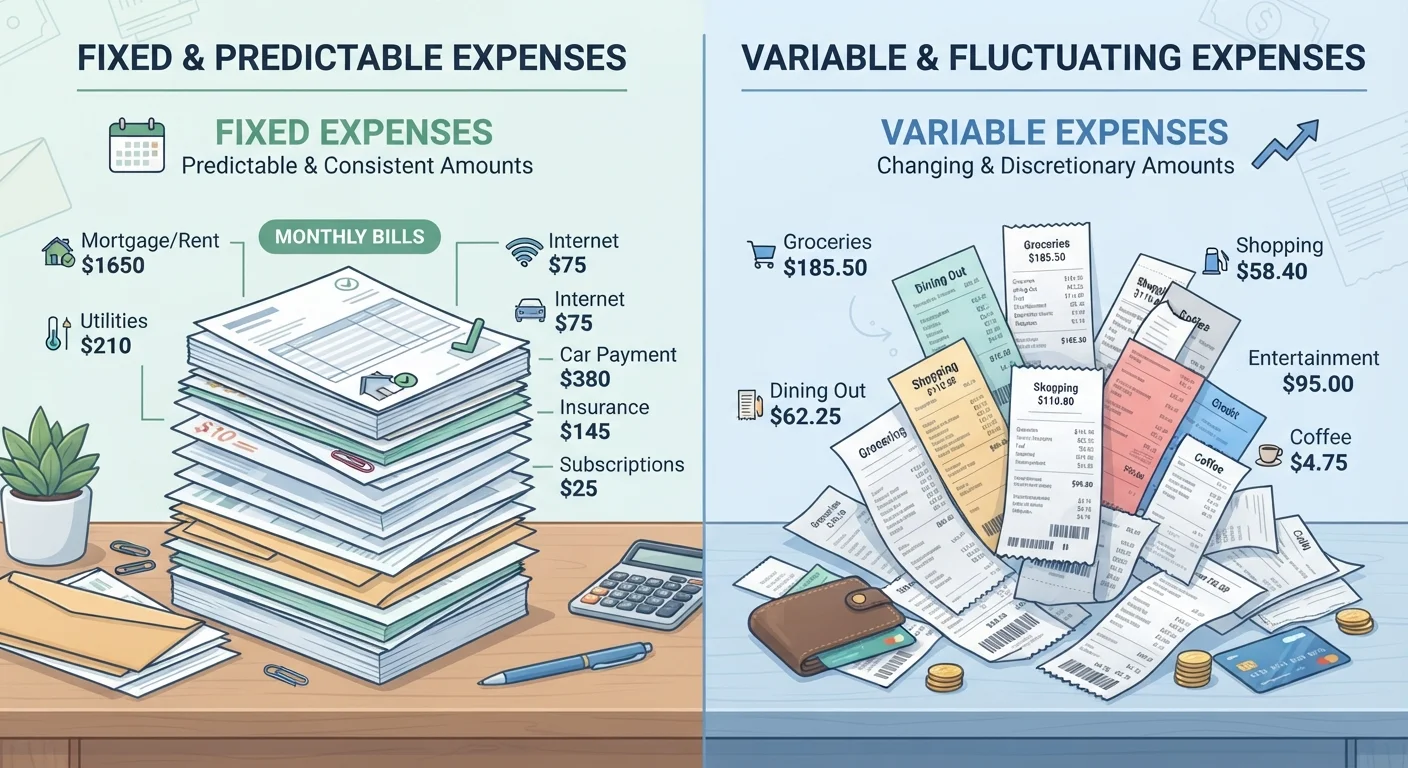
Option A
Fixed Expenses
The predictable, consistent anchor of your budget.
Best for: Establishing your non-negotiable monthly baseline so you always know your minimum financial commitment.
Option B
Variable Expenses
The flexible, adjustable portion of your spending.
Best for: Identifying where spending flexibility lives so you can make real adjustments when you need to save.
What Makes an Expense Fixed?
A fixed expense is any cost that remains the same amount from month to month, regardless of how much or how little you use a product or service. You agreed to the amount upfront — often through a lease, loan, or subscription contract — and it does not change based on your behavior during the billing period.
Common examples include rent or mortgage payments, auto loan payments, student loan installments, and certain insurance premiums. A fixed expense shows up on the same date, for the same dollar amount, every single month. That predictability is useful: it means you can plan around it with complete confidence.
It is worth noting that "fixed" does not mean "permanent." Fixed expenses can change when a contract ends, a rate adjusts at a scheduled interval, or you make a deliberate life decision — such as moving or paying off a loan. But within any given budget period, they are locked in. That is what separates them from their counterpart.
This article is for general informational and educational purposes only and does not constitute personalized financial advice. Consult a qualified financial professional regarding your specific circumstances.
What Makes an Expense Variable?
A variable expense is any cost that changes in amount from month to month, usually based on your choices and consumption habits. Unlike fixed costs, these are not locked in by a contract. They respond directly to how you live day to day.
Groceries, gasoline, dining out, utilities like electricity and water, entertainment, and clothing purchases are all common variable expenses. Even if you buy groceries every week without fail, the amount you spend shifts based on what you buy, where you shop, and how many people you are feeding.
This is where your real budgeting leverage lives. Because variable expenses respond to behavior, they are also the most responsive to deliberate change. When you need to find an extra $100 in a tight month, you are almost never going to do it by eliminating a fixed expense — you will do it by adjusting the variable side of your ledger.
| Criterion | Fixed Expenses | Variable Expenses |
|---|---|---|
| Amount each month | Same every billing cycle | Changes based on usage or choices |
| Examples | Rent, loan payments, insurance | Groceries, gas, dining, utilities |
| Short-term adjustability | Low — locked in by contract | High — responds to behavior quickly |
| Budget predictability | Very high — easy to plan around | Moderate — requires tracking and averaging |
| Best lever for savings | Long-term (refinancing, moving, payoff) | Short-term (spending habit changes) |
| Risk of budget surprise | Low within contract period | Higher without active monitoring |
The Semi-Fixed Middle Ground
Not every expense fits cleanly into one category. A useful third concept is the semi-fixed expense — costs that recur regularly but occasionally shift in amount. Your cell phone bill, for example, might be roughly stable but change when you add a line or exceed a data limit. Health insurance premiums tend to remain the same for a plan year but reset annually.
For budgeting purposes, treat semi-fixed expenses like fixed costs during the months they stay stable, and flag them for review when they are scheduled to reset. Annual subscriptions that auto-renew, gym memberships with occasional rate increases, and utility bills that spike seasonally all fall into this zone.
Knowing that a bill is semi-fixed — rather than truly fixed — is a signal to revisit it periodically, rather than assuming it will always be exactly the same. This habit alone can prevent budget surprises that derail an otherwise solid plan. For a broader look at how to structure categories like these, see the difference between a budget and a spending plan.
~$5,000
Average U.S. household monthly spending
The U.S. Bureau of Labor Statistics Consumer Expenditure Survey consistently shows the average American household spends roughly $60,000–$70,000 annually across all expense categories.
33%
Share of spending on housing alone
Housing — a largely fixed cost — typically accounts for the single largest share of household budgets, according to BLS Consumer Expenditure data.
3–6 months
Time to see impact of fixed expense reductions
Changes to fixed costs such as refinancing a loan or renegotiating insurance often take one to several billing cycles to fully reflect in a household budget.
Using This Knowledge to Build a Better Budget
Once you can label each expense as fixed, variable, or semi-fixed, budgeting becomes a more strategic exercise. Start by listing every fixed expense and totaling them. This number is your monthly baseline — the amount you must cover before any discretionary decisions begin.
Next, review the last two to three months of variable spending. Calculate a realistic average for each category. These averages become your variable budget targets. If the total of your fixed baseline plus your variable averages exceeds your take-home income, you now know exactly which category to work on: the variable side, because that is where adjustment is actually possible in the near term.
Different budgeting frameworks handle this breakdown differently. Zero-based and percentage-based budgets both benefit from knowing your fixed floor before allocating the rest of your income. If you manage shared finances, applying this same fixed-versus-variable lens together is a productive starting point — see budgeting as a household for practical guidance on that conversation.
The same logic applies beyond monthly living expenses. When planning a trip, for instance, certain costs — like flights booked in advance — behave like fixed expenses, while daily spending on food and activities is variable. Travel budgeting fundamentals walks through how to apply this thinking to trip planning specifically.
The content on this site is for informational purposes only and is not a substitute for professional advice. Always consult a qualified professional for guidance specific to your situation.