

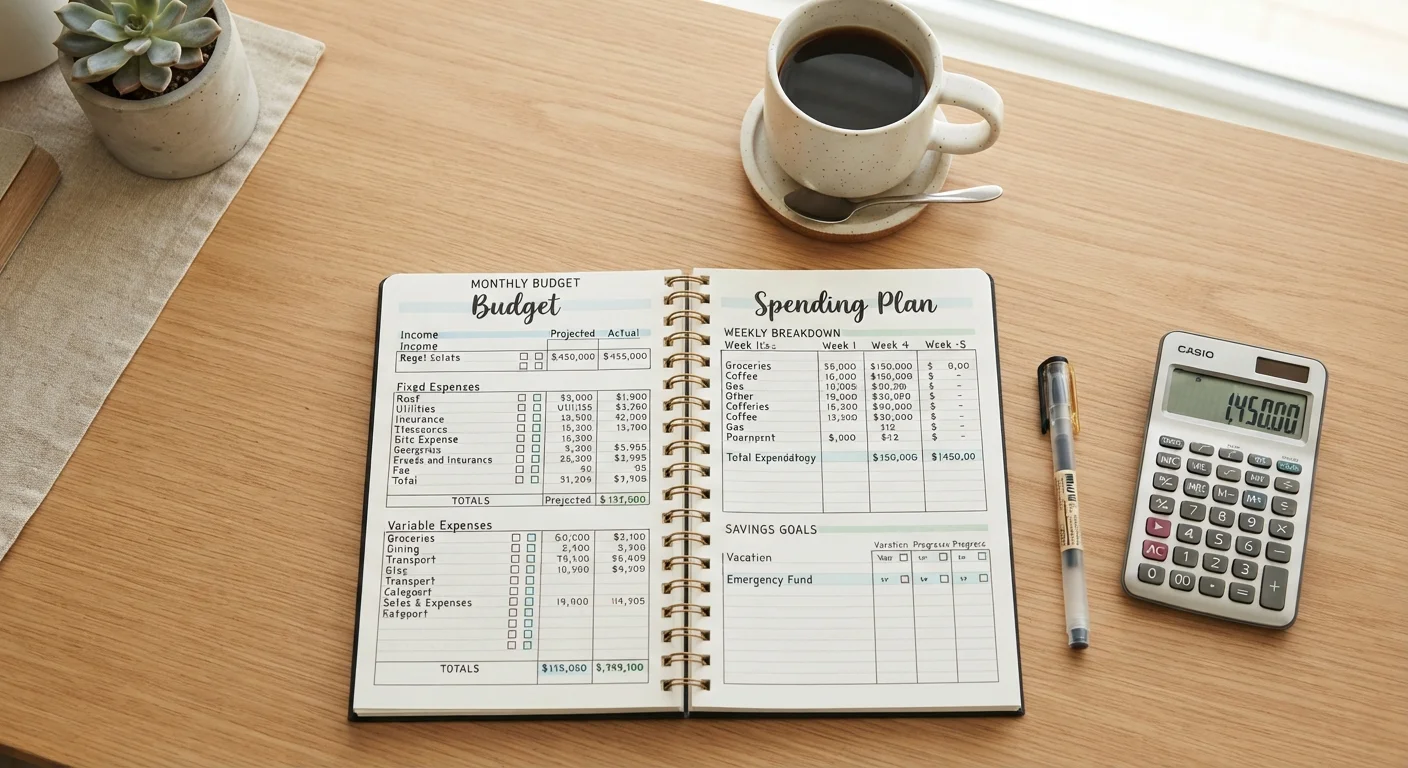
Option A
A Budget
The rule-based framework for controlling spending.
Best for: People who need firm guardrails and want a structured system to cap spending by category.
Option B
A Spending Plan
The intentional, values-driven allocation of every dollar.
Best for: People who want proactive control over where their money goes, aligned with personal goals.
Same Goal, Different Mindsets
The terms budget and spending plan are used interchangeably in personal finance conversations, but they carry meaningfully different psychological weight — and that distinction shapes how most people follow through.
A budget is typically understood as a set of spending limits: you earn a certain amount, you divide it into categories, and you try not to exceed those caps. It's reactive by nature, often built in response to a problem — debt, overspending, or a financial shock. As what a monthly budget actually is explains, much of what people imagine a budget to be is filtered through negative associations — deprivation, restriction, and failure.
A spending plan starts from the same raw material — your income and expenses — but frames the exercise differently. Instead of asking "What am I allowed to spend?" it asks "Where do I want my money to go?" That shift from permission-seeking to intentional allocation changes both the emotional experience and the outcome.
| Criterion | A Budget | A Spending Plan |
|---|---|---|
| Core question | What am I allowed to spend? | Where do I want money to go? |
| Orientation | Reactive — corrects past behavior | Proactive — assigns dollars in advance |
| Emotional tone | Often feels restrictive | Tends to feel intentional and empowering |
| Best used when | Curbing overspending or managing debt | Aligning money with values and goals |
| Flexibility | Fixed category caps | Built-in room to adjust priorities |
| Starting point | Last month's spending history | This month's income and intentions |
Where the Mechanics Actually Differ
In practice, a traditional budget often works backward: you review what you spent last month, identify problem areas, and set limits to correct them. It's a corrective tool. A spending plan, by contrast, works forward: before the month begins, you give every dollar an assignment — rent, groceries, savings, fun money — so nothing is left unaccounted for.
This distinction matters most when you look at irregular or variable expenses. Understanding fixed vs. variable expenses is critical regardless of which approach you use, but a spending plan tends to handle variability more naturally because it requires you to think through those fluctuations in advance rather than reacting when the bill arrives.
Neither method requires special software or a finance degree. A spreadsheet, a notebook, or a free app all work equally well. What separates success from frustration is whether the system you're using actually reflects your real income, your real expenses, and your real priorities.
Both Tools Require Honest Numbers
Neither a budget nor a spending plan can work if the numbers you put in don't reflect reality. Underestimating groceries or forgetting irregular bills like car registration will cause any system to fail — not because the method is flawed, but because the inputs were off. Review at least two to three months of actual spending before building your first plan.
Choosing the Right Frame — and Sticking With It
For many people, the word "budget" triggers a sense of scarcity. Research in behavioral economics suggests that language and framing influence financial decision-making — which is one reason financial counselors increasingly favor the term "spending plan" with clients who feel demoralized by conventional budgeting language.
That said, the label matters far less than the habit. Whether you call it a budget or a spending plan, the underlying mechanics are nearly identical: track income, categorize spending, compare planned to actual, and adjust. From there, you can explore structured approaches like zero-based budgeting vs. the percentage method to find a framework that fits your lifestyle.
If you're not sure where to begin, a budget category reference guide can help you build a complete picture of your spending without guesswork. The goal isn't a perfect plan on paper — it's a system you'll actually return to each month.
This article is for general informational and educational purposes only and does not constitute personalized financial advice. Consider consulting a qualified financial professional for guidance specific to your situation.
The content on this site is for informational purposes only and is not a substitute for professional advice. Always consult a qualified professional for guidance specific to your situation.