

Start here
What Is a Credit Report?
Next
Account History (Tradelines)
Then
Inquiries: Hard vs. Soft
Important
Public Records and Collections
Apply it
How to Read and Act on Your Report
What Is a Credit Report?
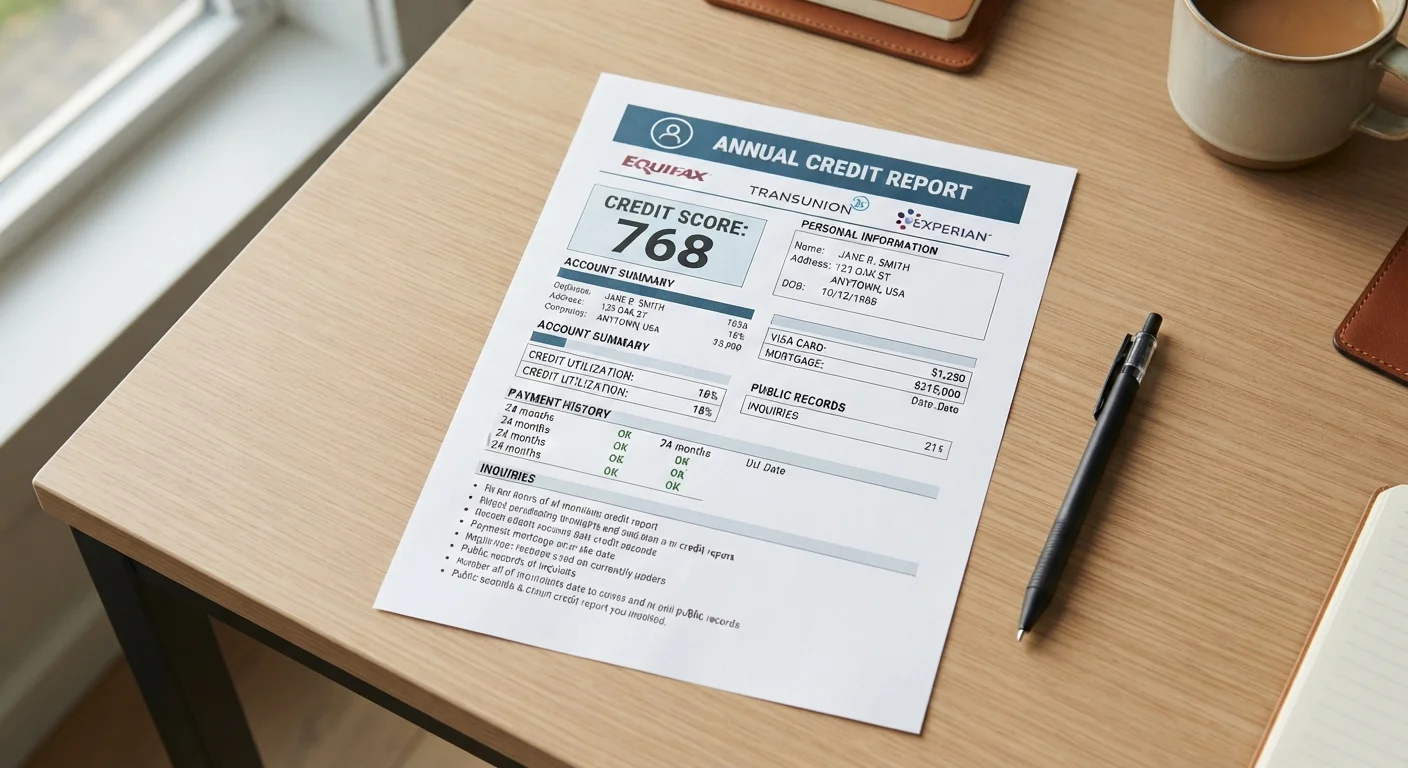
A credit report is a detailed record of how you have managed borrowed money over time. Three major credit bureaus — Equifax, Experian, and TransUnion — compile this information from lenders, collection agencies, and public court records, then make it available to creditors, landlords, and employers (with your permission) to help them assess financial risk.
Your credit report is not the same as your credit score. The report is the raw data; the score is a number calculated from that data. Understanding what's inside your report is the first step toward understanding — and improving — your score. Before diving in, it helps to be familiar with some foundational credit terminology that appears throughout the document.
Credit bureau
A company that collects and maintains financial data about consumers and compiles it into credit reports. The three major U.S. bureaus are Equifax, Experian, and TransUnion.
Tradeline
Any credit account that appears on your credit report, such as a credit card, mortgage, or auto loan, along with its full payment history.
Hard inquiry
A record created when a lender checks your credit because you applied for new credit. Hard inquiries can have a small, temporary effect on your score.
Derogatory mark
Any negative item on your credit report — such as a late payment, collection account, or bankruptcy — that signals past difficulty managing debt.
Credit utilization
The percentage of your available revolving credit (like credit cards) that you are currently using. Lower utilization generally helps your credit score.
Collection account
A debt that a creditor has sold or assigned to a collection agency after the borrower stopped making payments. It appears on your report as a negative item.
Personal Information Section
The first section of your credit report contains identifying details used to match accounts to you. This typically includes:
- Your full name and any name variations (maiden name, nicknames)
- Current and previous addresses
- Date of birth
- Social Security number (partially masked)
- Employer information, if reported by a lender
This section does not affect your credit score, but it's worth reviewing carefully. An unfamiliar address or a name you don't recognize could signal a data entry error — or, in some cases, identity theft.
Account History (Tradelines)
The account history section — often called your tradelines — is the heart of your credit report and the section that most directly shapes your credit score. Each account listed here typically includes:
- Creditor name and account number (partially masked)
- Account type (credit card, auto loan, mortgage, student loan, etc.)
- Date opened and current status (open, closed, transferred)
- Credit limit or original loan amount
- Current balance
- Payment history — usually shown as a month-by-month record indicating whether payments were on time, 30 days late, 60 days late, and so on
Payment history is the single largest contributor to your credit score, so any late or missed payments in this section carry real weight. Positive accounts in good standing — especially those with a long history — strengthen your profile. To understand exactly how this and other account details feed into your score, see the five factors behind your credit score.
Look for Payment History Patterns
Rather than just scanning for a single late payment, look at the overall pattern in your tradelines. Isolated late payments from years ago carry less weight than a recent streak of missed payments. Consistent, on-time payments over an extended period do the most to build a strong profile.
Inquiries: Hard vs. Soft
Whenever someone pulls your credit report, it generates an inquiry. Your report distinguishes between two types:
- Hard inquiries
- These occur when you apply for new credit — a credit card, mortgage, auto loan, or similar product. Hard inquiries are visible to lenders and can cause a small, temporary dip in your credit score. They remain on your report for two years but generally have a diminishing impact after 12 months.
- Soft inquiries
- These include pulling your own report, background checks by employers, and pre-approval screenings by lenders. Soft inquiries are not visible to lenders and have no effect on your score.
A cluster of hard inquiries in a short period can signal financial stress to lenders, though credit-scoring models typically treat multiple mortgage or auto loan inquiries within a short window as a single inquiry — recognizing that consumers often shop for rates.
Public Records and Collections
This section contains the most damaging information a credit report can carry. Public records that may appear include:
- Bankruptcies — Chapter 7 stays for up to 10 years; Chapter 13 for up to 7 years
- Civil judgments (though the major bureaus largely stopped reporting these after 2017)
Separately, collections accounts appear when an original creditor sells or transfers an unpaid debt to a collection agency. A collection entry — even for a small amount — is a serious negative mark. Most collection accounts remain for seven years from the original delinquency date.
Old Debts Can Still Appear
Even if you paid off a collection account, the record of the collection itself may still appear on your report until the seven-year period expires. Paying a collection does not remove it, though the status will update to show it as paid — which some lenders view more favorably.
If you spot an account in collections that you don't recognize or believe is inaccurate, you have the right to dispute it. Our guide to disputing credit report errors walks you through the process.
How to Read and Act on Your Report
You're entitled to a free credit report from each of the three major bureaus through AnnualCreditReport.com, the official federally authorized source. When you receive your report, work through it section by section:
- Verify personal information — confirm your name, addresses, and Social Security number are correct.
- Review every tradeline — check that you recognize each account, confirm balances look accurate, and look for any late-payment notations you believe are wrong.
- Scan the inquiries list — flag any hard inquiry you don't recognize, as it may indicate someone applied for credit in your name.
- Check public records and collections — note any items you dispute as inaccurate or outdated.
Building a habit of reviewing your report regularly puts you ahead of potential fraud and gives you the information you need to take deliberate steps toward stronger credit. For practical, ongoing strategies, explore responsible credit use practices that reinforce a healthy financial profile over time.
AnnualCreditReport.com
The official, federally authorized source for free credit reports from all three major bureaus. You can request reports from Equifax, Experian, and TransUnion without affecting your credit score.
Consumer Financial Protection Bureau (CFPB) Credit Resources
The CFPB offers clear, unbiased educational guides on understanding credit reports, disputing errors, and navigating the credit system — all free and publicly available.
This article is for general informational and educational purposes only and does not constitute personalized financial or legal advice. Consult a qualified financial professional for guidance specific to your situation.
Frequently Asked Questions
Checking your report at least once a year is a sound baseline, though reviewing it every few months helps you catch errors or fraudulent accounts sooner. Monitoring your own report does not affect your credit score.
No. When you pull your own report, it registers as a soft inquiry, which has no effect on your credit score. Only hard inquiries — those generated by lenders when you apply for credit — can cause a small, temporary dip.
Most negative information, including late payments and collections, stays on your report for seven years from the date of first delinquency. Chapter 7 bankruptcies can remain for up to ten years.
You have the right to dispute inaccurate information with the bureau that is reporting it. The bureau is generally required to investigate and respond within 30 days. See our <a href="/money-basics/credit-essentials/disputing-an-error-on-your-credit-report">guide to filing a dispute</a> for step-by-step instructions.
Not all lenders report to all three major credit bureaus — Equifax, Experian, and TransUnion — so the account data on each report can vary. It's worth reviewing all three to get a complete picture.
AnnualCreditReport.com is the official, federally authorized source for free credit reports from Equifax, Experian, and TransUnion. Be cautious of third-party sites that mimic this service.
The content on this site is for informational purposes only and is not a substitute for professional advice. Always consult a qualified professional for guidance specific to your situation.