

How Your Credit Score Is Built
A credit score is not a mystery — it's a calculation. Lenders, landlords, and even some employers use it as a shorthand for how reliably you manage borrowed money. If you understand what goes into that number, you can take deliberate steps to protect or improve it.
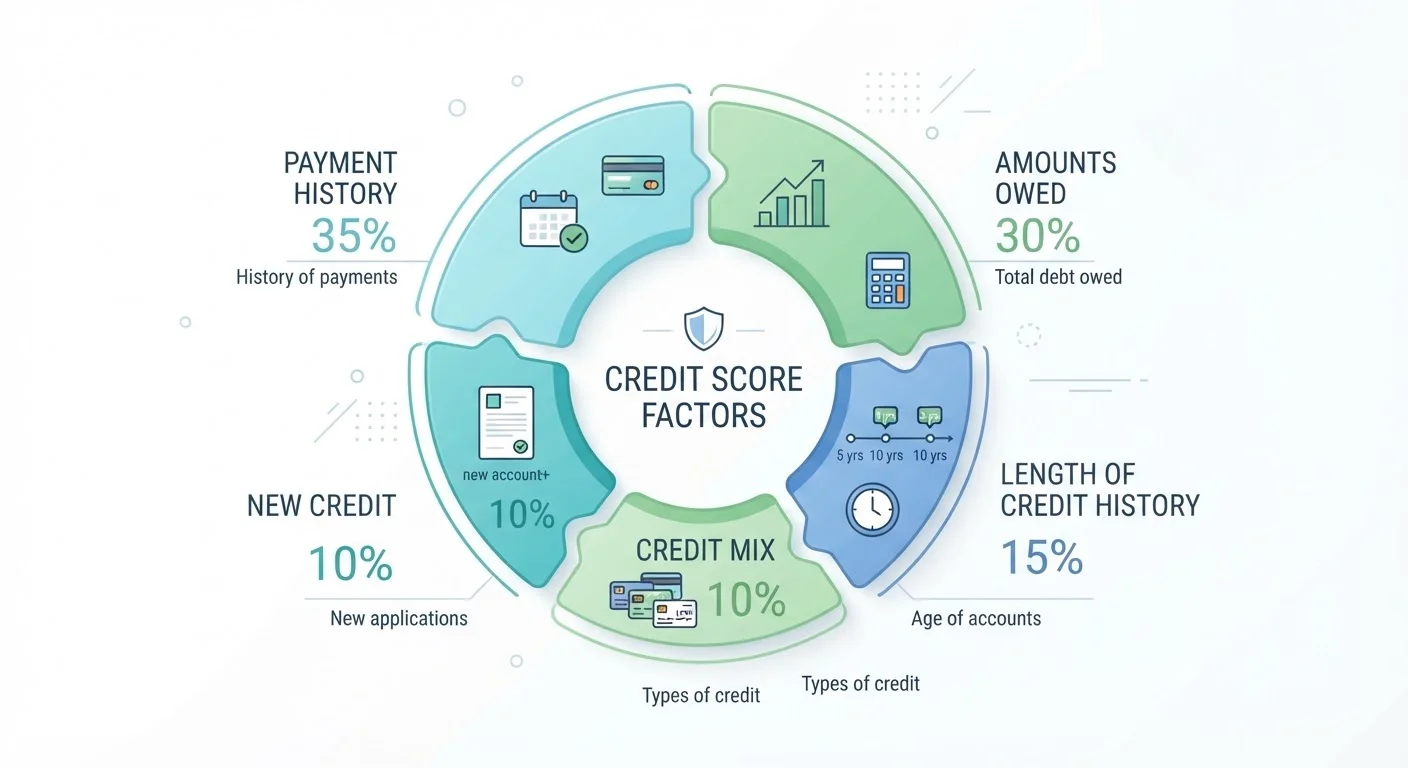
The most widely used scoring model is the FICO® Score, which breaks your credit profile into five weighted factors. For a broader look at what a score actually represents and why it matters to lenders, see Credit Scores Explained.
| Payment History Weight | 35% of FICO® Score (FICO scoring model) |
| Amounts Owed Weight | 30% of FICO® Score (FICO scoring model) |
| Length of Credit History Weight | 15% of FICO® Score (FICO scoring model) |
| Credit Mix Weight | 10% of FICO® Score (FICO scoring model) |
| New Credit / Inquiries Weight | 10% of FICO® Score (FICO scoring model) |
| Top Two Factors Combined | 65% of your score (Payment history + amounts owed) |
The Five Factors, Explained
1. Payment History (35%)
This is the single largest factor. Lenders want to know whether you pay your bills on time. Late payments, accounts sent to collections, bankruptcies, and foreclosures all leave negative marks. Even one missed payment can cause a meaningful score drop, particularly if your score was high to begin with. Consistent, on-time payments — month after month — are the most reliable way to build and sustain a strong score.
2. Amounts Owed / Credit Utilization (30%)
This factor measures how much of your available revolving credit you are currently using, expressed as a percentage. Using a large portion of your available credit signals financial stress to lenders, even if you pay in full each month. Most guidance suggests keeping utilization below 30%, though lower is generally better. For a deeper look at why this ratio carries so much weight, read Credit Utilization: The Ratio That Matters.
3. Length of Credit History (15%)
Scoring models consider how long your oldest account has been open, how long your newest account has been open, and the average age of all your accounts. Older, well-managed accounts generally help your score. This is one reason financial educators often advise against closing old credit cards — doing so can shorten your average account age and slightly lower your score.
4. Credit Mix (10%)
Lenders like to see that you can handle different types of credit responsibly. A healthy mix might include revolving accounts (credit cards, lines of credit) alongside installment loans (auto loans, student loans, mortgages). You don't need every type, and it's never wise to open accounts you don't need just for the sake of mix — but having variety does contribute positively.
5. New Credit / Recent Inquiries (10%)
Each time you apply for new credit, the lender typically performs a hard inquiry on your report. Too many hard inquiries in a short window can signal that you're taking on more debt than you can handle. The impact of any single inquiry is usually small and fades within a year. Scoring models also recognize rate-shopping behavior — multiple mortgage or auto loan inquiries within a short period are generally treated as a single inquiry. To understand the difference between inquiry types, see Hard Inquiries vs. Soft Inquiries.
Credit Utilization Ratio
The percentage of your total available revolving credit that you are currently using. It is calculated by dividing your total balances by your total credit limits across all revolving accounts.
Hard Inquiry
A formal review of your credit report triggered when you apply for new credit, such as a loan or credit card. Hard inquiries appear on your report and can slightly lower your score for a limited period.
Revolving Credit
A type of credit account, such as a credit card or line of credit, where you can borrow, repay, and borrow again up to a set limit. Your required payment fluctuates based on your balance.
Installment Loan
A loan repaid in fixed, scheduled payments over a set period of time. Common examples include auto loans, student loans, and mortgages.
Payment History
A record of whether you have paid your credit accounts on time. It is the largest single factor in most credit scoring models, reflecting your track record as a borrower.
Credit Mix
The variety of credit account types you have, such as credit cards, auto loans, and mortgages. A diverse mix can positively influence your credit score, though it is a relatively minor factor.
Putting It All Together
The five factors don't operate in isolation — they interact. A high utilization ratio hurts more if you also have a short credit history. Conversely, a long, clean payment record provides a cushion that makes a single late payment less damaging over time.
The practical takeaway: focus first on what matters most. Pay every bill on time and keep your credit card balances low. Those two habits alone account for 65% of your score. Then give attention to the remaining factors as opportunities arise — but avoid making hasty decisions (like closing old accounts or applying for several cards at once) based on a partial understanding of how the math works.
For evidence-backed habits that reinforce all five factors, visit Responsible Credit Use. And if you've encountered conflicting information about what helps or hurts your score, Credit Score Myths addresses the most common misconceptions.
This article provides general financial education and is not personalized financial advice. For guidance specific to your situation, consult a qualified financial professional.
The content on this site is for informational purposes only and is not a substitute for professional advice. Always consult a qualified professional for guidance specific to your situation.