

Start here
What Debt Actually Is (and Isn't)
Build vocabulary
Key Terms Every Borrower Should Understand
Develop perspective
Good Debt vs. Bad Debt: A Useful Framework
Take action
Balancing Debt Payoff and Saving Goals
Plan ahead
Your Next Steps as a Borrower
What Debt Actually Is (and Isn't)
Debt is money you borrow with an agreement to repay it — usually with interest — over a defined period. That's the neutral definition. In practice, debt carries a lot of emotional weight, and that weight can cloud clear thinking about it.
Debt is not inherently a sign of failure or irresponsibility. It is a financial tool that most Americans use at some point — to fund education, buy a home, or cover an unexpected medical expense. The question worth asking isn't simply "do I have debt?" but rather "do I understand the terms of my debt, and do I have a plan to manage it?"
Understanding debt also means recognizing that lenders are businesses. They profit from the interest you pay. That's a normal arrangement, but it's worth keeping in mind when evaluating whether to borrow and on what terms. For a foundation in how your borrowing behavior is tracked over time, see the Credit Essentials hub.
Key Terms Every Borrower Should Understand
Before you can manage debt effectively, you need a working vocabulary. These core concepts appear in almost every loan agreement or credit card statement you'll encounter.
Principal
The original amount of money you borrowed, before any interest is added. When you make payments, some goes toward interest and the rest reduces your principal.
Interest Rate / APR
The cost of borrowing expressed as a percentage. APR (Annual Percentage Rate) includes fees along with interest, making it a more complete comparison tool than the stated interest rate alone.
Minimum Payment
The smallest amount you're required to pay each billing cycle to keep your account in good standing. Paying only the minimum on high-interest debt can extend your repayment for years and cost significantly more in total.
Secured vs. Unsecured Debt
Secured debt is backed by collateral — property a lender can claim if you default. Unsecured debt has no collateral, so lenders charge higher rates to offset their risk.
Revolving Credit
A type of credit, like a credit card, where you can borrow up to a limit, repay it, and borrow again. Your balance and minimum payment can change month to month.
Loan Term
The length of time you have to repay a loan. Longer terms lower your monthly payment but typically increase the total interest you pay over the life of the loan.
Knowing these terms prevents surprises. When you receive a loan offer, you'll be able to compare the APR across options, understand how long it will take to repay at a given payment level, and recognize what happens if you only meet the minimum each month.
Good Debt vs. Bad Debt: A Useful Framework
You may have heard debt divided into "good" and "bad" categories. It's a simplification, but a useful one for beginners. Generally speaking, debt that funds something with lasting value — a degree, a home, a reliable vehicle for work — and carries a manageable interest rate is considered less harmful than debt used to fund short-term spending at high interest rates.
High-interest consumer debt, such as revolving credit card balances, is the most costly form of debt for most households. When interest compounds monthly and the rate exceeds 20%, even modest balances grow quickly if only minimum payments are made.
Ask Three Questions Before Borrowing
Before taking on any new debt, ask yourself: What is the total cost including interest? Can I realistically fit this payment into my budget? What happens if my income changes? These questions don't require a financial degree — just honest answers before you sign.
That said, context matters. A mortgage at a low fixed rate is structurally very different from a payday loan, even though both are debt. Rather than labeling debt as simply good or bad, ask: What is the interest rate? What am I getting in return? And is this repayable within my current budget?
Balancing Debt Payoff and Saving Goals
One of the most common questions in personal finance is whether to pay down debt aggressively or build savings at the same time. The honest answer is that it depends on your interest rates, your income stability, and whether you have any financial cushion at all.
Most financial educators suggest a dual approach rather than an either/or choice. Keeping a small emergency fund — even a modest one — means you're less likely to put an unexpected expense back on a credit card, which would undo your payoff progress. Beyond that safety net, directing extra cash toward high-interest debt typically reduces your total cost the fastest.
Before you consider using existing savings to wipe out debt entirely, it's worth thinking through the trade-offs carefully. Our article Before You Dip Into Savings to Pay Off Debt walks through those considerations in depth. A clear budget is also essential here — the Budgeting Basics hub can help you find room to act on both goals.
This article is for general informational purposes only and does not constitute personalized financial advice. Consult a qualified financial professional for guidance specific to your situation.
Your Next Steps as a Borrower
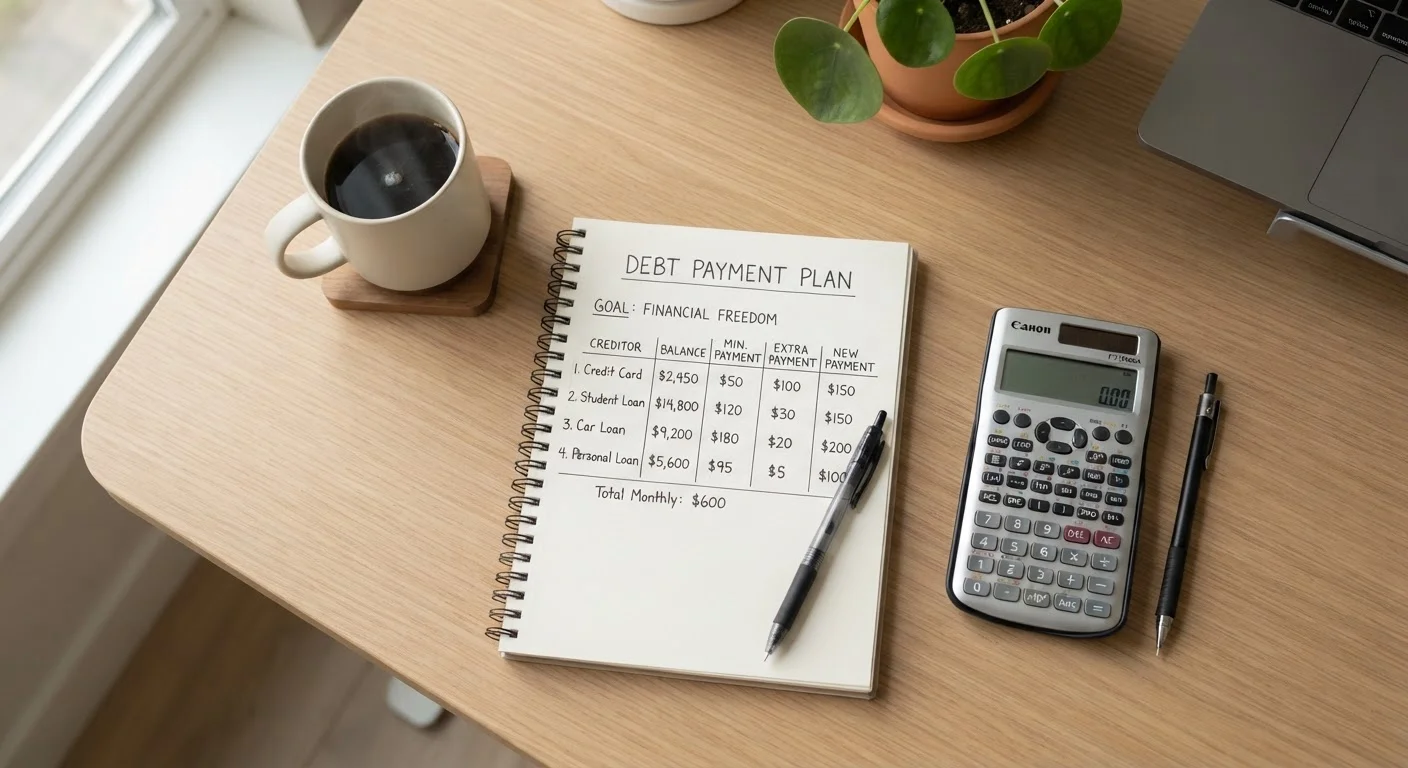
Managing debt starts with knowing what you owe. Set aside time to list every debt: the lender, current balance, interest rate, minimum payment, and due date. Put it all in one place — a spreadsheet, an app, or even a handwritten table. Seeing the complete picture is often the first genuinely clarifying moment for people who feel overwhelmed.
From there, two questions guide most decisions: Which debt is costing me the most in interest? And which payoff approach will I actually stick with? Those questions lead directly to choosing a repayment strategy. Our article The Debt Avalanche vs. Debt Snowball compares the two most widely recommended methods in detail.
If your debt picture is complex — multiple loans, difficulty keeping up with payments, or interest charges that seem to outpace your efforts — Debt Consolidation: What It Actually Does to Your Finances explains one common tool and its real trade-offs. Progress rarely happens all at once, but a clear starting point makes every next step easier.
Debt Payoff Strategy Comparison
A detailed look at the avalanche and snowball methods — how each works mathematically and psychologically — so you can choose the approach that fits your personality and goals.
Budget Building Starter Guide
Practical guidance on tracking income and expenses to find room in your monthly cash flow for both debt payments and savings contributions.
National Foundation for Credit Counseling (NFCC)
A nonprofit network of credit counseling agencies offering free and low-cost guidance on debt management, budgeting, and financial distress situations.
Frequently Asked Questions
List every debt you have, including the balance, interest rate, minimum payment, and due date. This complete picture lets you make informed decisions rather than guessing where to focus your energy.
Most financial educators suggest doing both at a basic level. Building a small emergency fund (often $500–$1,000) before attacking debt helps you avoid borrowing again when an unexpected expense arises. Beyond that minimum cushion, prioritizing higher-interest debt typically saves the most money over time.
Secured debt is backed by an asset — like your car or home — that a lender can claim if you stop paying. Unsecured debt, such as credit card balances or medical bills, has no collateral, which is why it typically carries higher interest rates.
The higher your interest rate, the more you pay on top of what you originally borrowed. A debt with a 20% annual rate can cost significantly more over time than one at 6%, even if the original balance is identical.
Paying only the minimum keeps you in good standing but extends your repayment timeline considerably and increases the total interest you pay. On high-interest debt especially, minimum payments can mean you're barely reducing the principal each month.
If your total debt payments consume more than 40–50% of your income, you're missing payments regularly, or you feel unable to make progress on your own, it may be worth consulting a nonprofit credit counselor. They can help you review options without selling you a product.
The content on this site is for informational purposes only and is not a substitute for professional advice. Always consult a qualified professional for guidance specific to your situation.