

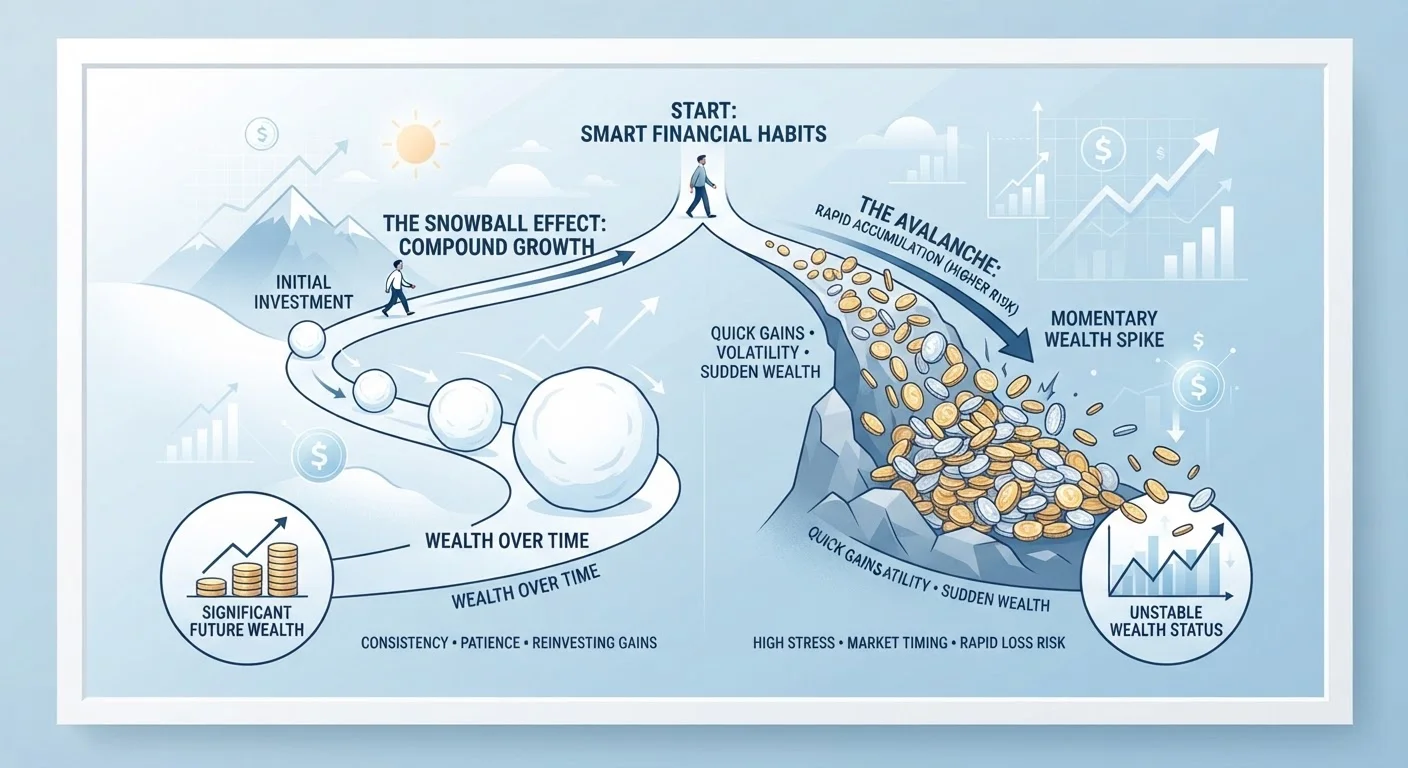
Option A
Debt Avalanche
The mathematically efficient, interest-minimizing approach.
Best for: People who want to pay the least total interest and are comfortable staying the course without frequent milestone wins.
Option B
Debt Snowball
The psychologically motivating, momentum-building method.
Best for: People who need early wins to stay engaged and find motivation more important than minimizing total interest paid.
How Each Strategy Works
Both methods share a common foundation: you make minimum payments on every debt you carry, then direct any extra money toward one target account. The strategies differ only in which account gets that extra payment first.
Debt Avalanche: List your debts from highest interest rate to lowest. Put all extra money toward the highest-rate balance. Once it's gone, roll that payment into the next highest-rate debt, and so on. You pay less interest over the long run because you're neutralizing the most expensive debt first.
Debt Snowball: List your debts from smallest balance to largest, regardless of rate. Focus extra payments on the smallest balance. Once it's eliminated, you redirect that full payment to the next smallest. Each paid-off account adds momentum — hence the snowball metaphor.
If you're newer to the fundamentals of managing debt, our overview of core debt management concepts provides helpful grounding before you choose a strategy.
| Criterion | Debt Avalanche | Debt Snowball |
|---|---|---|
| Payoff order | Highest interest rate first | Smallest balance first |
| Total interest paid | Typically lower | Typically higher |
| Time to first win | Longer (if high-rate debt is large) | Shorter (small balances clear fast) |
| Motivational structure | Long-term savings focus | Frequent milestone rewards |
| Best math scenario | Large rate spread between debts | Similar rates across debts |
| Ideal behavioral profile | Disciplined, goal-oriented planners | Those needing visible progress |
| Extra monthly payment required | No — same budget, different target | No — same budget, different target |
The Real Cost Difference — and Why It Matters Less Than You'd Think
In a straightforward mathematical comparison, the avalanche method almost always results in less total interest paid. The gap can be significant if your debts carry meaningfully different rates — for instance, a 24% credit card versus a 6% personal loan. Every month the high-rate balance lingers, it compounds against you.
However, the snowball method's psychological dividend is real and well-documented in behavioral economics research. A debt repayment plan that you abandon halfway through costs more than a slightly less efficient plan you complete. That's the central case for the snowball: finishing matters more than optimizing.
~$1,000+
Potential interest saved with avalanche method
Consumer finance analyses consistently show the avalanche can save hundreds to over a thousand dollars versus the snowball, depending on balance sizes and rate spreads.
~33%
Americans with debt who feel overwhelmed managing it
Surveys on household financial stress regularly find roughly one-third of indebted Americans report difficulty keeping track of multiple debt obligations.
The practical verdict is that the difference in total interest often amounts to hundreds of dollars over a multi-year repayment horizon — meaningful, but not transformative for most households. What is transformative is actually eliminating the debt.
For households juggling debt payoff with savings goals simultaneously, see our guide on paying off debt while saving at the same time.
Choosing the Right Fit for Your Situation
Neither strategy is universally superior. Your choice should reflect your financial profile and your behavioral tendencies.
Consider the avalanche if:
- You have one or more accounts with very high interest rates (often 20% or above).
- You feel motivated by long-term savings rather than short-term wins.
- You've maintained consistent financial habits in the past.
Consider the snowball if:
- You have several small balances that feel scattered and overwhelming.
- Past debt payoff attempts lost steam before completion.
- The psychological reward of closing accounts would help you stay committed.
It's also worth noting that these strategies aren't the only debt management tools available. Debt consolidation can sometimes simplify repayment, though it carries its own trade-offs to evaluate carefully. And if you're weighing whether to use savings to accelerate payoff, review key considerations before using savings to pay off debt first.
Hybrid Approaches Are Allowed
Some people start with the snowball to clear a couple of small balances and build confidence, then switch to the avalanche once they've gained momentum. There's no rule requiring you to follow one method exclusively for the entire repayment period. What matters is that your approach remains intentional and consistent.
For guidance on structuring your broader financial picture so that debt payoff and savings can coexist, see our article on balancing debt payoff with long-term savings goals.
This article is for general informational and educational purposes only and does not constitute personalized financial or legal advice. Consult a qualified financial professional regarding your specific circumstances.
The content on this site is for informational purposes only and is not a substitute for professional advice. Always consult a qualified professional for guidance specific to your situation.