

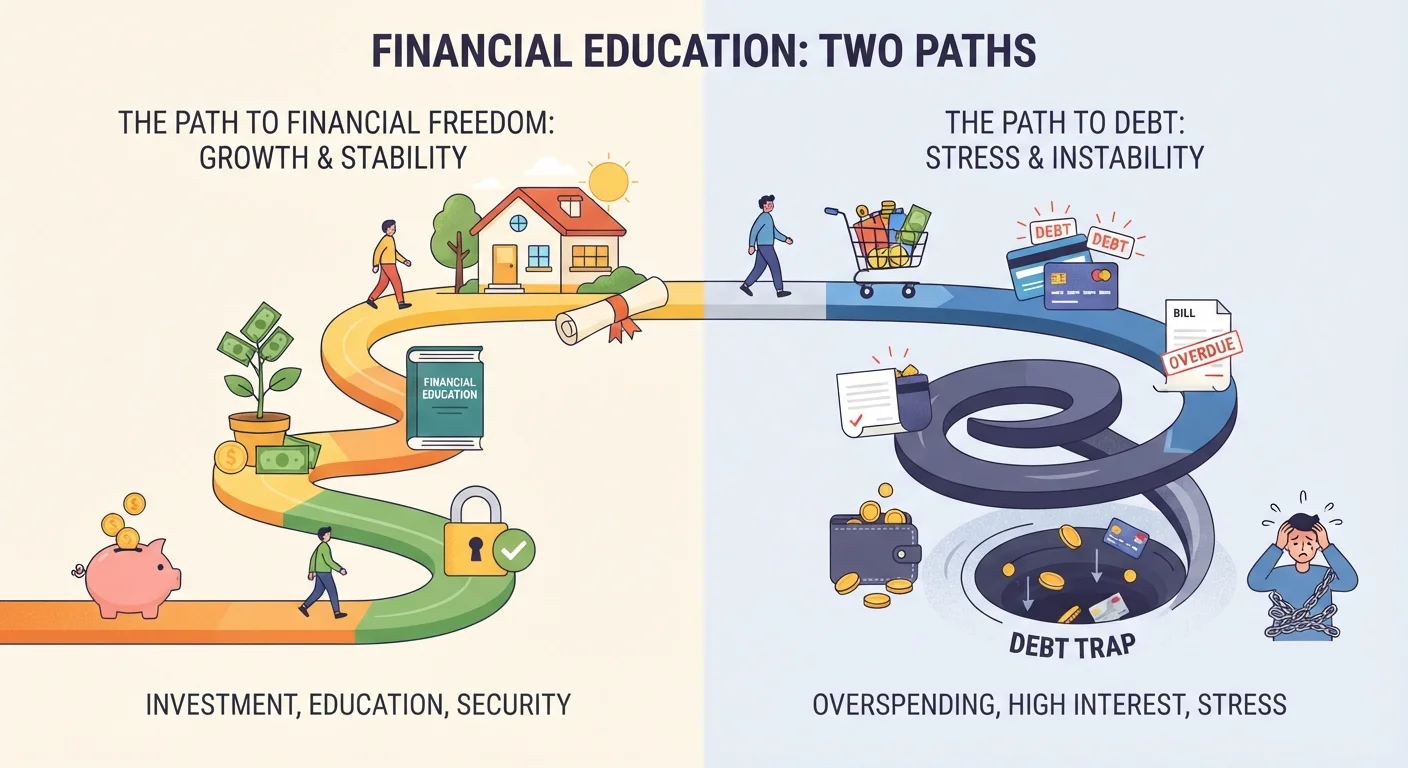
Why We Label Debt "Good" or "Bad"
The good debt/bad debt framework exists to help borrowers think more clearly about why they're taking on debt and what it will cost them long-term. At its core, the idea is simple: some borrowing funds assets or opportunities that grow in value or increase earning capacity, while other borrowing funds consumption that disappears after the purchase.
But the labels are shorthand, not rules. A mortgage on a home you genuinely cannot afford is not good debt. A modest personal loan that bridges a gap during a medical crisis might be the smartest financial move available to you. Context matters more than category.
If you're new to thinking about debt strategically, a foundational overview of debt management concepts can help you build the vocabulary before diving deeper.
~$1.13T
Total U.S. credit card debt outstanding
According to the Federal Reserve Bank of New York's quarterly household debt report, credit card balances have reached historically high levels in recent years.
20%+
Average credit card interest rate
The Federal Reserve tracks average credit card interest rates; rates on accounts assessed interest have consistently exceeded 20% in recent reporting periods.
$1.77T
Total U.S. student loan debt
Federal Reserve data shows student loan debt is one of the largest categories of household debt in the United States, behind only mortgage debt.
What Makes Debt "Good" — And Its Hidden Risks
Debt is generally considered productive when it funds something with lasting value and carries a manageable interest rate. Three common examples:
- Mortgages: You're borrowing to own an asset that historically appreciates. You're also building equity with each payment — effectively forced saving. The tax treatment of mortgage interest can also be favorable, though this varies by situation.
- Federal student loans: Education can meaningfully increase lifetime earnings. Federal loans come with protections — income-driven repayment, deferment options — that private debt rarely offers.
- Small business loans: Borrowing to invest in a business that generates returns can be rational, though it carries entrepreneurial risk.
The hidden risk in each category is overextension. A degree financed at a high rate in a low-wage field, or a home purchased at the ceiling of your borrowing capacity, can drag on your finances for years. Good debt can still cause harm when the payment exceeds what your budget can sustain.
A Simple Rule of Thumb for Any Debt
Before borrowing, ask two questions: Will this purchase retain value or increase my income? And can I afford the monthly payment without straining my budget? If the answer to either is no, reconsider the amount — or the debt itself. No category label overrides those fundamentals.
What Makes Debt "Bad" — And the Gray Zone
High-interest revolving debt — primarily credit card balances — is the clearest example of harmful borrowing. Average credit card interest rates are often well above 20%, meaning a balance carried month to month grows quickly and can far exceed the original purchase price. You're financing consumption, not an asset, and the cost compounds against you.
Payday loans and certain personal loans with triple-digit APRs fall into a similar category — high cost, short window, and a cycle that's difficult to exit.
The gray zone includes auto loans, medical debt, and buy-now-pay-later arrangements. A car loan finances a depreciating asset, but a car might be essential to your income. Medical debt is often unavoidable and frequently negotiable — a different kind of problem than discretionary borrowing. Buy-now-pay-later can be interest-free if paid on time, but missed payments carry penalties.
For those wrestling with how to handle a mix of these debt types, understanding what debt consolidation actually does to your finances can help clarify whether simplifying payments makes sense in your situation.
Balancing Debt Payoff With Savings Goals
One of the most common dilemmas Americans face is whether to throw extra money at debt or put it toward savings. The mathematically clean answer depends on your interest rates — if your debt costs more than your savings earn, prioritizing debt payoff is usually the better return. But personal finance is not purely math.
An emergency fund matters even while you're in debt. Without one, an unexpected expense often means more debt. Most financial educators suggest maintaining at least a small cash cushion — typically a few hundred to one thousand dollars — even while aggressively paying down balances.
Before making a dramatic move like liquidating savings to wipe out debt, it's worth thinking through the trade-offs carefully. Our guide on what to consider before using savings to pay off debt walks through the key questions. And for a structured approach to doing both at once, proven principles for balancing debt payoff and long-term savings offers a practical framework.
This article is for general informational and educational purposes only and does not constitute personalized financial advice. Consult a qualified financial professional for guidance specific to your circumstances.
Frequently Asked Questions
A mortgage is commonly labeled good debt because real estate often appreciates and you're building equity. However, borrowing more than you can comfortably repay, or buying in a declining market, can turn a mortgage into a financial strain. The interest rate and loan terms matter significantly.
Student loans can be bad debt when the degree doesn't lead to income growth that justifies the borrowing cost. High-rate private student loans carry more risk than federal loans, which offer income-driven repayment options. The field of study and total borrowed relative to expected salary are key factors.
Not necessarily — it depends on your interest rates and financial safety net. High-interest debt should typically be addressed urgently, but completely abandoning savings leaves you vulnerable to emergencies. A balanced approach often makes more sense than an all-or-nothing strategy.
Car loans fall in a gray area. A vehicle may be necessary for earning income, which gives the loan some practical value. But cars depreciate rapidly, so you're financing a depreciating asset — making the loan closer to neutral or mildly negative depending on your rate.
Not all debt harms your credit. Responsibly managed installment loans (like mortgages or auto loans) can build credit history. What tends to hurt scores is high credit utilization on revolving accounts and missed payments. See <a href="/money-basics/credit-essentials">Credit Essentials</a> for a deeper look at how credit scoring works.
A common approach is to prioritize high-interest debt first to minimize total interest paid — this is the foundation of the debt avalanche method. Others prefer starting with the smallest balance for motivational wins. Your <a href="/money-basics/saving-and-debt/the-debt-avalanche-vs-debt-snowball-which-payoff-strategy-fits-your-life">choice of payoff strategy</a> should fit both your numbers and your personality.
The content on this site is for informational purposes only and is not a substitute for professional advice. Always consult a qualified professional for guidance specific to your situation.