

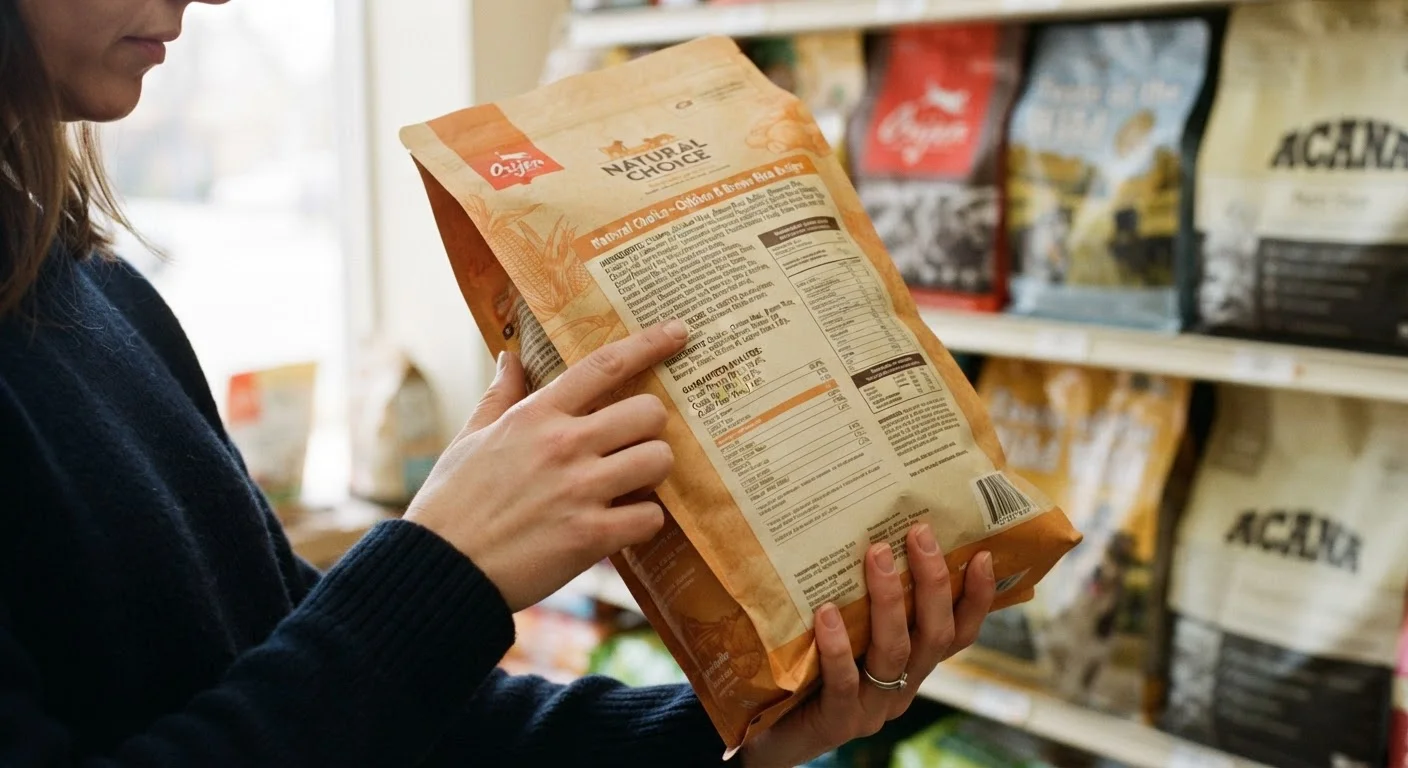
Why the Front of the Bag Is Built for Marketing, Not Information
Pet food packaging is designed to catch your eye, not inform your decision. Terms like "premium," "holistic," "natural," and "human-grade" are largely unregulated marketing language. The U.S. Food and Drug Administration (FDA) and the Association of American Feed Control Officials (AAFCO) set rules for the back of the bag — not the front. That's where the meaningful information lives.
Front-of-bag images of grilled chicken or garden vegetables don't reflect how those ingredients look after processing. A photo of a salmon fillet means the food contains some salmon — it doesn't tell you how much, in what form, or whether it's the primary protein source.
Redirecting your attention from the front panel to the ingredient list, guaranteed analysis, and AAFCO statement is the single biggest shift you can make as a pet owner. The Pet Nutrition Guide explores the full landscape of what balanced feeding looks like for dogs and cats.
The Back Panel Is the Real Label
Spend less than 30 seconds on the front of the bag — it's almost entirely marketing. Flip it over and focus on the AAFCO statement, ingredient list, guaranteed analysis, and calorie statement. Those four sections contain nearly everything that matters for evaluating a food's nutritional legitimacy.
What You Need Before You Start
Reading a pet food label effectively doesn't require any special tools — just the bag itself and a basic understanding of what each section is supposed to tell you.
What you will need
Step-by-Step: Decoding the Label
Work through the label in the order below. Each section builds on the last, and skipping ahead can lead to misreading what you find.
Find the AAFCO Nutritional Adequacy Statement
This is usually a small paragraph near the bottom of the back panel. It tells you whether the food is complete and balanced — meaning it meets established nutritional standards for a particular life stage. Look for phrasing like:
"[Product name] is formulated to meet the nutritional levels established by the AAFCO Dog Food Nutrient Profiles for adult maintenance."
Two key things to check: the life stage (puppy/kitten, adult maintenance, all life stages, or senior) and whether the food was validated by feeding trials or nutrient profile formulation. Feeding-trial validation means animals actually ate the food and were monitored; formulation alone means the recipe meets targets on paper.
Check the Life Stage Designation
The AAFCO statement will name a life stage. This matters more than most owners realize:
- Adult maintenance: Calibrated for healthy, non-reproducing adults.
- Growth (puppy/kitten): Higher in calories, protein, and certain minerals to support development.
- All life stages: Must meet growth standards — which means it may be too calorie-dense or mineral-rich for sedentary adult pets.
- Senior: Not officially defined by AAFCO; formulations vary widely by manufacturer.
Feeding a food formulated for "all life stages" to a healthy, low-activity adult dog or cat may contribute to excess caloric intake over time.
Read the Ingredient List with Moisture in Mind
Ingredients are listed by weight before processing. Fresh chicken, for example, is roughly 70–75% water by weight. After cooking, that water is removed, and the actual dry-matter contribution of chicken drops significantly. Meanwhile, a lower-listed ingredient like chicken meal (which is already dried and concentrated) may actually deliver more protein by dry weight.
This doesn't mean fresh meat is bad — it can still be a quality ingredient — but it does mean that a meat listed first doesn't automatically make a food high in animal protein. Look at the first five to eight ingredients as a group to get a realistic picture of what the food is primarily made of.
Interpret the Guaranteed Analysis Panel
The guaranteed analysis lists minimum or maximum percentages for key nutrients: crude protein (minimum), crude fat (minimum), crude fiber (maximum), and moisture (maximum). A few things to know:
- These are guarantees, not exact values. A minimum of 26% protein means at least 26% — the actual amount could be higher.
- Comparing wet and dry foods directly using these numbers is misleading because moisture content differs dramatically. To compare them fairly, you'd need to calculate dry-matter basis values (a straightforward calculation your vet can walk you through).
- Crude fiber is a rough measure; it doesn't capture all dietary fiber types.
The guaranteed analysis is a starting point, not the whole nutritional story. For context on how these numbers fit into broader dietary planning, the Daily Pet Care hub covers feeding routines and habits that support long-term health.
Note the Calorie Statement
AAFCO requires most pet foods to display a calorie statement, expressed as kilocalories (kcal) per kilogram and per common household measure (e.g., per cup or per can). This is one of the most practically useful numbers on the label for managing your pet's weight.
Compare calorie density across foods you're considering, and cross-reference the manufacturer's feeding guidelines — keeping in mind those guidelines are general estimates, not personalized prescriptions. Your veterinarian can help determine an appropriate daily intake for your individual animal based on body condition score and activity level. If you notice changes in your pet's coat, energy, or digestion after switching foods, our article on signs your pet's diet might be missing something can help you recognize what to watch for.
Common Label Claims and What They Actually Mean
Even after you understand the regulated sections of a label, marketing language can still create confusion. Here's a quick reference for terms you'll frequently encounter:
- "With chicken" vs. "chicken formula": AAFCO rules require a named ingredient to make up at least 95% of the product (excluding water) to lead the name. The word "with" drops that threshold to just 3%. A food called "with chicken" may contain very little of it.
- "Natural": AAFCO defines this as derived from plant, animal, or mined sources without chemical synthesis — but it says nothing about nutritional quality or safety.
- "Grain-free": Removing grains doesn't automatically make a food healthier. The FDA has investigated a potential link between certain grain-free diets and dilated cardiomyopathy (an enlarged heart condition) in dogs, though research is ongoing. See our article on grain-free dog food evidence for more context.
- "Organic": USDA organic certification applies here as it does to human food, but organic certification does not guarantee nutritional completeness for pets.
Marketing Terms ≠ Regulatory Standards
Words like 'premium,' 'holistic,' and 'superfood' have no defined meaning under FDA or AAFCO rules and cannot be used to assess nutritional quality. A food using none of these terms but carrying a valid AAFCO completeness statement has cleared a meaningful bar; one using all of them without such a statement has not. Always evaluate the regulated sections of the label, not the promotional copy.
For a deeper look at how ingredient lists are structured and what specific entries signal, see Pet Food Labels Decoded. And if you want to understand what dogs specifically need — versus what packaging implies — What Dogs Actually Need in Their Diet is a useful companion read.
This article provides general educational information about pet food labeling and is not a substitute for guidance from a licensed veterinarian. Consult your vet for advice tailored to your individual pet's health needs and life stage.
The content on this site is for informational purposes only and is not a substitute for professional advice. Always consult a qualified professional for guidance specific to your situation.