

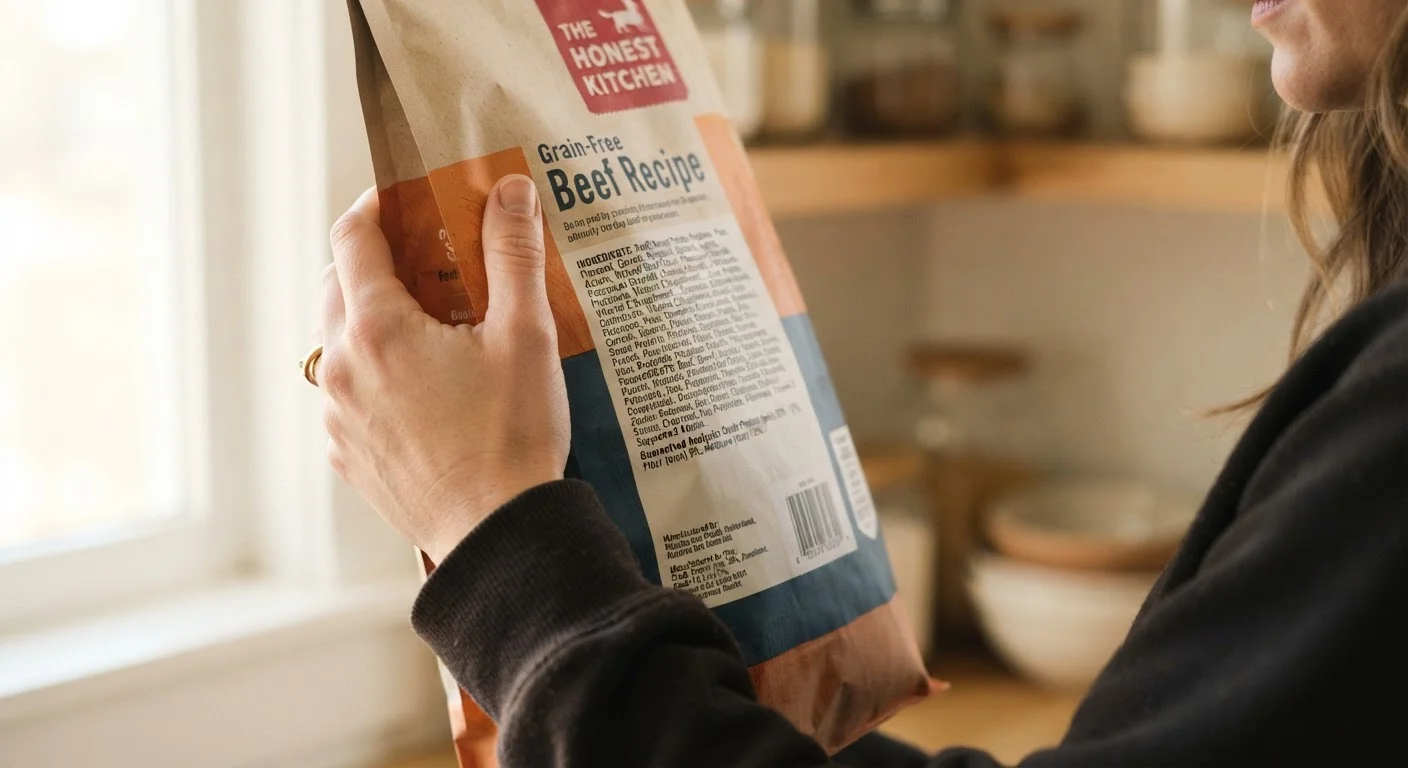
The Ingredient List: More Complicated Than It Looks
At first glance, a pet food ingredient list looks straightforward. By law, manufacturers must list ingredients in descending order by weight — heaviest first. But there's an important catch: that weight is measured before processing. Ingredients with high water content, like fresh chicken or beef, appear heavier in their raw state. After cooking removes that moisture, their actual contribution to the finished product may be considerably smaller.
This is why "chicken meal" — a dried, concentrated form of chicken — can sometimes deliver more protein per pound of food than fresh chicken listed first. Neither is inherently better; understanding the distinction just gives you a more accurate read.
Another tactic worth knowing is ingredient splitting. A manufacturer might list the same base ingredient under several different names — say, "pea protein," "pea flour," and "pea starch" — so each entry appears lower on the list individually. Taken together, those pea derivatives might represent a much larger share of the food than any single entry suggests. For a broader look at how ingredient lists work across different products, our guide to reading pet food labels without marketing confusion breaks this down further.
Look Beyond the First Ingredient
When scanning an ingredient list, consider the first five to ten ingredients as a group rather than fixating on number one alone. That cluster typically represents the bulk of the food's composition. If you see multiple protein sources or a mix of whole and meal forms, note their order and think about how moisture might affect their relative weight. This broader view gives a more accurate sense of what your pet is actually eating.
The Guaranteed Analysis Panel: Minimums, Maximums, and What's Missing
Below the ingredient list, you'll find the guaranteed analysis — a small table showing percentages for crude protein, crude fat, crude fiber, and moisture. What many pet owners don't realize is that these are guaranteed values, not precise measurements. Protein and fat are listed as minimums (the food contains at least this much); fiber and moisture are listed as maximums.
This means the actual nutrient content could be higher or lower than what's printed. Comparing two foods directly using as-printed percentages can also be misleading when their moisture content differs significantly — a wet food and a dry kibble will show very different numbers even if their underlying nutrition is comparable. To make a fair comparison, nutritionists use a dry matter basis calculation that removes moisture from the equation. Your veterinarian can help you work through this if you're comparing foods for a specific health need.
Wet Food vs. Dry Food Comparisons
Comparing guaranteed analysis percentages between wet and dry foods directly can be misleading because wet foods typically contain 70–80% moisture while dry kibble contains around 10%. To make a fair nutritional comparison, you'd need to calculate both foods on a dry matter basis. Your veterinarian can guide you through this process, especially if your pet has a specific health condition that requires careful dietary management.
The AAFCO Statement: Your Most Reliable Label Signal
If there's one section of a pet food label that delivers the most useful information in the fewest words, it's the AAFCO nutritional adequacy statement. This small block of text — sometimes easy to overlook — tells you whether the food is formulated to be complete and balanced, and for which life stage.
A food labeled for "all life stages" meets the most demanding AAFCO nutrient profile, which is calibrated for growth and reproduction. A food labeled for "adult maintenance" meets a less stringent standard. If a food carries no AAFCO statement at all, or is labeled "for intermittent or supplemental feeding only," it is not designed as a standalone diet.
The statement also tells you how the food was validated — either through nutrient profile formulation or through an actual feeding trial. Feeding trials involve live animals and generally represent a higher level of real-world testing, though formulation-based foods can still meet AAFCO standards reliably. If your pet has specific health conditions, always discuss dietary choices with your veterinarian before making changes. You might also find it helpful to review signs your pet's diet may be missing something important to pair label knowledge with observable health cues.
Marketing Language: What It Means (and What It Doesn't)
Pet food packaging is full of words designed to appeal to caring owners. Terms like "premium," "gourmet," "human-grade," and "natural" are common — but most have little or no strict regulatory definition in the pet food context. AAFCO does offer a working definition for "natural" (generally meaning no synthetic ingredients), but enforcement is inconsistent, and no definition exists for "premium" or "gourmet" at all.
Ingredient names can also be confusing. "Chicken by-products" sounds unappetizing, but by AAFCO definition these are organ meats and other non-rendered parts — nutritious for many animals. "Meat meal" is a rendered, dried protein concentrate, which isn't inherently inferior to whole meat. Understanding these definitions helps you evaluate a food on its actual composition rather than its packaging appeal.
For a deeper dive into how canine-specific nutrition science compares to what pet food marketing implies, see our article on what dogs actually need in their diet. And if you're curious how grain-free claims measure up to the evidence, grain-free dog food: separating the evidence from the trend is a useful companion read.
This article is for general informational and educational purposes only and is not a substitute for professional veterinary advice. Always consult a licensed veterinarian before making significant changes to your pet's diet or if you have concerns about your pet's health.
Frequently Asked Questions
It means the food meets AAFCO nutrient profiles for a specified life stage, such as adult maintenance or growth. A food carrying this claim has either been formulated to meet those profiles or passed a feeding trial. It should provide all the nutrients your pet needs without requiring supplements.
Generally, yes — ingredients are listed in descending order by pre-processing weight. However, ingredients like fresh chicken contain a lot of water, so after cooking their actual contribution may be smaller than it appears. Look at the overall ingredient picture rather than focusing solely on the first item.
Ingredient splitting is when a manufacturer lists the same base ingredient in multiple forms — for example, 'corn flour,' 'corn gluten,' and 'corn meal' — so each appears separately and lower on the list. Combined, those ingredients might rank much higher. Being aware of this practice helps you assess a food more accurately.
Not necessarily. Grain-free foods substitute other carbohydrate sources like peas, lentils, or potatoes. The FDA has investigated a possible link between certain grain-free diets and dilated cardiomyopathy in dogs, though research is ongoing. Talk to your veterinarian before choosing a grain-free diet.
It shows minimum percentages of protein and fat, and maximum percentages of fiber and moisture. These are guaranteed floor or ceiling values, not precise measurements, so actual nutrient levels may differ. For deeper comparisons between foods, you'd need to request dry matter basis calculations.
In the U.S., pet food must comply with FDA regulations on ingredients and labeling, and most states also apply AAFCO model guidelines. Look for an AAFCO adequacy statement on the packaging as a baseline indicator of regulatory compliance. When in doubt, your veterinarian is the best resource for guidance on specific products.
The content on this site is for informational purposes only and is not a substitute for professional advice. Always consult a qualified professional for guidance specific to your situation.