

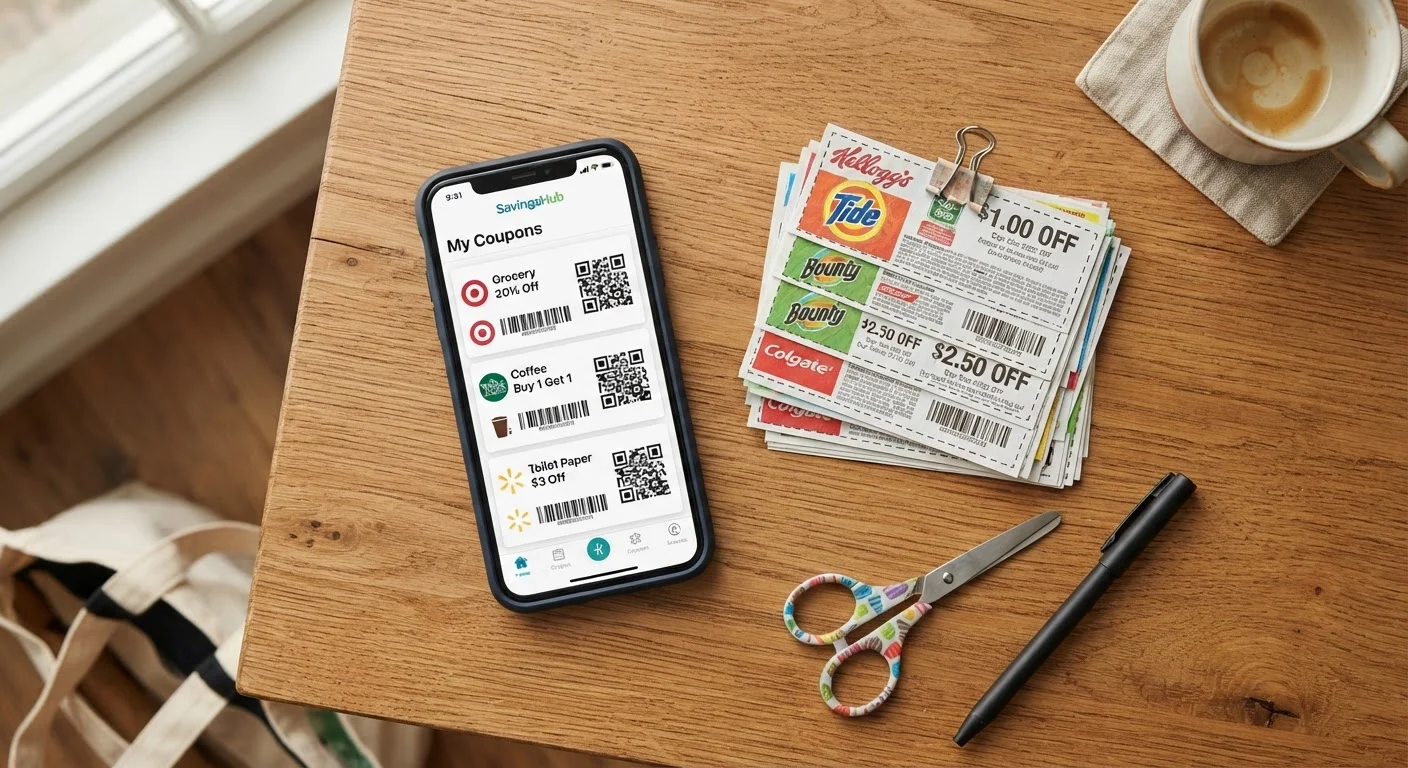
Option A
Digital Coupons
The app-based, click-to-clip convenience play.
Best for: Shoppers who want frictionless savings without managing physical materials or planning well ahead.
Option B
Paper Coupons
The traditional, tangible format with deeper discount potential.
Best for: Shoppers willing to invest prep time in exchange for higher face-value discounts and more stacking flexibility.
How Each Format Actually Works
Digital coupons live in retailer apps, grocery loyalty accounts, or third-party coupon platforms. You browse available offers, clip them to your account, and the discount is applied automatically at checkout — either by scanning a barcode or linking your phone number. The entire process is designed to reduce friction.
Paper coupons come from weekly store circulars, Sunday newspaper inserts, manufacturer mailers, and product packaging. You cut or tear them out, bring them to the store, and hand them to a cashier. Some retailers also accept printed versions of digital coupons, which blurs the line between formats.
Both formats are governed by specific redemption rules: expiration dates, quantity limits, product size restrictions, and eligible SKUs. Ignoring the fine print is one of the most common reasons a coupon fails at checkout — regardless of format. Before your next shopping trip, it's worth running through a quick pre-trip routine; see the budget shopper's pre-trip checklist for a practical framework.
Savings Potential and Discount Depth
Paper coupons have historically offered higher face-value discounts, particularly manufacturer coupons distributed through print channels. A $1.50 off a single product is more common in paper format than in most app-based offers, which tend to cluster around percentage discounts or smaller dollar amounts.
Digital coupons compensate with volume and timing. Apps frequently surface offers that are automatically applied without any planning, which means more shoppers actually use them. A smaller discount you reliably capture is often worth more in practice than a larger one you forget about.
| Criterion | Digital Coupons | Paper Coupons |
|---|---|---|
| Ease of access | Instant via app or website | Requires sourcing and clipping |
| Typical discount depth | Often smaller, percentage-based | Often higher face-value amounts |
| Organization required | Minimal — auto-applied at checkout | Significant — physical management needed |
| Data privacy trade-off | Purchase history tracked by retailer | No account or tracking required |
| Stacking flexibility | Limited; depends on retailer policy | More common; still retailer-dependent |
| Expiration visibility | Usually displayed in-app clearly | Printed on coupon; easy to miss |
| Environmental footprint | No paper waste | Paper and ink consumption |
Stacking — combining a manufacturer coupon with a store sale — is where paper coupons have traditionally had an edge. However, stacking policies differ significantly by store, and some retailers have tightened restrictions over time. Digital coupons may also allow stacking in some loyalty programs, but retailer terms govern what's permitted. Understanding price versus value matters here: a stacked deal is only worthwhile if it's on something you'd have bought anyway.
The Hidden Costs of Each Format
Paper coupons cost time. Sourcing them, organizing them, tracking expiration dates, and ensuring you remember to bring the right ones to the right store all represent real labor. For occasional shoppers or those with unpredictable schedules, that overhead can outweigh the savings.
Digital coupons cost data. Retailer apps track what you click, what you buy, and when. This purchase history is used to personalize future offers — which sounds convenient but is also a mechanism that can subtly influence buying behavior. Knowing this doesn't mean avoiding apps, but it's useful context when evaluating what you're exchanging for convenience. Retailers have designed loyalty ecosystems with their own interests in mind, as explored in the analysis of what stores get out of loyalty programs.
91%
US consumers who used a coupon in the past year
According to Statista consumer research, coupon use remains widespread across both digital and print formats in the United States.
3x
Digital coupon growth rate vs. print over recent years
Industry tracking from sources including Inmar Intelligence has noted accelerating digital coupon adoption, particularly through grocery loyalty apps.
47%
Shoppers who say coupons influenced an unplanned purchase
Surveys from the Promotion Marketing Association have highlighted that coupon-driven impulse buying is a measurable behavioral pattern across both formats.
There's also the psychological cost of coupon-driven spending: both formats can encourage buying items you wouldn't otherwise purchase. A 40% discount on something you don't need is still money spent, not saved. This is one of the more persistent frugality myths worth examining critically.
Which Format Fits Which Shopper
The right format depends less on which one is objectively superior and more on which one actually fits into how you shop. Frequent grocery shoppers with consistent brand preferences often find the time investment in paper coupons worthwhile. Sporadic shoppers or those buying across categories may get more consistent value from digital tools that surface relevant offers automatically.
One underused strategy: treat both formats as complementary rather than competing. Paper coupons for planned, high-value purchases; digital coupons for routine items where convenience matters more than maximizing savings per transaction. This hybrid approach mirrors the logic behind selective bulk buying — matching the method to the context rather than applying one rule universally.
Neither format adds value when it shifts your spending toward things you didn't need. The most effective coupon strategy, regardless of format, starts with a defined shopping list and treats discounts as a secondary consideration rather than the primary purchase driver.
The content on this site is for informational purposes only and is not a substitute for professional advice. Always consult a qualified professional for guidance specific to your situation.