

Our Verdict
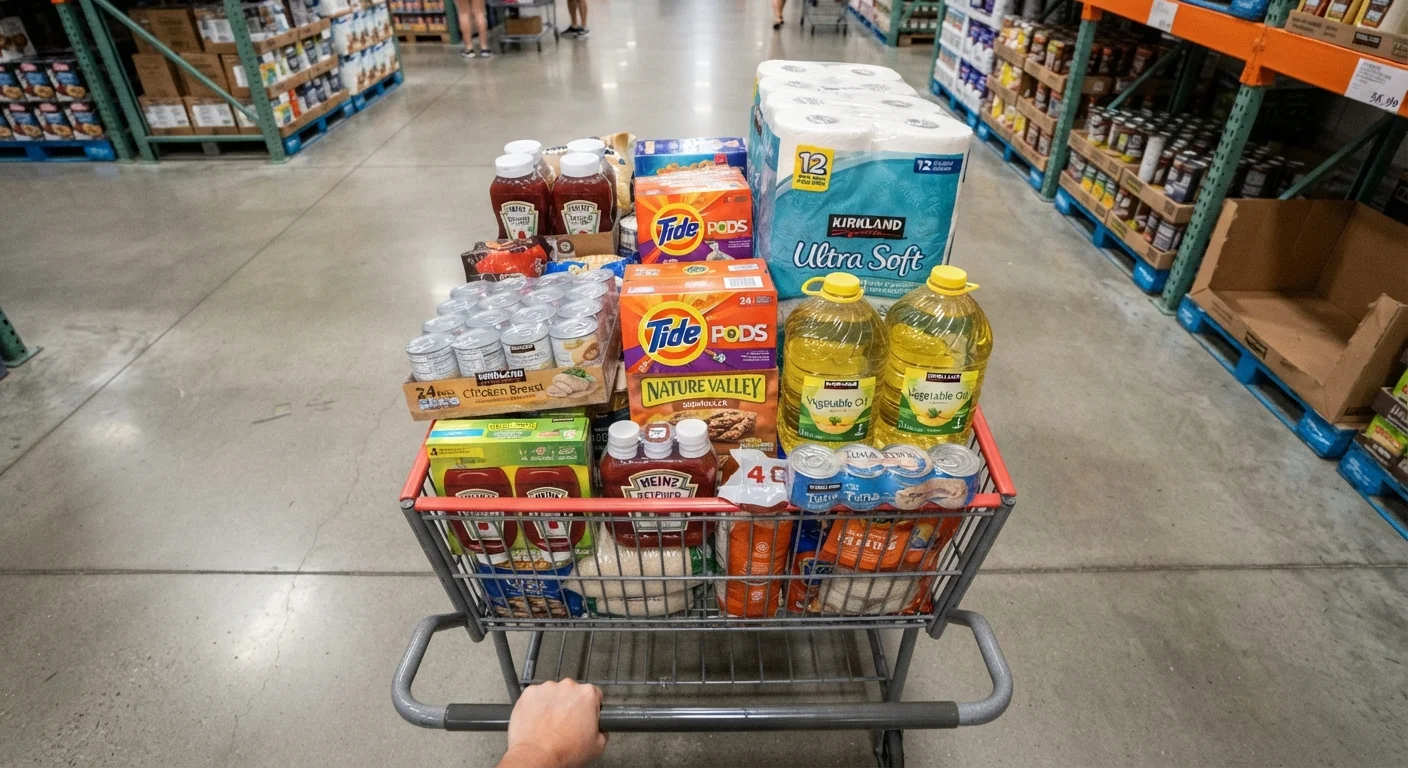
Bulk buying delivers genuine savings on the right products for the right households — primarily non-perishables, high-rotation staples, and items with predictable usage rates. For smaller households, those with limited storage, or anyone buying perishables they won't realistically use, bulk purchasing often costs more than it saves once spoilage, upfront spending, and membership costs are factored in.
Best for households of two or more with stable storage space, consistent consumption patterns, and the budget to absorb higher upfront costs on non-perishable staples.
The Core Logic of Bulk Buying
Bulk buying operates on a simple premise: manufacturers and retailers can offer a lower cost-per-unit when products move in larger volumes, and some of that margin gets passed to the consumer. That logic holds in the right conditions — but it's frequently overstated in retail marketing and personal finance shortcuts alike.
The honest framework starts with unit price, not sticker price. A $14 package of 36 paper towel rolls costs less per roll than a $5 package of 8 — that math is real. But the same arithmetic applied to a jumbo container of salsa that a household won't finish before it molds produces the opposite outcome. Understanding when the unit price advantage actually reaches your wallet requires thinking past the shelf tag.
This is part of a broader set of value-focused habits covered in the comprehensive guide to value-focused buying — where unit pricing, seasonal cycles, and store psychology all intersect.
The Unit Price Check Is Non-Negotiable
Not all bulk packages offer a lower cost-per-unit. Retailers occasionally price large formats at the same — or even higher — per-unit rate than smaller packages, particularly during promotional periods on standard sizes. Always divide the shelf price by the quantity or weight before assuming the bigger package is the better deal. Most stores are required to display unit pricing on shelf tags, which makes this comparison straightforward.
Where Bulk Buying Works
Bulk purchasing tends to deliver consistent value in a specific set of circumstances:
Lower unit price on high-rotation staples
Warehouse-format retailers typically offer a lower cost-per-unit on items like toilet paper, cooking oil, and canned goods compared to standard grocery stores. For products a household genuinely cycles through quickly, this translates into real, repeatable savings.
Fewer shopping trips save time and fuel
Stocking up reduces trip frequency, which cuts both the time spent shopping and the incidental spending that tends to occur on each visit. Fewer trips can also reduce fuel or transportation costs over time.
Protection against short-term price increases
Purchasing a larger quantity of a product at today's price can shield a household from near-term retail price fluctuations, particularly on commodity-linked goods such as cooking staples or paper products.
Reduced packaging waste per unit
Larger formats typically use less packaging material relative to the volume of product, which can reduce household waste and the frequency of recyclable disposal — a secondary benefit beyond pure cost.
The common thread across these advantages is predictability. When a household knows it will use a product at a reliable rate, and that product has a shelf life long enough to cover the consumption window, the unit price advantage compounds into meaningful savings over time. Cleaning supplies, cooking oils, dried grains, canned goods, and paper products are the categories most frequently cited as bulk-purchase wins for this reason.
If you're building a broader shopping framework, pairing bulk strategy with a structured budget is worth the effort. The grocery budget guide walks through how to set spending limits that can accommodate periodic large-format purchases without disrupting weekly cash flow.
Where Bulk Buying Costs You
The downsides of bulk buying are real and frequently underestimated — particularly by shoppers motivated more by the feeling of a deal than by verified unit economics.
Spoilage erases savings on perishables
Buying a three-pound container of berries or a bulk pack of bakery items only saves money if everything gets consumed before it spoils. Households that can't realistically use the volume frequently throw away the margin they thought they captured.
Membership fees add to the true cost
Warehouse clubs typically require an annual membership fee ranging from roughly $65 to over $120 depending on the tier. For households with modest bulk purchasing habits, this fixed cost can eliminate the savings advantage entirely.
High upfront spending strains cash flow
Even when the per-unit math works in your favor, paying significantly more at checkout puts pressure on near-term household cash flow. This tradeoff is especially relevant for those managing tight monthly budgets.
Storage requirements are a real constraint
Bulk quantities require space — pantry room, garage shelving, or a secondary freezer. Households without adequate dry or cold storage may find bulk buying impractical regardless of the unit economics.
Risk of buying what you won't actually use
Warehouse formats can encourage purchasing based on the perception of a deal rather than genuine need. Buying a bulk supply of a product you use infrequently — or that a household member ends up disliking — results in waste, not savings.
The spoilage risk deserves particular attention for anyone shopping at a warehouse club primarily for food. A single discarded bulk package of produce or prepared food can offset weeks of unit-price savings on shelf-stable items. Households of one or two people face this risk acutely.
It's also worth recognizing that bulk format retailers are skilled at using scale and store layout to encourage larger cart totals — a mechanic explored in more depth in the article on how retailers use bundling and upselling. Awareness of these dynamics helps keep bulk purchases intentional rather than reactive.
Making a Smarter Bulk Buying Decision
The decision to buy in bulk should be product-specific, not a blanket shopping philosophy. A practical starting point is a short mental checklist before adding any oversized package to the cart:
- Will we actually use all of this before it expires? Be honest about your household's consumption rate — not your aspirational one.
- Does the unit price genuinely beat the regular-format alternative? Check the shelf tag or do the math.
- Do we have space to store it properly? Improper storage can accelerate spoilage or degradation even on shelf-stable items.
- Does the upfront cost fit this month's spending plan? A good unit price doesn't help if it means shortfalling elsewhere.
For a broader pre-shopping discipline, the pre-trip shopping checklist offers a structured way to enter any retail environment with clearer intentions — bulk club or otherwise.
~30%
Typical unit price reduction in bulk formats
Consumer research consistently shows per-unit costs at warehouse clubs running roughly 20–30% lower than conventional grocery pricing on shelf-stable items, though this varies significantly by product category.
40%
Share of food purchased in US that goes to waste
The USDA estimates that approximately 30–40% of the US food supply is wasted, a figure that includes household overbuying — a risk bulk purchases can amplify.
Bulk buying is a tool, not a rule. Applied selectively to the right products for the right household, it can meaningfully reduce the cost of everyday staples. Applied broadly as a default, it can quietly inflate total spending while giving the impression of savings.
The content on this site is for informational purposes only and is not a substitute for professional advice. Always consult a qualified professional for guidance specific to your situation.