

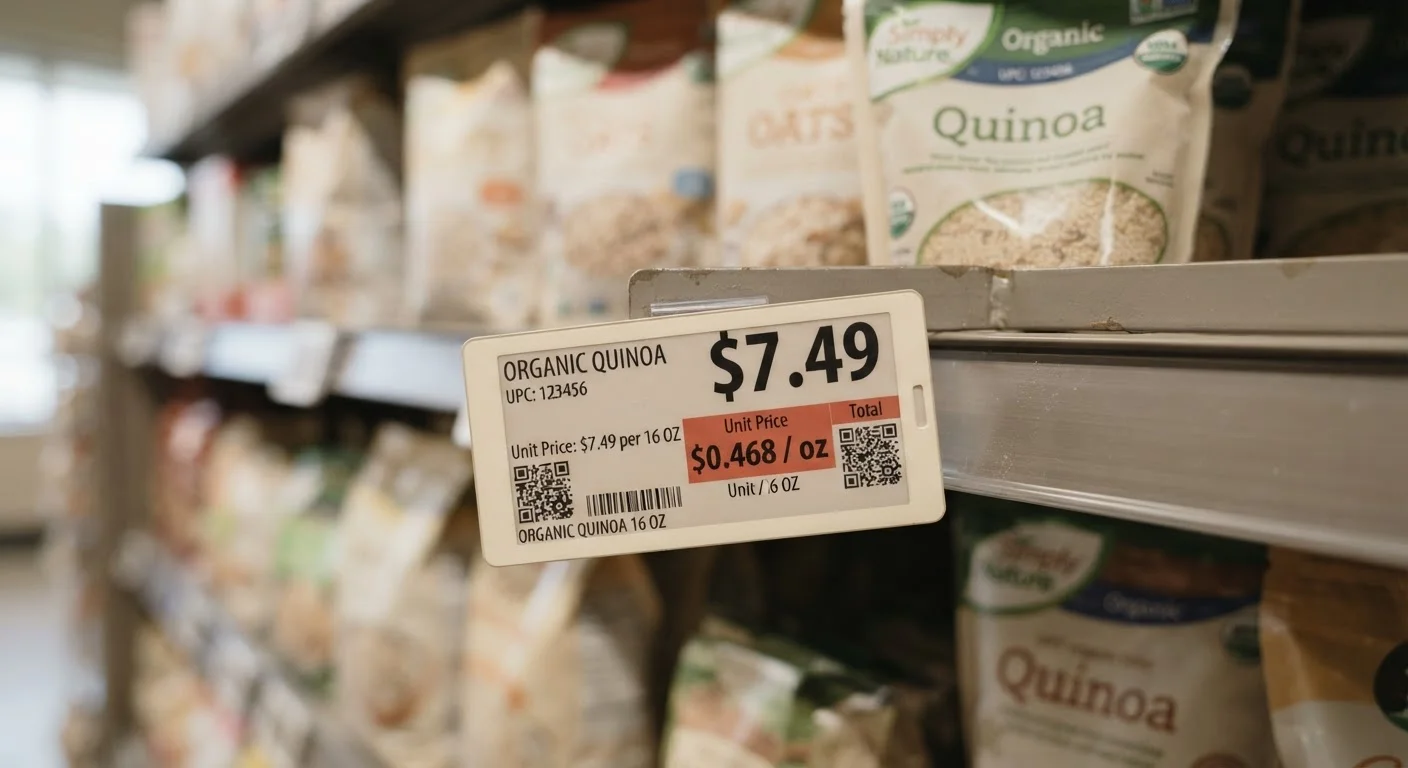
Why the Sticker Price Misleads You
Retailers are skilled at structuring product sizes and price points in ways that make comparison difficult. A 24-ounce bottle of dish soap sitting next to a 30-ounce bottle might be priced just $0.75 apart — close enough that most shoppers guess they're roughly the same value. They're often not.
This is where unit pricing does the work your eyes can't. Instead of comparing total prices, you compare what each product actually costs per ounce, per sheet, per tablet, or per serving. That single shift in perspective — from package price to unit cost — is one of the most underused tools in everyday shopping.
It also connects directly to a broader concept: the real difference between price and value. A lower sticker price can still represent worse value if the quantity inside is proportionally smaller.
~35%
Shoppers who regularly check unit prices
Consumer research has consistently found that a minority of grocery shoppers actively use shelf unit prices when making purchasing decisions, despite their availability.
30–40%
Potential unit cost gap between package sizes
Depending on the product category, the unit cost difference between the largest and smallest available package sizes can exceed 30–40%, with the larger size not always winning.
$0.12 vs $0.18
Example unit price spread in paper goods
In commodity categories like paper towels, unit prices across brands and sizes commonly vary by 50% or more — a difference invisible from sticker prices alone.
How to Read a Unit Price Label
On most grocery shelf labels, the unit price appears in smaller print — often in the top corner of the tag, sometimes labeled as "price per oz" or "per 100 ct." Retailers aren't required to make it prominent, and design conventions vary. Once you know it's there, though, spotting it becomes second nature.
The formula itself is simple: Total Price ÷ Number of Units = Unit Price. If a 32-oz bottle costs $3.84, the unit price is $0.12 per ounce. A 20-oz bottle at $2.60 is $0.13 per ounce — slightly more expensive per use, despite the lower total outlay.
Keep in mind that unit measurements must match for a comparison to be valid. Comparing price per ounce to price per liter, or price per sheet to price per square foot, requires a conversion step. When categories use inconsistent units, do a quick calculation rather than guessing.
Quick Shelf-Side Unit Price Check
If a shelf label is missing or uses a different unit than the competing product, check the package itself — weight and count are always printed on the label. Divide total price by that number on your phone's calculator. The entire process takes under 15 seconds and routinely surfaces differences that would otherwise go unnoticed.
When Bigger Isn't Actually Cheaper
The assumption that bulk always wins is one of the more persistent retail myths. In reality, promotional pricing, store-brand competition, and category-specific dynamics mean smaller sizes frequently win on unit cost — at least temporarily.
Common scenarios where the larger size loses:
- Sale pricing on standard sizes: A manufacturer running a promotion on a mid-size package can push its unit price below the warehouse-club equivalent.
- Private-label vs. name-brand bulk: A store-brand 16-oz jar can beat a name-brand 48-oz jar on unit cost without any promotion involved.
- Perishable goods: If you can't use a large quantity before it expires, the effective unit cost rises sharply — you're paying for waste.
This is also worth keeping in mind when evaluating promotional pricing. Sale prices aren't always genuine discounts, and a "value size" label on packaging is marketing language, not a factual claim about cost efficiency.
Building Unit Pricing Into a Shopping Habit
The practical barrier to using unit pricing isn't complexity — the math is simple. The barrier is attention. Most shoppers scan for the total price and move on. Retraining that habit takes deliberate repetition over a handful of shopping trips before it becomes automatic.
A few strategies that help:
- Start with one category. Pick paper products or canned goods as your test category. Compare unit prices across sizes and brands every trip until the habit is automatic in that aisle.
- Use your phone's calculator. When a shelf label is missing or the units don't match, divide total price by quantity on the spot. It takes about ten seconds.
- Note when your default assumption was wrong. Catching a moment where the "obvious" deal wasn't the best unit price cements the habit faster than any advice can.
Unit pricing also pairs well with a broader literacy about how retail shelf placement and pricing architecture works. Understanding the hidden codes on price tags — including markdown indicators and color-coded stickers — gives you a fuller picture of what a label is actually communicating.
Ultimately, unit pricing is about converting marketing presentation into a comparable fact. It doesn't require a coupon, a loyalty card, or any special access. It's already printed on the label. You just have to look at the right number.
Frequently Asked Questions
It's typically printed in smaller type in the upper-left or lower portion of the shelf tag, often labeled as 'price per oz,' 'per 100 ct,' or a similar unit. The format varies by retailer but is usually present in any store required by state law to display it.
Not always. While bulk sizes are often more economical per unit, promotional pricing on smaller packages can reverse that. Specialty or organic lines in larger sizes sometimes cost more per unit than standard versions in smaller sizes. Always check the shelf label math.
This can make direct comparison tricky. A paper towel priced per sheet and another priced per square foot require you to convert one before comparing. When units differ, focus on the measurement that best reflects actual use — for towels, sheet size and absorbency matter alongside price.
No federal law mandates unit pricing in the U.S., but many states — including California, Massachusetts, and Connecticut — do require it for certain product categories. Even where it's optional, most large grocery chains display it voluntarily.
Yes. Unit pricing is useful across household goods, personal care products, cleaning supplies, and more. The same logic applies: convert to a common measurement and compare apples to apples.
Absolutely. Divide the total price by the number of units (ounces, sheets, count, etc.) listed on the package. Most smartphones have a calculator handy for exactly this kind of quick check at the shelf.
The content on this site is for informational purposes only and is not a substitute for professional advice. Always consult a qualified professional for guidance specific to your situation.