

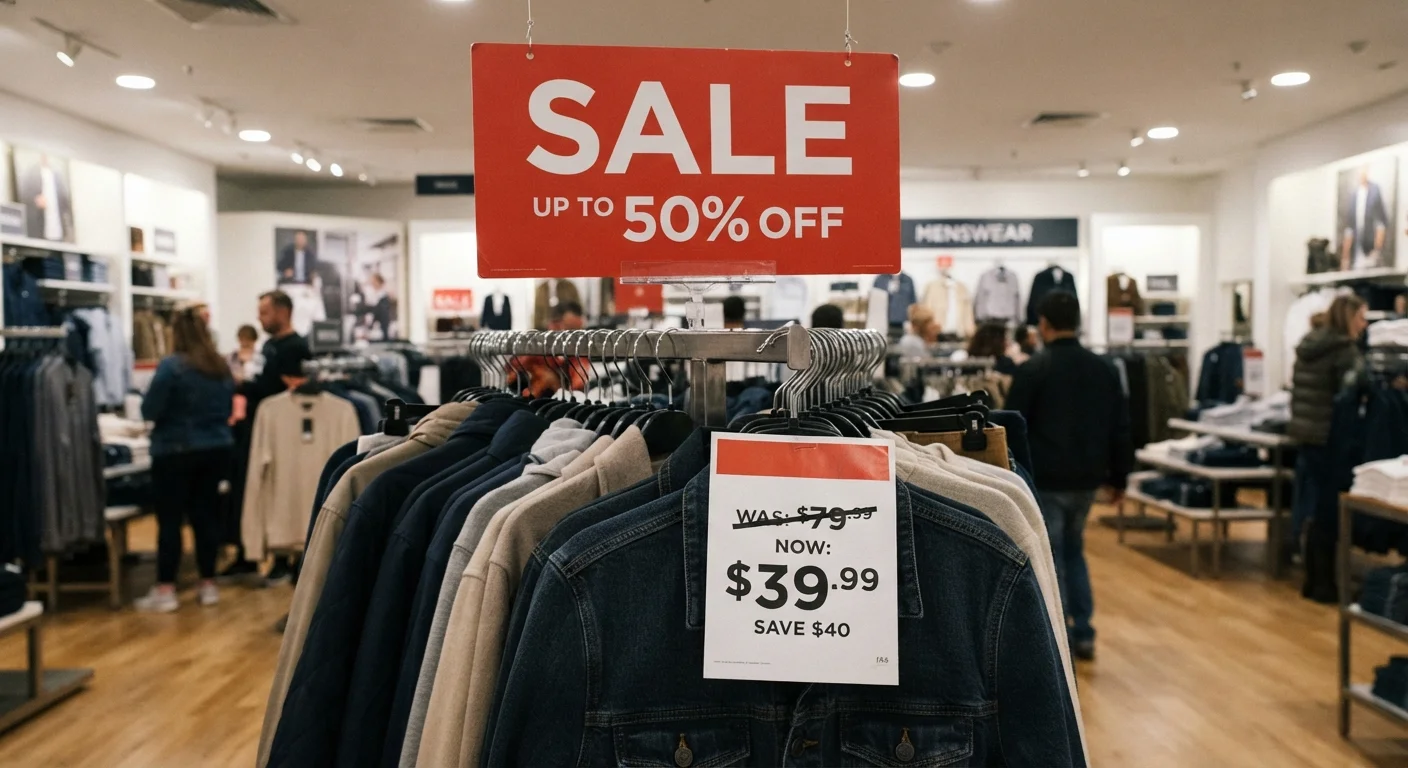
How 'Sale Price' Actually Works
Walk through any retail store and you'll see strikethrough prices, red tags, and percentages-off banners. The implied promise is simple: you were going to pay more, and now you're paying less. But that framing depends on one assumption most shoppers don't question — that the original price was real.
In U.S. retail, a "sale price" is legally required to reflect a meaningful reduction from a price that was actually offered to consumers for a genuine period of time. In practice, however, enforcement is inconsistent, and the definition of "genuine" leaves significant room for interpretation. Some retailers establish a high reference price briefly — sometimes only for a matter of days — before marking it "on sale" at the price they always intended to charge. This practice, sometimes called reference pricing or anchor pricing, is pervasive across department stores, e-commerce platforms, and home goods retailers alike.
Understanding this mechanic doesn't require cynicism — it requires awareness. For a deeper look at how this psychological tool shapes perceived value, see how anchor pricing creates the illusion of a deal.
Myth
If the tag shows a strikethrough price, the item is genuinely on sale.
Fact
A strikethrough price is only meaningful if the original price was real and charged for a legitimate period — something shoppers cannot easily verify.
Retailers can legally establish a reference price by offering a product at a higher price for a limited window, then advertising the lower current price as a "sale." The strikethrough communicates a story, but it doesn't verify one. Without knowing the product's actual price history, the strikethrough is marketing copy, not accounting.
Myth
A higher discount percentage means a better deal.
Fact
Percentage discounts are calculated from the reference price — which may itself be inflated. The percentage tells you little about whether the current price is competitive.
A product marked "75% off" from an MSRP of $200 sells for $50. If that product routinely sells for $45–$55 across comparable retailers with no promotion, the 75% figure is technically accurate and practically meaningless. The number that matters is whether $50 is a fair price for the item in the current market — not how large the spread looks on a tag.
Myth
Sale prices create urgency because they're temporary.
Fact
Many sale prices are semi-permanent or rotate so frequently that urgency is manufactured rather than real.
Some retailers run overlapping or rolling promotions year-round, meaning a product is almost never sold at full price in practice. When a sale is the default state, the "limited time" framing functions as a psychological prompt rather than an accurate description of scarcity. Shoppers who wait rarely miss an equivalent or better price window.
Myth
The 'compare at' price reflects what competitors are charging.
Fact
'Compare at' typically references the manufacturer's suggested retail price (MSRP), not actual competitor pricing.
MSRP is a list price set by manufacturers, and many products are routinely sold below MSRP across the retail landscape. When a tag reads "Compare at $150 — Our Price $89," it does not necessarily mean competitors sell it for $150. It may simply mean the manufacturer lists it at $150. Independent price checking across multiple retailers gives a far more grounded baseline than a "compare at" figure.
Myth
Buying on sale always saves money.
Fact
Purchasing a discounted item you didn't need or plan to buy is a net cost, not a savings — regardless of the percentage off.
Savings language frames spending as its opposite. If a $60 item marked down from $100 wasn't on your shopping list and doesn't solve a genuine need, you didn't save $40 — you spent $60. The mechanism by which sale pricing drives impulse purchases is well-documented in behavioral economics literature, and it works precisely because "saving money" feels virtuous in ways that straightforward spending does not.
What Shoppers Get Wrong About Markdowns
The gap between retail mythology and retail reality is wide — and retailers have little incentive to close it. Several common beliefs about sale pricing systematically work against shoppers' financial interests.
~40%
U.S. retail purchases made on promotion
Industry estimates from retail analytics firms have consistently found that a large share of consumer goods transactions occur at a promotional price, suggesting sales are the norm rather than the exception.
87%
Shoppers influenced by seeing a 'sale' label
Consumer behavior research has found that price presentation — including strikethrough pricing and sale labels — meaningfully affects purchase likelihood even when the actual discount is modest.
One underappreciated factor is that "compare at" or "was" prices on e-commerce platforms often reflect the manufacturer's suggested retail price (MSRP), not the actual price at which the item sold. MSRP is a list price set by the manufacturer, and many products rarely sell at MSRP in normal market conditions. When a product is shown as "60% off MSRP," that percentage may describe a discount from a price almost no one ever paid.
Similarly, the assumption that a clearance label signals a deeper discount than a sale label isn't always accurate. The two tags signal different things about inventory status, not necessarily about the size of the reduction. Clearance and sale labels have distinct meanings that are worth understanding before you assume you've found the lowest price.
For a broader look at how pricing psychology shapes everyday spending, several retail pricing myths still trip up experienced shoppers.
Reference Prices Can Be Legally Set Briefly
U.S. consumer protection guidelines generally require that a "former price" be genuine, but what counts as genuine varies by jurisdiction and is not always enforced consistently. Some state attorneys general have taken action against deceptive reference pricing, but shoppers should not assume that a posted original price was ever widely charged. Price-tracking tools and cross-retailer comparisons remain the most reliable personal safeguard.
Building a Pricing Reality Check
If you can't rely on the sale tag alone, what can you rely on? A few practical habits shift the power dynamic back toward the shopper.
- Track price history. Browser extensions and third-party tools record historical pricing on major e-commerce platforms, letting you see whether the "original" price is genuine or inflated for marketing purposes. A product priced at $80 for eleven months and $120 for two weeks before a "sale" tells a clear story.
- Use unit pricing. For consumables and packaged goods, the price per unit (per ounce, per sheet, per serving) is often more informative than the sticker price or the discount percentage. Unit pricing is the shelf-label math most shoppers ignore — but it's the number that actually governs cost-per-use value.
- Separate price from value. A 40% reduction on a product you wouldn't otherwise buy isn't a savings — it's a cost. Price and value are not the same thing, and conflating them is precisely what reference pricing exploits.
- Recognize dynamic pricing. Online prices shift based on demand, time of day, and browsing behavior. The sale price you see may not be the one your neighbor sees. Dynamic pricing in everyday retail is now standard practice across major platforms.
This article is for general informational and educational purposes only and does not constitute financial, legal, or consumer protection advice. Retail pricing regulations vary by state and retailer; consult relevant consumer protection resources in your area for guidance specific to your situation.
The content on this site is for informational purposes only and is not a substitute for professional advice. Always consult a qualified professional for guidance specific to your situation.