

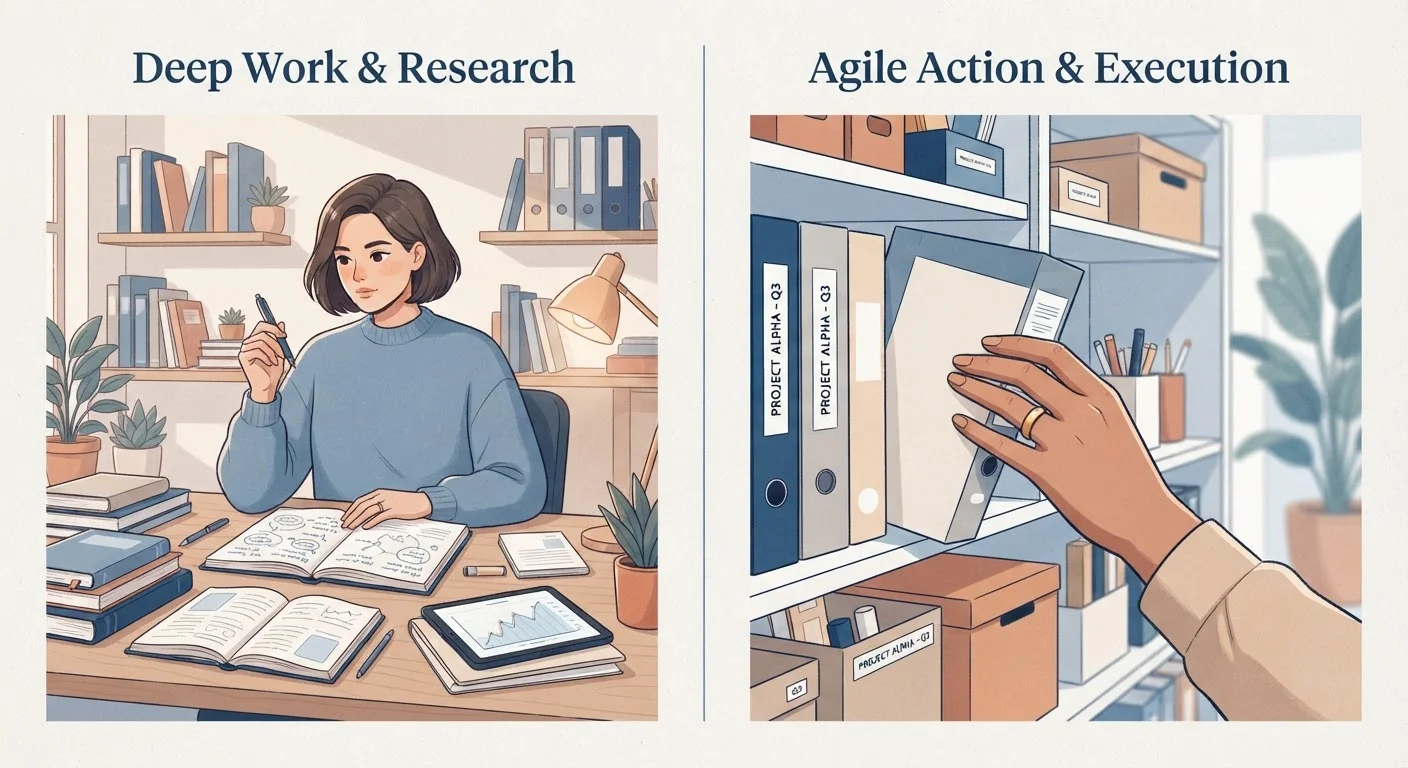
Our Verdict
Neither deep research nor fast decisions is universally superior — the right approach depends on stakes, reversibility, and your existing knowledge. Match your effort level to what a mistake would actually cost you, and set a firm stopping point before you start. Over-researching low-stakes purchases wastes time; under-researching major commitments invites costly regret.
Deep research is best for shoppers making high-cost, hard-to-return, or long-commitment purchases; quick decisions suit those buying low-cost, familiar, or easily exchangeable items.
The Core Trade-Off: Time vs. Risk
Every purchase decision sits somewhere on a spectrum. At one end: the impulse grab of a $4 snack. At the other: a six-month comparison of home appliances. Most buying decisions land somewhere in between — and knowing where to land is what separates confident shoppers from those who feel either paralyzed or remorseful.
The fundamental trade-off is straightforward: investing more time in research reduces the probability of a costly mistake, but that time has a real opportunity cost. Spending four hours comparing blenders means four hours not spent on something else. The question isn't whether research matters — it's how much research the specific purchase actually warrants.
Two variables drive that calculation more than any others: the cost of being wrong and the reversibility of the decision. A purchase you can return in 30 days for a full refund tolerates a much faster decision than one that locks you into a multi-year commitment. See our questions worth asking before any major purchase for a structured way to think through these factors before you commit.
The Case for Going Deep
Thorough research consistently pays off under specific conditions. When stakes are high — think major appliances, vehicles, health-related equipment, or long-term service contracts — the hours invested upfront can prevent expensive mistakes that take months to recover from financially or logistically.
Reduces likelihood of costly buyer's remorse
Understanding a product's known weaknesses before purchase means fewer surprises after. For high-cost or long-use items, avoiding one significant defect can justify hours of upfront research.
Uncovers hidden costs and ownership factors
Deep research often surfaces total cost of ownership details — maintenance requirements, compatibility limitations, or ongoing fees — that surface-level browsing misses entirely.
Builds durable category knowledge
Time spent genuinely understanding a product category pays dividends beyond the current purchase, making future decisions in the same space faster and more confident.
Identifies red flags and quality patterns
Repeated complaints across independent reviews signal systemic issues that a single product listing would never reveal. Deeper research aggregates those signals.
Deep research also builds transferable knowledge. If you spend time genuinely understanding what makes a category of product work well, future purchases in the same space become faster and more confident. That compounding value is easy to overlook when you're in the middle of a tedious comparison process. Our principles for doing product research well outlines habits that build exactly this kind of durable knowledge.
The Case for Going Fast
Speed has genuine advantages that careful shoppers can underestimate. For routine, low-cost, or highly returnable purchases, deep research is often a poor use of limited mental energy — particularly given what behavioral research consistently shows about decision fatigue: the more decisions a person makes, the lower the quality of subsequent choices.
Consumes time with diminishing informational returns
Research yields its most valuable insights early. Extended investigation typically surfaces minor details that don't materially change the final decision, making the time cost hard to justify.
Decision fatigue degrades final choice quality
Processing large amounts of comparative information depletes the mental resources used for evaluating trade-offs, potentially leading to a worse decision at the end of a long research session.
Can cause analysis paralysis
Exposure to more options and conflicting information can create uncertainty rather than resolve it, resulting in delayed or stress-driven decisions.
Opportunity cost of time is real
Hours spent comparing low-stakes items represent time unavailable for higher-value activities. The cost of over-researching a $30 purchase is often greater than the cost of a mildly suboptimal choice.
Fast decisions also prevent a real phenomenon sometimes called analysis paralysis, where an abundance of options and information leads to no decision at all — or a stress-driven one made at the last minute under worse conditions. If you're buying in a category you already understand well, trusting that knowledge and moving quickly is a rational, defensible strategy.
How to Calibrate Your Effort
Rather than defaulting to either extreme, use a quick pre-research check to assign an effort level before you start looking. Ask three questions:
- What does a mistake cost me? Estimate the realistic worst-case financial and practical cost of a poor choice.
- Can I reverse this decision easily? Free returns, trials, and short contracts significantly reduce the research burden.
- How familiar am I with this category? Existing knowledge compresses the research curve sharply.
A purchase that scores high on all three (expensive, irreversible, unfamiliar) warrants deep research. A purchase that scores low on all three (cheap, returnable, familiar territory) warrants a fast decision. Most purchases fall in the middle and benefit from a focused, time-boxed effort — say, 30–60 minutes with a defined stopping point.
Set a Stopping Rule Before You Start
Decide in advance how long you'll research and what information would change your decision. Without a predefined stopping rule, research sessions tend to expand indefinitely without proportionally improving outcomes. A useful default: stop when additional searching no longer changes your leading option — not when you feel fully certain.
This framework applies beyond consumer goods. The same logic governs how much due diligence to apply to financial decisions, travel bookings, and other commitments. For an unfamiliar product category specifically, our structured approach to researching the unknown can help you get up to speed without overdoing it.
The Diminishing Returns Problem
Research has a quality curve. The first hour of investigation on a meaningful purchase typically yields the most valuable insights — category basics, deal-breaker flaws, realistic price ranges. Each subsequent hour tends to produce incrementally less useful information while consuming the same amount of energy.
~30 min
Effective research window for mid-range purchases
Consumer behavior researchers generally find that focused, time-boxed research sessions produce decisions comparable in quality to much longer open-ended searches for most everyday product categories.
3 questions
Key factors that determine research depth needed
Cost of error, reversibility, and prior category knowledge are the primary variables consumer decision researchers cite when modeling optimal pre-purchase effort allocation.
This matters practically because shoppers who set no stopping point often find themselves making a rushed final decision anyway — just after burning hours on marginal details. Setting a time budget before you start, rather than researching until you feel fully confident (a feeling that rarely arrives), tends to produce better outcomes. If you're evaluating bulk purchases or subscription-style commitments, the honest trade-offs of bulk buying article is a useful parallel case study in calibrating effort to actual savings potential.
The goal of research is an informed decision — not a perfect one. Accepting that distinction is often what separates efficient shoppers from exhausted ones.
The content on this site is for informational purposes only and is not a substitute for professional advice. Always consult a qualified professional for guidance specific to your situation.