

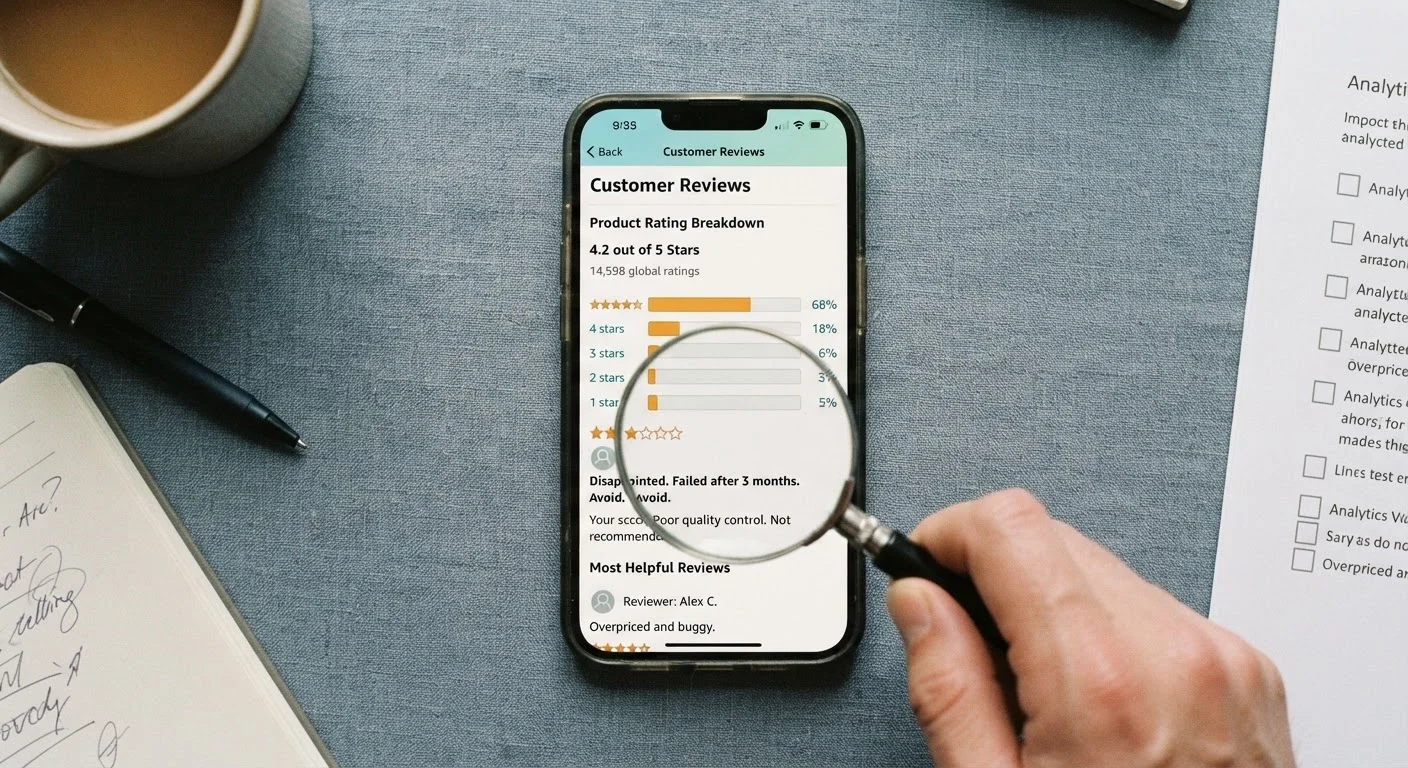
Why the Star Average Hides More Than It Shows
A 4.3-star rating sounds reassuring — until you realize it could represent 200 people who loved the product and 80 who experienced it failing within a month, averaged together into a number that describes neither group accurately. The star average is a compression algorithm applied to human experience, and like most compressions, it loses critical detail.
The core problem is that star systems collapse wildly different complaints into a single dimension. A customer furious about slow shipping and a customer whose product stopped working after two weeks both leave 1-star reviews — but those failures are entirely different in significance. The average treats them identically.
Myth
A product with 4+ stars is reliably good — the crowd has spoken.
Fact
The crowd has averaged, not agreed. A 4-star rating can coexist with hundreds of reports of the same critical flaw.
Averages suppress variance. When a product has 10,000 reviews and a meaningful percentage describe a structural defect, those negative data points get mathematically diluted by the majority of satisfied customers. The average doesn't flag the defect — it buries it. If that defect is a dealbreaker for your use case, the rating gave you no useful warning.
Myth
More reviews always means a more trustworthy rating.
Fact
High review volume can reflect aggressive solicitation campaigns or review manipulation, not product quality.
Some sellers systematically solicit reviews from satisfied customers immediately after purchase — before problems have time to emerge — while dissatisfied customers are less likely to follow up after a return. Others have historically used incentive schemes that platforms now prohibit but can't fully eliminate. A high review count is worth noting, but it should prompt scrutiny of the distribution and text, not automatic trust. Understanding how review sources get compromised is essential context for any shopper relying on platform ratings.
Myth
One-star reviews are mostly from difficult customers or shipping complaints.
Fact
In aggregate, negative reviews often reveal the most specific, recurring product failures that affect real-world durability.
While some low ratings reflect misplaced expectations or logistics issues unrelated to the product itself, reading a batch of 1-star reviews in sequence quickly reveals whether there's a legitimate quality pattern. A single angry customer is an outlier; fifteen reviewers independently describing the same hinge breaking within 30 days is a design or materials problem. The skill is distinguishing noise from signal in the negative end of the distribution.
Myth
A product's rating today reflects what you'll receive today.
Fact
Product formulations, components, and manufacturers change — older reviews may describe a genuinely different item.
Consumer goods undergo quiet changes all the time: a supplier switch, a cost-cutting reformulation, a new production facility. The product listed under the same name and same listing may not be physically identical to what earlier reviewers received. Sorting by most recent reviews and watching for phrases like "this used to be great" or "something changed" is an informal but effective way to detect post-change quality shifts.
What savvy shoppers look for instead is the rating distribution — the breakdown of 1-star through 5-star counts. A product with a 4.2 average from a J-shaped distribution (lots of 5s, very few middle ratings, a notable cluster of 1s) tells a very different story than the same average from a bell curve. The J-shape often signals that experiences are polarized, meaning the product works brilliantly for some use cases and fails badly in others. Knowing which camp you're likely to fall into requires reading the negative reviews, not averaging them away.
More Reliable Signals to Research Instead
Once you stop anchoring on the star average, several more informative signals become available.
Review Recency and Trend Direction
A product that earned 4.8 stars over three years but has been averaging 3.1 stars for the past six months is a product in decline — possibly due to a manufacturing change, quality-control regression, or a formula update. Platforms that show rating trends over time make this visible; on those that don't, sorting reviews by most recent is a manual workaround. As detailed in what makes a review trustworthy, recency is one of the clearest markers separating useful feedback from outdated signal.
Verified Purchase Filters
On platforms that offer them, filtering to verified-purchase reviews removes a meaningful layer of noise. Incentivized, promotional, or fraudulent reviews are disproportionately clustered in the unverified segment. This filter is imperfect — it can exclude legitimate buyers who received the item as a gift — but it raises the average quality of the evidence you're reading.
One-Star Review Patterns
The single most underused research tool is the lowest-rated reviews, read in bulk. If the same failure mode appears in 15 separate 1-star reviews — a zipper that breaks, a battery that won't hold charge, a seam that unravels — that's a pattern, not an outlier. Mining one-star reviews for recurring flaws is one of the highest-return habits a careful shopper can develop.
Independent and Expert Testing
For higher-stakes purchases, look for product categories covered by independent testing organizations. These sources apply controlled, repeatable methodology rather than subjective impressions. Combining controlled testing with crowd feedback gives you coverage that neither source provides alone — lab results tell you how something performs under standard conditions; user reviews tell you how it holds up in the real world over time.
Watch for Rating Resets After Listing Changes
Some sellers reset their review history by making minor edits to a product listing — changing a variant, bundling an accessory, or relaunching under a slightly different title. If a product has very few reviews despite appearing to be an established item, it may be a relisted product shedding a poor rating history. Check whether the review count seems inconsistent with how long the product appears to have been available.
Understanding which type of review to lean on also depends on what you're buying. When user reviews outperform expert tests — and vice versa is a useful framework for matching your research method to your purchase type.
The content on this site is for informational purposes only and is not a substitute for professional advice. Always consult a qualified professional for guidance specific to your situation.