

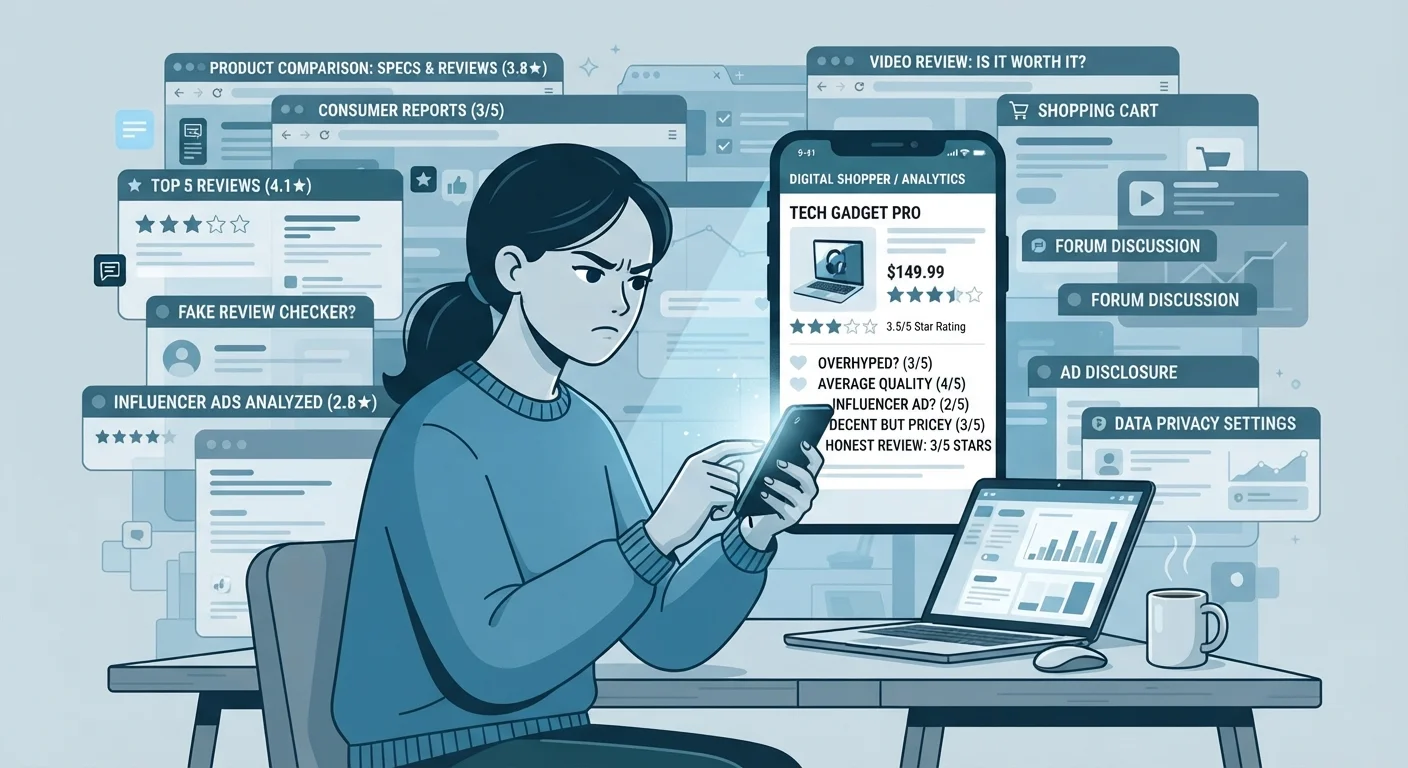
Why Shoppers Default to Unreliable Sources
Most shoppers don't set out to make poorly informed decisions — they use sources that feel authoritative, familiar, or convenient. The problem is that convenience and trustworthiness rarely overlap in the modern retail information landscape.
A high follower count can signal popularity, not expertise. A 4.6-star aggregate can mask hundreds of five-star reviews left by people who received a product for free. A brand's own website, however polished, exists to sell — not inform. These are structural realities, not occasional exceptions. Understanding them is the first step to researching products more effectively.
Understanding the business models behind product content online is foundational — once you see how a source earns money, its incentives become obvious.
42%
Shoppers who can't identify sponsored content
A study by the Advertising Standards Authority found that a significant share of consumers struggle to distinguish paid influencer posts from organic recommendations even when disclosures are present.
30–40%
Estimated share of online reviews that are fake or incentivized
Research from the University of Southern California and various consumer advocacy groups has estimated that a substantial portion of marketplace reviews across major platforms may be inauthentic or commercially motivated.
Common Mistakes Shoppers Make When Evaluating Sources
The following patterns surface repeatedly across consumer categories — from appliances to skincare. Recognizing them in your own research habits is a practical starting point for making smarter decisions.
Treating influencer content as independent product advice.
Why it happens: Influencers project authenticity, and their recommendations feel like advice from a knowledgeable friend. Disclosure requirements are inconsistently followed, making paid partnerships easy to miss.
Using a product's overall star rating as the primary trust signal.
Why it happens: Aggregate scores are visually prominent and feel like a crowd-sourced verdict, but they compress enormous variation into a single number that hides more than it reveals.
Relying on a brand's own website or product page for factual comparison.
Why it happens: Brand pages look professional and are easy to find via search, creating an impression of objectivity that the content doesn't warrant.
Assuming that publications with editorial-sounding names are independent.
Why it happens: Many content sites are structured around affiliate commissions and present buying guides as editorial content. The format and tone mimic journalism without the independence.
Treating a large review volume as a proxy for product reliability.
Why it happens: More reviews intuitively feel like more evidence. But review count can be inflated through verified-purchase incentive programs, promotional giveaways, or review aggregation across product variants.
What Reliable Research Actually Looks Like
Trustworthy product research isn't complicated, but it does require a deliberate shift in where you look and how you weigh what you find.
Verified-purchase reviews with detailed context — reviewers who describe their specific use case, timeline of ownership, and what failed — carry far more signal than generic praise. What separates genuine reviews from paid or manipulated ones comes down to specificity, balance, and disclosed context.
Independent testing organizations that charge subscription fees rather than earning commissions have a business model aligned with reader trust. Their findings are reproducible and methodology-documented, which matters when comparing across product categories.
Owner communities and forums — particularly those organized around long-term use — surface durability and failure-mode information that no pre-purchase review can provide. More reliable signals for judging whether a product holds up often come from owners a year or two into use, not buyers in their first week.
Cross-referencing at least three independent sources before a significant purchase is a practical default. The goal isn't perfection — it's reducing the odds that any single biased source drives your decision. For broader principles that apply across every category, these research habits consistently lead to more informed decisions.
Disclosures Are Your First Filter
Federal Trade Commission guidelines require that material connections between a reviewer and a brand — including free products, affiliate payments, or sponsorships — be disclosed clearly and conspicuously. When you cannot find a disclosure, that absence itself is informative. It does not mean the source is independent; it may mean the disclosure is being withheld or buried. Always look before you trust.
The content on this site is for informational purposes only and is not a substitute for professional advice. Always consult a qualified professional for guidance specific to your situation.