

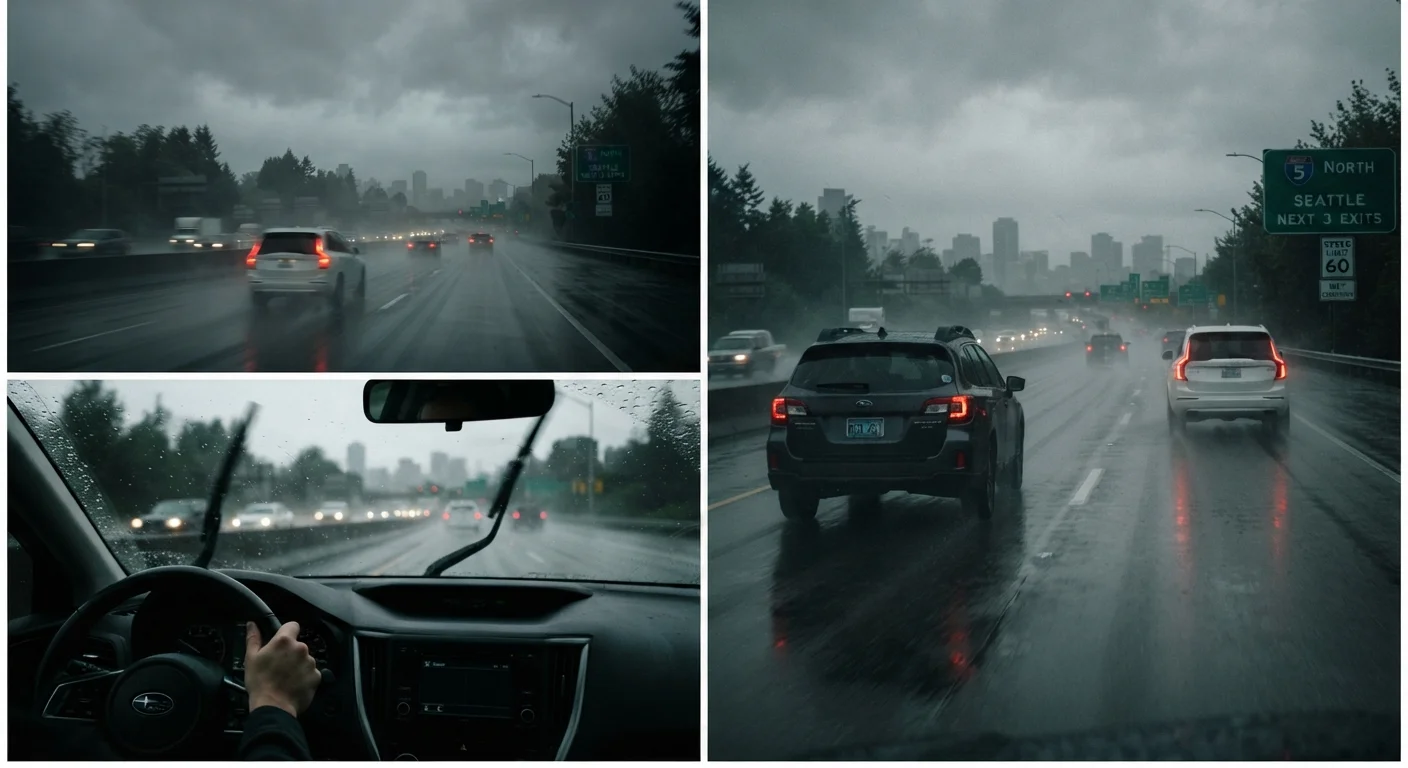
Why Bad Weather Demands a Different Mindset
Most driving skills are built for predictable, dry conditions. Rain, snow, fog, and ice don't just make the road harder to navigate — they change the physics of what your vehicle can do. Tires lose grip. Stopping distances stretch. Visibility narrows. The margin for error shrinks, often faster than drivers expect.
Confidence behind the wheel is valuable, but in bad weather it needs to come from preparation and adjusted technique — not from assuming your car will handle whatever the road throws at it. Even vehicles with all-wheel drive or advanced traction control have limits, and those features help with acceleration and handling but do not shorten stopping distances on ice the way many drivers assume.
The good habits that matter in any condition — smooth inputs, attentive scanning, predictable behavior — become life-saving in poor weather. See our guide to behind-the-wheel habits for the broader picture of what experienced drivers do consistently.
Check Your Vehicle Before Bad Weather Arrives
Tread depth, wiper blade condition, and working headlights are not just maintenance details — they directly affect how your car handles in wet or icy conditions. See our pre-trip safety checklist for a quick rundown before you head out.
Before you get into the steps, run through your prerequisites and gather what you'll need:
What you will need
Step-by-Step: Driving Safely in Rain, Snow, Fog, and Ice
Each of the four main bad-weather conditions has its own specific challenges, but the core adjustments follow a consistent logic: slow down, increase space, maximize visibility, and stay smooth. The steps below apply across all four — with notes on where one condition calls for a different approach than another.
Slow down before you feel like you need to
The posted speed limit reflects safe conditions on a clear, dry road. In rain, snow, fog, or ice, that number no longer applies in any practical sense. Reduce your speed significantly — by 10 mph or more depending on conditions — before the road demands it. Your tires need far more distance to stop on a wet or slick surface. On ice, stopping distances can increase by six to ten times compared to dry pavement.
Speed reduction is also required by law in many states when visibility or road conditions are hazardous. See our guide to posted, statutory, and advisory speed limits for how these rules work across U.S. roads.
Increase your following distance
The standard three-second following distance assumes dry roads. In rain, extend that to at least four seconds. In snow or slush, aim for six seconds or more. On ice, eight to ten seconds is a reasonable starting point — and even that may not be enough at higher speeds. Count seconds by picking a fixed marker on the road and timing how long after the car ahead passes it before you reach the same spot.
Maintaining extra space is one of the easiest, highest-impact adjustments you can make. It costs nothing and gives you more time to react to what the car in front does.
Adjust your headlights for the condition
In rain and snow, turn on your low-beam headlights even during daylight hours. Many states require this by law when wipers are in use. In fog — whether ground-level or elevated — use low beams only. High beams scatter off suspended water droplets and actually reduce how far you can see. If your vehicle has dedicated fog lights, use them in thick fog.
Never drive with no lights or parking lights only. Other drivers need to see you, not just the other way around.
Brake and steer smoothly — no sharp inputs
On slick surfaces, abrupt steering, braking, or acceleration breaks the balance between your tires and the road. All inputs should be gradual. Brake early and gently. Steer in steady, measured movements. If you need to slow down for a turn, do most of your braking in a straight line before the curve, not during it.
If your vehicle has anti-lock brakes (ABS), apply firm, steady pressure to the pedal and let the system pulse the brakes — do not pump the pedal. If your vehicle does not have ABS, apply gentle, progressive pressure to avoid wheel lockup.
Handle a skid without panicking
A rear-wheel skid (the back of the car slides out) is corrected by steering gently in the direction the rear is sliding — often called "steering into the skid" — and easing off the accelerator without braking hard. A front-wheel skid (the car pushes wide through a turn) is corrected by easing off the gas and letting the front tires regain grip before steering again. In both cases, smooth and calm wins over quick and jerky.
The instinct to brake hard during a skid is natural but counterproductive. Practice awareness of what your car is doing and respond with minimal inputs.
Know when to pull over and wait
If conditions deteriorate beyond your ability to drive safely — blinding snow squalls, dense fog with near-zero visibility, or roads that have turned to solid ice — the right move is to stop. Signal and move to a safe area off the road. Turn on your hazard lights. Stay in the vehicle with your seatbelt on if you're on a highway. If you exit, move well away from traffic lanes.
Check weather reports before long trips and be willing to adjust your departure time. No schedule or appointment is worth a preventable crash.
[important_callout]Black Ice Has No Warning Signs
Black ice forms when road temperature drops below freezing even if air temperature feels mild, and it looks like a wet patch of pavement. Bridges, overpasses, and shaded stretches freeze first. Treat any dark, shiny-looking road surface with maximum caution when temperatures are at or near freezing.
For more on how to adapt your approach based on road type — highway versus city — see our highway vs. city driving guide. Bad weather adds another layer to those distinctions.
The content on this site is for informational purposes only and is not a substitute for professional advice. Always consult a qualified professional for guidance specific to your situation.