

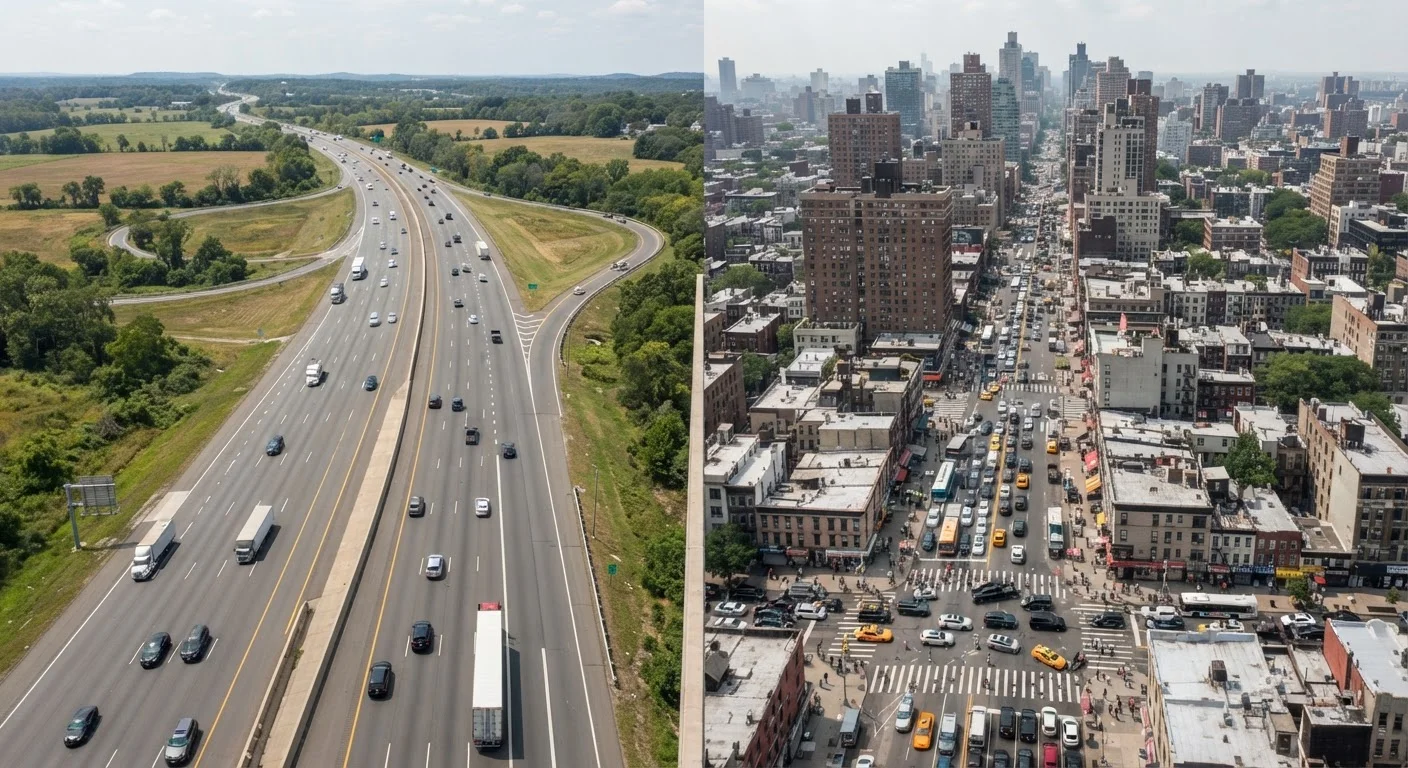
Option A
Highway Driving
High-speed, sustained focus on open roads.
Best for: Drivers covering long distances who need to manage fatigue, lane discipline, and safe following distances at speed.
Option B
City Driving
Low-speed, high-complexity urban navigation.
Best for: Drivers navigating dense traffic, frequent stops, pedestrians, cyclists, and unpredictable intersection situations.
Why These Two Environments Demand Different Skills
Most licensed drivers operate in both environments regularly, yet few consciously adjust their technique when the setting changes. That gap is where risk builds. A driver carrying highway habits into city traffic — or urban habits onto an interstate — is working with the wrong mental toolkit for their surroundings.
Highway driving operates at higher sustained speeds with fewer obstacles but demands attention over long stretches where fatigue and complacency become real hazards. City driving happens at lower speeds but with far more variables per mile: traffic signals, crosswalks, cyclists, double-parked vehicles, and intersections with competing right-of-way claims. For a deeper look at intersection dynamics, see how right-of-way works at every type of intersection.
Understanding the distinct demands of each setting — and deliberately switching between them — is one of the most practical things any driver can do to stay safer.
| Criterion | Highway Driving | City Driving |
|---|---|---|
| Typical speed | 55–80 mph | 15–45 mph |
| Primary hazard | Speed, fatigue, merging | Pedestrians, cyclists, signals |
| Recommended following distance | 3+ seconds (more in poor conditions) | 2–3 seconds, adjusting often |
| Scanning focus | Long horizon, lane changes | Near foreground, intersections, sidewalks |
| Speed limit variability | Generally consistent per road | Changes frequently block-to-block |
| Fatigue risk | High on long trips | Lower but stress accumulates |
| Decision frequency | Lower, but consequences are faster | Very high per mile traveled |
Highway Driving: Managing Speed, Distance, and Attention
The most underestimated hazard on a highway is not speed itself — it is the reduced reaction time that speed creates. At 70 mph, your vehicle covers roughly 103 feet per second. The standard guidance of maintaining a three-second following gap is a minimum, not a target; under wet or reduced-visibility conditions, that gap should expand significantly. Driving in bad weather covers when and how to extend that buffer.
Lane discipline matters more than many drivers realize. On multi-lane highways, the left lane is generally intended for passing, not cruising. Staying in it unnecessarily creates hazards by forcing faster traffic into unpredictable maneuvers around you. Signal early, check mirrors and blind spots, and complete lane changes decisively.
Fatigue is the highway-specific hazard that has no city equivalent at the same scale. Long unbroken stretches of road reduce stimulation, and attention degrades without the driver noticing. Stopping every two hours or so to walk and reset is widely recommended by highway safety authorities. Night driving compounds fatigue risk further and warrants its own approach.
~56%
Fatal crashes occurring on rural roads and highways
According to NHTSA data, rural roads — including highways — account for a disproportionate share of fatal crashes relative to total vehicle miles traveled.
103 ft/sec
Distance covered at 70 mph per second
At highway speeds, the gap between a safe stop and a collision can close in fractions of a second, underscoring the importance of generous following distances.
~76%
Pedestrian fatalities occurring in urban areas
NHTSA pedestrian safety data consistently shows the vast majority of pedestrian traffic deaths occur in urban settings, where foot traffic and vehicle interaction are highest.
City Driving: Scanning, Anticipating, and Slowing Down
Speed in the city is rarely the challenge — complexity is. Urban streets compress decision-making: a cyclist may appear from a bike lane, a pedestrian may step off the curb between signals, or a delivery vehicle may abruptly block your lane. Effective city driving means scanning farther ahead than feels instinctive, using your mirrors frequently, and staying aware of what is happening in adjacent lanes and on sidewalks simultaneously.
Smooth, early braking is one of the most protective habits in stop-and-go traffic. Anticipating a red light or slowing traffic ahead — rather than reacting late — gives the driver behind you more time to respond and dramatically reduces rear-end collision risk. Behind-the-wheel habits that make roads safer for everyone explores this and other low-cost, high-impact practices in detail.
Speed limits in urban areas often change within a few blocks. School zones, hospital zones, and residential streets carry lower statutory limits that may not always be prominently posted. Understanding posted, statutory, and advisory speed limits helps clarify those distinctions.
Making the Switch: Resetting Between Environments
The transition between highway and city driving — typically at an off-ramp — is one of the most consistently hazardous moments in a drive. After sustained highway speeds, 35 mph feels slow, but your perception of speed has recalibrated upward. Checking your actual speedometer rather than relying on feel is a simple but genuinely useful habit at every off-ramp.
Drivers of all experience levels benefit from a brief mental reset at the transition point: consciously noting the change in environment, recalibrating following distance, and shifting your scanning pattern from the long horizon to the immediate foreground. Driver safety across different ages and experience levels is worth reading for perspective on how these transitions affect newer drivers differently than experienced ones.
Your vehicle's condition also plays a role that spans both environments. Tires, brakes, and mirrors in good working order are the mechanical baseline for handling demands in either setting. The car maintenance hub is a practical resource for staying on top of those basics.
This article provides general driver education and safety information. Always follow applicable traffic laws in your state and consult your state's driver handbook for jurisdiction-specific rules.
The content on this site is for informational purposes only and is not a substitute for professional advice. Always consult a qualified professional for guidance specific to your situation.