

The Core Idea Behind Right-of-Way
Right-of-way isn't a privilege you own — it's something you're given by traffic law and road conditions. No driver can legally take the right-of-way; you can only yield it. That distinction matters because it shapes how every intersection encounter should be handled.
The rules below apply to U.S. roadways generally, but state laws can vary in specifics. Always check your own state's driver handbook for the exact wording. See the driving rules most Americans overlook for a broader foundation.
| Most common right-of-way rule at 4-way stops | First to stop, first to go; ties yield to the right |
| Roundabout priority | Yield to vehicles already inside the circle |
| Pedestrian right-of-way | Generally applies at all marked and unmarked crosswalks once pedestrian enters road lawfully (Varies by state law) |
| Flashing red signal | Treat as a stop sign (Uniform Vehicle Code, adopted across U.S. states) |
| T-intersection rule | Driver on the dead-end road yields to all through traffic |
Four-Way Stops
Four-way stops follow a clear priority sequence that most drivers learn — and many forget under pressure.
- First to stop, first to go. The vehicle that came to a complete stop first has the right-of-way.
- Tie goes to the right. When two vehicles arrive at the same time, the driver on the left yields to the driver on the right.
- Straight traffic before turning traffic. If arrival times and positions are still equal, a vehicle going straight takes priority over one turning left.
- Right turn before left turn. When two vehicles across from each other arrive simultaneously, the one turning right generally goes before the one turning left.
If you're ever unsure, make eye contact, use a brief hand wave to communicate intent, and only proceed when you're certain the other driver has acknowledged your movement.
Two-Way Stops and Uncontrolled Intersections
At a two-way stop, only traffic on one road has a stop sign. The cross-street traffic moves freely and always has the right-of-way over stopped vehicles. A common mistake is assuming that a gap in traffic gives you a guaranteed right-of-way — it doesn't. You yield until it's clearly safe.
At an uncontrolled intersection (no signs or signals), the same first-to-arrive, then yield-to-the-right logic from four-way stops applies. Approach slowly enough to make that judgment accurately.
Right-of-Way
The legal right of a driver, cyclist, or pedestrian to proceed through a space before others. It is granted by law or road conditions — never something a driver can claim unilaterally.
Yield
To slow down or stop and allow other traffic or pedestrians to pass before you proceed. A yield sign makes this obligation explicit, but the duty to yield can exist without one.
Uncontrolled Intersection
An intersection with no traffic signs or signals governing movement. Drivers must rely on general right-of-way rules — typically first to arrive, then yield to the right.
Roundabout
A circular, one-way road junction where entering vehicles yield to traffic already circulating inside the ring. Designed to reduce conflict points compared to traditional intersections.
For more on the maneuvers that cause the most confusion at intersections, see where most drivers go wrong with merging and yielding.
Traffic Signals, Roundabouts, and T-Intersections
Traffic signals assign right-of-way directly. A green light does not guarantee the intersection is clear — you're still required to check before entering. A flashing red functions as a stop sign; a flashing yellow means proceed with caution.
Roundabouts follow one simple rule: yield to traffic already inside the circle. Enter only when there's a safe gap. Do not stop inside the roundabout unless traffic compels it. Signal your exit.
T-intersections (where a road dead-ends into another) require the driver on the dead-end road to yield to all traffic on the through road, regardless of which direction they intend to turn.
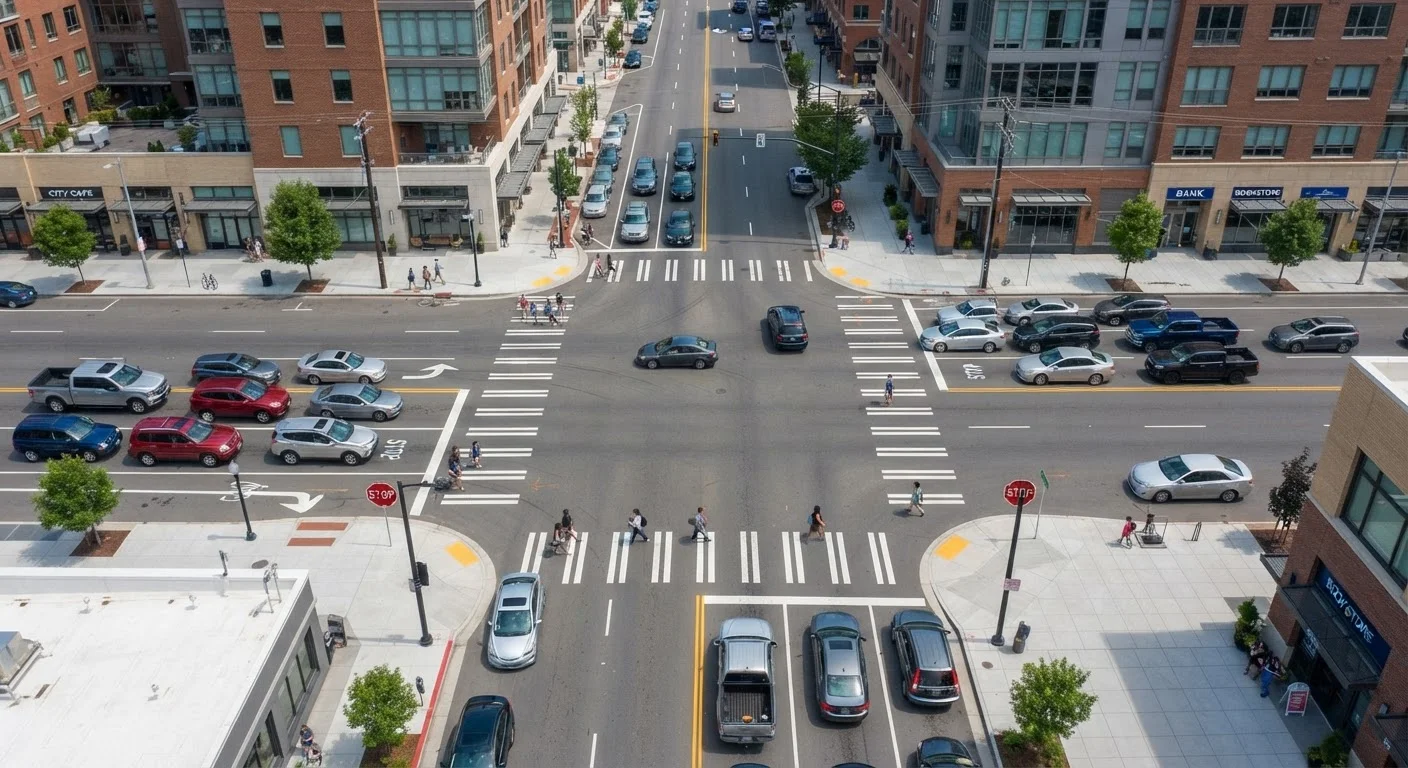
Pedestrians and cyclists are part of every intersection equation. At crosswalks — marked or unmarked — pedestrians generally have the right-of-way once they've entered the road lawfully. Cyclists may be treated as vehicles in many states. Learn how to share the road safely with vulnerable users to avoid the most common conflicts.
Applying these rules consistently is one of the behind-the-wheel habits that make roads safer for everyone.
The content on this site is for informational purposes only and is not a substitute for professional advice. Always consult a qualified professional for guidance specific to your situation.