

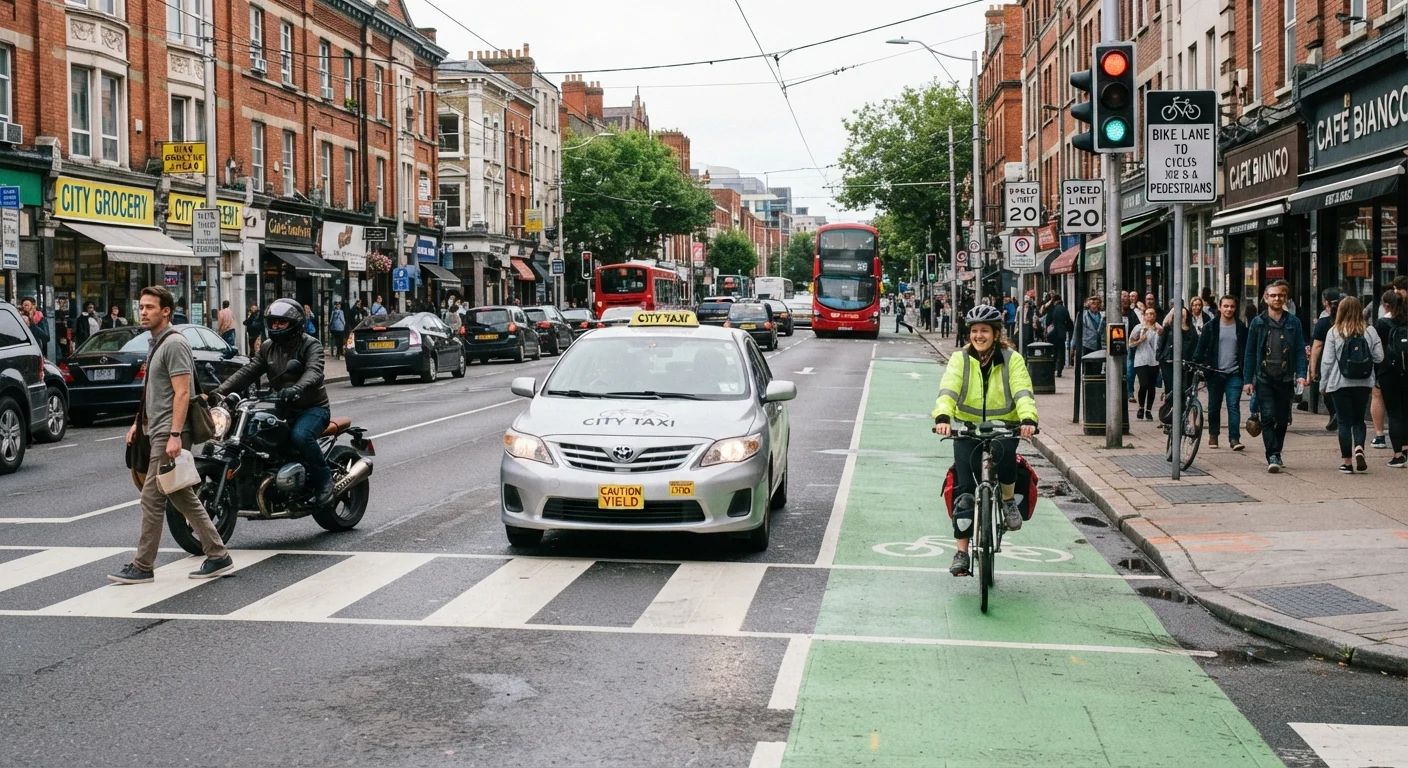
Why Vulnerable Road Users Deserve Extra Attention
When a car collides with another car, both vehicles absorb energy and both drivers have crumple zones, airbags, and seatbelts working for them. None of that protection exists for a pedestrian, a cyclist, or a motorcyclist. The physics is unforgiving: a person struck at 30 mph faces a dramatically higher chance of fatal injury than one struck at 20 mph. That gap in protection is why traffic safety researchers and road safety agencies consistently classify these groups as vulnerable road users — and why drivers carry a heavier burden of care around them.
This isn't about blame. Most drivers want to share the road safely. The challenge is that vehicles create blind spots, speed compresses reaction time, and familiar routes can breed inattention. Building a few deliberate habits closes that gap significantly. For a broader foundation on safe driving principles, see our evidence-backed driving habits guide.
Sharing the Road With Pedestrians
Pedestrians have the right-of-way at marked crosswalks in all 50 states, and in many states drivers must also yield at unmarked crosswalks — the implied crossing point at any intersection. A few specific situations catch drivers off guard:
- Stopped vehicles ahead: If a car in an adjacent lane has stopped near a crosswalk, slow down. A pedestrian may be crossing in front of that stopped car and stepping into your path.
- School zones and residential streets: Children move unpredictably and may enter the roadway without warning. Posted school zone speeds are legal limits, not suggestions.
- Distracted pedestrians: A pedestrian wearing headphones or looking at a phone may not notice your vehicle. Don't rely on them to look up in time — that responsibility falls on the driver.
At intersections, even when you have a green light, scan for pedestrians who may be finishing a crossing before accelerating. Understanding how right-of-way works at intersections helps you anticipate who should yield in every scenario.
The 'Stopped Car' Warning Sign
If a vehicle in a lane next to you has stopped near an intersection or mid-block, treat it as a signal that a pedestrian may be crossing. Slow down before you draw level with that stopped car, and be prepared to stop. This situation accounts for a notable share of pedestrian injuries involving multiple lanes of traffic.
Passing Cyclists Safely
Cyclists are legally permitted to ride on most public roads, and in many jurisdictions they're entitled to use the full lane when conditions require it — for example, when the lane is too narrow to share side-by-side. The nationally recognized standard, adopted into law in most states, is a minimum three-foot buffer when a driver passes a cyclist. In some states that minimum is four feet.
Practical tips for passing cyclists:
- Wait until you have enough room in the oncoming lane to give the full required clearance before passing — treat it like passing a slow-moving vehicle.
- Do not honk to rush a cyclist out of your path. It startles them and can cause a crash.
- After passing, don't cut back into the lane sharply. Merge back gradually once the cyclist is clearly behind you.
- At intersections, watch for cyclists approaching on your right before turning right — the classic right hook collision pattern.
Give cyclists the legally required minimum clearance — at least three feet — every time you pass.
Cyclists hit by passing vehicles are frequently injured by the vehicle's mirror or side panel, not even the wheel. Consistent clearance prevents the catch-all category of close-pass crashes and meets legal requirements in most states.
Scan intersections twice for motorcycles before turning left across oncoming traffic.
The brain tends to search for car-sized threats. A second, deliberate scan after the first specifically looking for motorcycles counteracts this perceptual gap. This single habit addresses the single most common multi-vehicle motorcycle crash pattern.
Yield to pedestrians at all crosswalks — marked or unmarked — before proceeding.
Pedestrian fatalities disproportionately occur at or near intersections. Drivers who yield consistently reduce risk far more effectively than those who yield only when a pedestrian is already in their path.
Increase following distance to at least four seconds behind motorcycles.
Motorcycles can decelerate faster than cars, and their brake lights may be harder to read in bright daylight. More following distance gives you reaction time if the motorcyclist stops suddenly or swerves.
Check your right mirror before right turns for cyclists approaching from behind.
The right-hook crash — a turning car cutting off a cyclist moving straight — is one of the most common urban cycling crash types. A dedicated mirror check before turning right takes under two seconds and prevents it.
Spotting and Sharing the Road With Motorcycles
Motorcycles are faster and more maneuverable than bicycles, but they're easier to miss than a car because their profile is so narrow. According to the National Highway Traffic Safety Administration (NHTSA), a significant share of multi-vehicle motorcycle crashes involve the other driver failing to see the motorcyclist. This isn't carelessness — it's a perceptual limitation called inattentional blindness, where the brain filters out unexpected or small objects. Knowing this exists is the first step to counteracting it.
Key habits for driving near motorcycles:
- Check twice at intersections. The most common crash type is a driver turning left across the path of an oncoming motorcycle. Scan, then scan again before turning.
- Maintain a larger following distance. A motorcyclist can stop faster than a car on a good surface. Rear-ending a motorcycle is catastrophically dangerous for the rider.
- Never share a lane. A motorcycle is entitled to a full lane. Don't squeeze past one within the same lane, even if there appears to be room.
- Adjust for wind and road debris. Motorcyclists may swerve to avoid hazards or compensate for crosswind. Give them room to maneuver.
~14%
Share of traffic fatalities that are motorcyclists
According to NHTSA data, motorcyclists account for a disproportionately high share of road fatalities relative to vehicle miles traveled.
3 feet
Minimum passing clearance for cyclists in most U.S. states
Most states have codified a three-foot minimum passing distance law; some states require four feet when passing bicyclists.
If you're working on overall risk awareness behind the wheel, our practical foundation for new drivers covers situational awareness strategies that apply at every experience level.
Quick Actions You Can Take Starting Today
Most of these habits cost nothing and take no extra time — they're adjustments to how you already drive. Even experienced drivers benefit from a regular reset on awareness. See also our guide on merging and yielding for how these habits apply in lane-change scenarios too.
The content on this site is for informational purposes only and is not a substitute for professional advice. Always consult a qualified professional for guidance specific to your situation.