

The Physics of a Crash in Plain Terms
When your car stops suddenly — whether from braking or a collision — your body doesn't stop at the same time. That's Newton's first law at work: objects in motion stay in motion. Your vehicle decelerates rapidly; your body wants to keep traveling at whatever speed you were going.
In a 30 mph crash, an unbelted occupant continues moving forward at 30 mph until something stops them — usually the steering wheel, dashboard, or windshield. The forces involved are substantial. A 160-pound person in a 30 mph crash exerts roughly 4,800 pounds of force on impact. That's the problem restraint systems are designed to solve.
A seatbelt's job is to make your body and the vehicle decelerate together. By anchoring you to the seat, the belt spreads that deceleration over a longer period and across broader, stronger areas of the body — the chest, pelvis, and shoulder — rather than concentrating it on your face or skull.
~45%
Of crash fatalities among unbelted occupants
According to NHTSA data, roughly 45% of passenger vehicle occupant fatalities in recent years involved people who were not wearing a seatbelt.
30 ms
Typical airbag deployment time
Frontal airbags generally deploy within 20–30 milliseconds of a qualifying collision event, according to vehicle safety engineers.
3-point
Belt design standard in U.S. vehicles since 1968
Federal Motor Vehicle Safety Standards have required three-point seatbelts in front outboard seating positions since 1968.
How Seatbelts Work — and Why Fit Matters
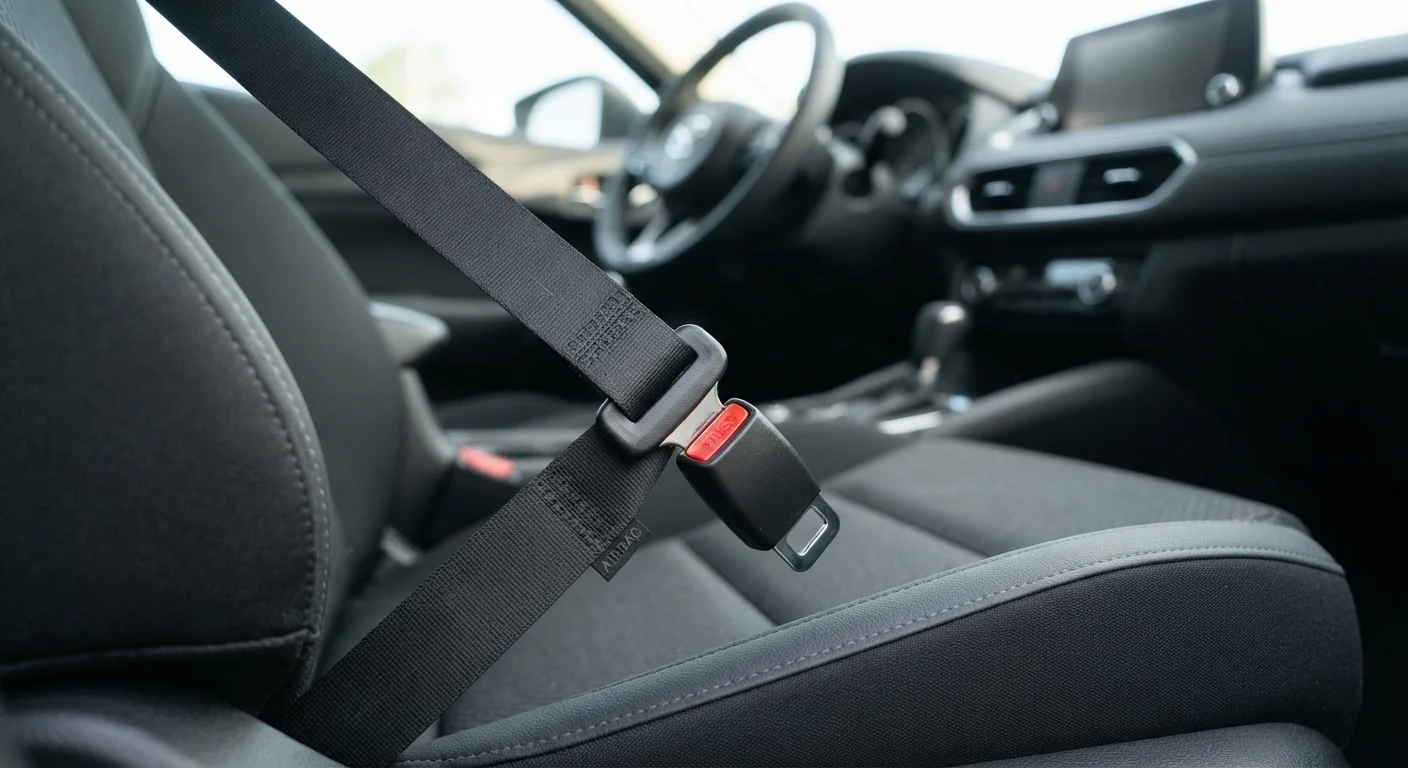
Modern seatbelts use a three-point design: one strap crosses the shoulder and chest, another lies across the hips. This configuration is deliberate. The shoulder strap engages the ribcage and collarbone — structures built to handle significant load. The lap belt anchors the pelvis, the body's center of mass.
Fit is not optional. A shoulder belt worn behind the back or under the arm removes the protection the chest strap provides and can concentrate force on the abdomen, causing internal injury. The lap portion should lie flat across the hip bones, not ride up onto the soft stomach area.
Most modern vehicles also include a pretensioner — a device that tightens the belt in the first fraction of a second of a crash — and a load limiter that allows the belt to give slightly to prevent chest injuries at very high forces. These are standard engineering features, not options.
Check the Belt Path Every Ride
Before pulling out of a parking spot, take two seconds to confirm the shoulder belt lies across the center of your chest — not your neck — and the lap belt sits across your hip bones. Repositioning the seat or the belt anchor height can make a significant difference in how well the belt performs if you need it.
What Airbags Actually Do
Airbags are a second layer of protection, not a first. Sensors in the vehicle detect a rapid deceleration that signals a collision and trigger the airbag inflator. The bag fills with nitrogen gas and deploys in roughly 20 to 30 milliseconds — well before your body has moved far from its starting position.
The deployed bag creates a cushioned surface between your face or chest and hard interior surfaces. It then vents almost immediately so it doesn't trap or suffocate an occupant. The entire event — inflate, cushion, deflate — takes less than a second.
Side curtain airbags, knee airbags, and rear-seat airbags extend this protection to more collision types and more occupants. However, all of them assume the occupant is belted and in the correct seating position. An unbelted occupant can be positioned anywhere in the cabin at the moment of deployment, making the geometry of airbag protection unpredictable.
For more on the habits that support these systems, see our guide to behind-the-wheel safety habits.
Common Mistakes That Reduce Protection
Several behaviors undermine what restraint systems can do:
- Riding too close to the wheel or dashboard. Airbags need space to deploy. NHTSA recommends at least 10 inches between the chest and the steering wheel.
- Wearing the shoulder belt under the arm. This redirects force to the ribs and abdomen and increases the risk of internal injury.
- Leaving children in adult seatbelts too soon. A standard three-point belt is designed for an adult body. Children need appropriately sized child restraints or booster seats until the belt fits correctly across their frame.
- Assuming airbags alone are enough. Airbags in some crash types — rear-end collisions, minor frontal impacts — may not deploy at all. The seatbelt is the primary restraint in every crash scenario.
Vehicle maintenance also plays a supporting role. Tires in poor condition can affect how a vehicle responds before and during a crash event — see our overview of tire pressure and safety for more.
Frequently Asked Questions
Not effectively. Airbags are engineered to work with a seatbelt already holding you in position. Without a seatbelt, your body may move forward too fast for the airbag to provide proper protection — and the bag itself can cause serious injury on impact.
Airbags typically inflate within 20 to 30 milliseconds of a qualifying collision — faster than the blink of an eye. They begin deflating almost immediately to cushion the occupant's forward movement, so by the time your body reaches the bag, it's already softening.
The lap belt should sit low across the hips and pelvis, not across the abdomen. The shoulder belt should cross the chest between the breasts. Pregnant drivers should consult their healthcare provider for specific guidance on seatbelt positioning.
A seatbelt can cause bruising or, in severe collisions, soft-tissue injuries — but these are far less serious than what occurs without one. The belt is absorbing and redirecting forces that would otherwise strike the steering wheel, dashboard, or windshield.
Yes. The National Highway Traffic Safety Administration (NHTSA) recommends maintaining at least 10 inches between your chest and the steering wheel. Sitting too close means the airbag has less room to deploy safely and can cause more harm than protection.
The content on this site is for informational purposes only and is not a substitute for professional advice. Always consult a qualified professional for guidance specific to your situation.