

Why That Little Number Matters
Most drivers glance at their tires, see they look round, and move on. But a tire can lose significant pressure before it visibly looks flat — and at that point, it's already affecting how your car handles, how quickly the tread wears, and how much fuel you're burning.
Tire pressure is the single easiest maintenance item to check, requires no tools beyond a basic gauge, and takes under five minutes. Yet the National Highway Traffic Safety Administration (NHTSA) has consistently found that a large share of vehicles on U.S. roads are running on tires that are meaningfully under- or overinflated. The downstream effects — reduced braking performance, increased blowout risk, faster tread degradation — are entirely avoidable.
This is general vehicle maintenance information. For any concerns about your specific vehicle's condition, consult a qualified mechanic.
~1 PSI
Pressure lost per 10°F temperature drop
A widely cited rule of thumb from tire industry and DOT guidance; actual change varies slightly by tire volume.
0.5%–3%
Fuel economy improvement from proper inflation
The U.S. Department of Energy estimates underinflated tires can lower gas mileage by roughly 0.2% per 1 PSI drop below recommended levels.
~25%
Below recommended PSI when TPMS light activates
Federal regulations require TPMS systems to alert drivers when pressure drops 25% below the vehicle placard recommendation.
Where to Find the Right PSI for Your Vehicle
The most common misconception about tire pressure is reading the maximum PSI stamped on the tire's sidewall and treating it as the target. That number is the tire's structural limit — the highest pressure it can safely hold — not what you should be driving on.
Your vehicle's recommended PSI is printed on a sticker inside the driver-side door jamb. It's also in your owner's manual. Front and rear tires sometimes have different recommended pressures, so check both. If you've replaced your tires with a different size or type than the originals, speak with a tire professional about the correct pressure for the new setup.
Store a Gauge in Your Glove Box
A small digital or stick-style tire pressure gauge costs just a few dollars and is far more reliable than the gauges attached to most gas station air hoses. Keeping one in your vehicle means you can check pressure anywhere, anytime — no trip to the gas station required. Make it part of a monthly habit, and pair it with a quick visual inspection of each tire.
The Real Risks of Getting It Wrong
Underinflation is the more common problem and the more dangerous one. When a tire is underinflated, more of its sidewall flexes with each rotation. That extra flex generates heat, which is one of the primary causes of tire blowouts. An underinflated tire also has a larger, softer contact patch with the road, which reduces steering precision and extends braking distances — particularly on wet pavement.
Underinflation also causes the outer edges of the tread to wear faster than the center. If you're seeing wear patterns like this, reading your tread wear can tell you a lot about what's happening with your tires and alignment.
Overinflation has its own problems. A tire inflated above the recommended PSI becomes rigid, reducing the contact patch to a narrow strip in the center of the tread. That centered strip wears faster, and the rigid tire transmits road imperfections more harshly — reducing ride comfort and, more importantly, grip during sudden maneuvers.
How to Check Tire Pressure Correctly
For an accurate reading, check your tires when they are cold — meaning the vehicle has been parked for at least three hours or driven fewer than a mile. Driving heats the air inside the tire, which increases pressure and gives a reading that's typically 4–6 PSI higher than the true resting pressure.
- Remove the small cap from the tire's valve stem.
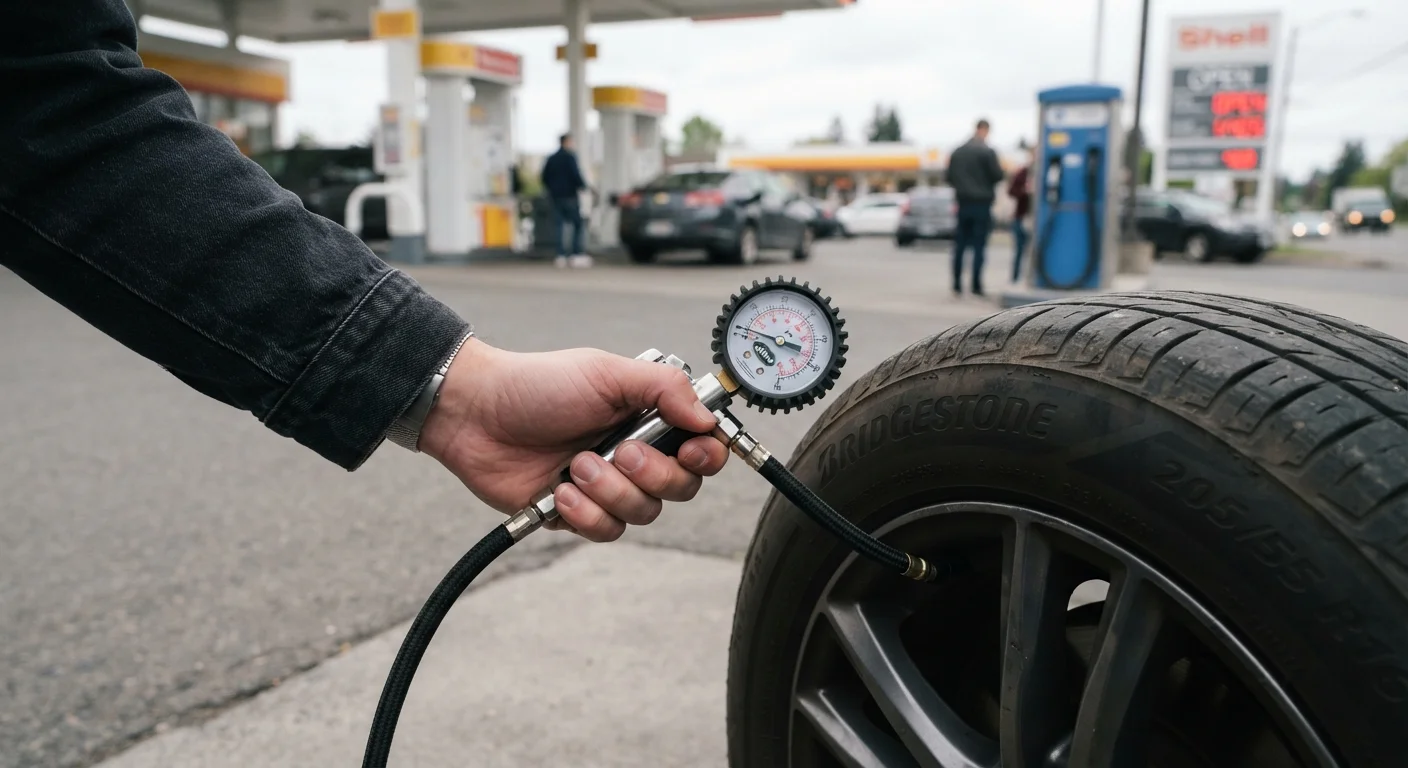
- Press your gauge firmly onto the valve stem until the hissing stops.
- Read the PSI on the gauge display or stick gauge.
- Compare it to the recommended PSI on your door jamb sticker.
- Add air if low, or release small amounts if overinflated, then recheck.
- Replace the valve cap when done.
A basic digital or stick-style pressure gauge is inexpensive and far more reliable than the built-in gauges on many gas station air compressors. Keeping one in your glove box makes monthly checks easy. For context on how tire care fits into broader vehicle upkeep, see our complete car maintenance overview.
Temperature, Seasons, and Knowing When to Check
Tire pressure isn't static — it changes with temperature. Air contracts in cold weather and expands in heat. As a general guideline, pressure drops approximately 1 PSI for every 10°F decrease in outside temperature. A tire that reads perfectly in September may be 5–6 PSI low by January without a single slow leak.
This makes fall and early winter the most important times to be attentive. It's also worth checking after any sudden temperature change of 20°F or more. Most modern vehicles (2008 and newer) are equipped with a Tire Pressure Monitoring System (TPMS), which triggers a dashboard warning light when pressure falls too low. Treat that light as a minimum alert — by the time it activates, your tires are already meaningfully underinflated. Regular manual checks remain worthwhile even with TPMS.
Proper tire pressure is one of the simplest elements of a pre-trip safety check, especially before long highway drives where tire heat and sustained loads matter most.
Frequently Asked Questions
A monthly check is a practical habit for most drivers. You should also check before long road trips and whenever temperatures shift dramatically — a cold snap can drop pressure enough to matter. Don't rely solely on your TPMS warning light, which typically activates only after pressure is already meaningfully low.
Look at the sticker on your driver-side door jamb — it lists the manufacturer's recommended PSI for your specific vehicle. Do not use the maximum PSI stamped on the tire sidewall; that figure is the tire's structural limit, not a target for everyday driving.
Yes, to a meaningful degree. The U.S. Department of Energy has noted that underinflated tires increase rolling resistance, which requires more fuel to maintain speed. Keeping tires properly inflated is one of the simplest ways to avoid unnecessary fuel waste.
Air contracts when it cools, reducing the pressure it exerts inside the tire. As a general rule of thumb, pressure drops approximately 1 PSI for every 10°F drop in temperature. This means tires that were properly inflated in summer may read low on a cold winter morning.
Yes — most gas stations have air compressors you can use. Bring your own tire pressure gauge for accuracy, since station gauges can be unreliable. Check your tires before you start driving so you get a cold reading, which is the most accurate baseline.
TPMS stands for Tire Pressure Monitoring System. The warning light means at least one tire has dropped below a threshold — typically 25% below the recommended PSI. That level of underinflation already affects handling and wear, so address it promptly rather than waiting for the next scheduled check.
The content on this site is for informational purposes only and is not a substitute for professional advice. Always consult a qualified professional for guidance specific to your situation.