

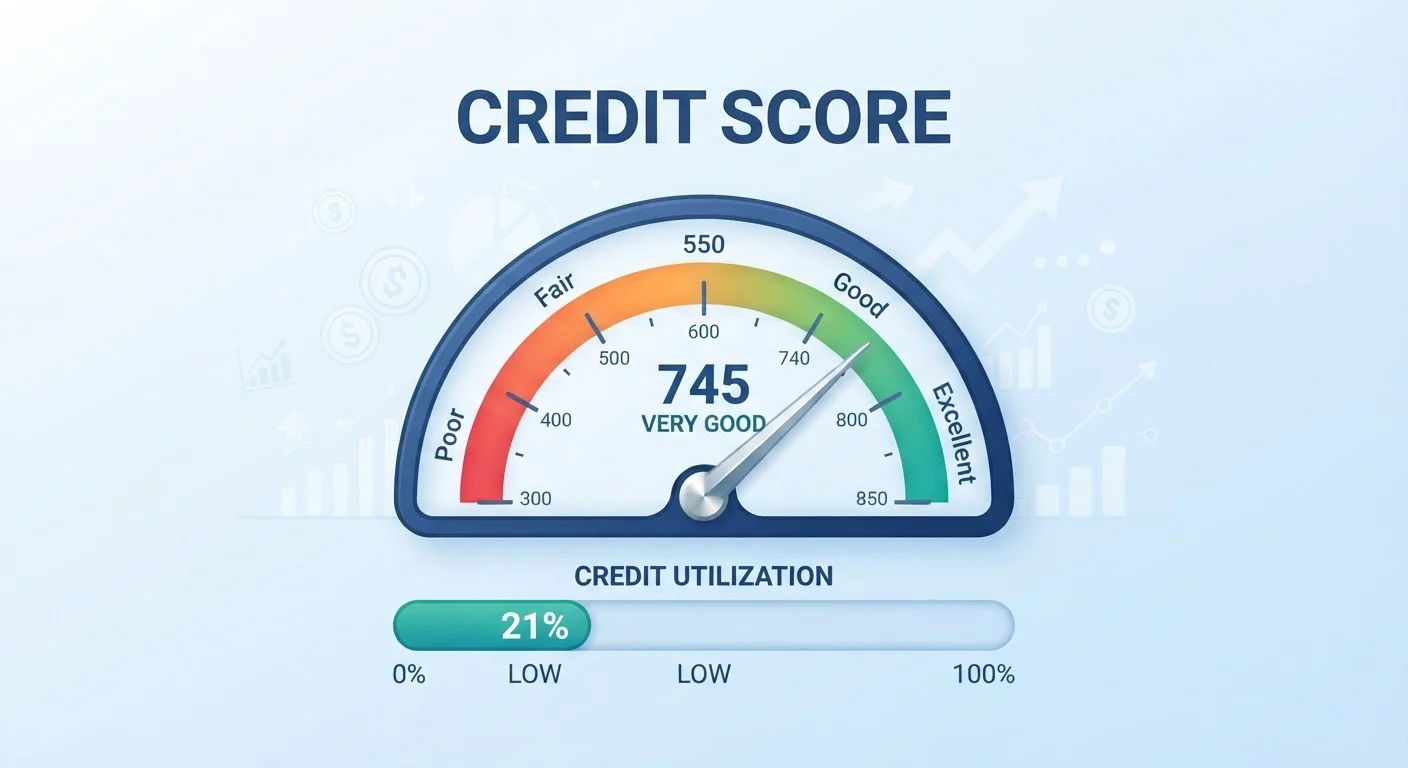
Why Utilization Carries So Much Weight
When lenders review your creditworthiness, they're asking one core question: are you likely to repay what you borrow? Your credit score is designed to help answer that. To understand how your score is built, see our full breakdown of what a credit score actually measures.
Within that score, payment history is the dominant factor — but credit utilization runs a close second, making up roughly 30% of a standard FICO score. That's a significant share of your score tied directly to how much of your available credit you're drawing on at any given time.
The logic behind this weighting is straightforward: borrowers who consistently use a large portion of their available credit are statistically more likely to have trouble managing debt. A high utilization ratio signals financial stress to lenders, even if you're making every payment on time.
~30%
Share of FICO score from credit utilization
According to FICO's published scoring factor breakdown, amounts owed — which includes utilization — accounts for approximately 30% of a standard FICO score.
<10%
Utilization common among top scorers
Analyses of consumers with scores above 800 consistently show average revolving utilization rates in the single digits, according to published credit bureau research.
30%
Widely cited utilization guideline
Consumer financial education resources, including those from major credit bureaus, frequently cite keeping utilization below 30% as a general rule of thumb for maintaining a healthy score.
How the Ratio Is Calculated — and When It's Reported
The math itself is simple: divide your current revolving balance by your total revolving credit limit, then multiply by 100 to get a percentage. If your combined credit card balances total $2,500 and your combined limits total $10,000, your utilization is 25%.
What trips many people up is when that balance is reported. Credit card issuers typically report your account balance to the credit bureaus on or around your statement closing date — not when you actually pay your bill. This means you could pay your balance in full every month and still show a higher utilization than you'd expect, simply because the statement balance was reported before your payment posted.
If you want to lower the balance that gets reported, consider making a payment before your statement closing date, not just before the payment due date. These two dates are different, and understanding the gap between them is one of the more practical utilization management strategies available.
Common Utilization Mistakes to Avoid
Several behaviors can quietly push utilization higher without feeling like obvious financial missteps. One of the most common: putting a large expense on a single card. Even if you plan to pay it off immediately, if the charge is reported before your payment clears, it can temporarily spike that card's individual utilization.
Another frequent mistake is closing credit cards you no longer use. It feels tidy, but removing a card eliminates its credit limit from your available total — which mechanically raises your utilization ratio on remaining balances. For a deeper look at behaviors that erode your score gradually, see our guide on habits that quietly damage your credit over time.
A third misconception — addressed in detail among credit score myths worth dispelling — is that carrying a small balance helps your score. It doesn't. Paying your balance in full is better for both your score and your finances.
Time Your Payments Strategically
If you want to lower the balance your card issuer reports to the credit bureaus, make a payment before your statement closing date — not just before your payment due date. These are two separate dates on your billing cycle. Paying down your balance before the statement closes means a lower balance gets reported, which translates directly to lower utilization on your credit report.
Practical Ways to Lower Your Utilization
The most direct path is simply paying down balances. Because utilization updates each billing cycle, even one month of lower balances can produce a measurable score improvement. Prioritize cards where your balance is closest to the limit, since per-card utilization matters alongside your overall ratio.
If paying down balances quickly isn't feasible, asking your card issuer for a credit limit increase is another option worth exploring. A higher limit on the same balance reduces your utilization percentage. Be aware that some issuers perform a hard credit inquiry for limit increase requests, so it's worth asking whether they use a soft or hard pull first.
Spreading spending across multiple cards rather than concentrating it on one can also help keep individual card utilization lower. And if you have a large purchase coming up, timing it after your statement closing date gives you more time to pay it down before it's reported. For a broader set of habits that support a strong credit profile, our article on responsible credit use practices is a useful companion read.
This article is for general informational and educational purposes only and does not constitute personalized financial or credit advice. For guidance specific to your situation, consider consulting a qualified financial professional.
Frequently Asked Questions
Most financial guidance recommends keeping utilization below 30% of your available credit. However, people with the strongest credit scores often maintain utilization in the single digits. There is no universally 'perfect' number, but lower is generally better.
Yes, significantly. Paying your full balance each month keeps reported balances low, which lowers your utilization ratio. Because scoring models typically use the balance reported on your statement closing date, paying before that date can help even more.
It can. A higher credit limit reduces your utilization percentage if your spending stays the same. For example, a $1,000 balance on a $5,000 limit is 20% utilization; the same balance on a $10,000 limit is 10%. Requesting a credit limit increase from your card issuer is one way to achieve this, though issuers may perform a credit inquiry.
Yes. Credit scoring models typically look at both your overall utilization across all revolving accounts and your utilization on individual cards. Maxing out one card can drag down your score even if your total utilization looks fine.
Because utilization is recalculated each billing cycle based on reported balances, improvements can show up relatively quickly — often within one to two statement cycles after you pay down a balance. It is one of the faster-responding factors in a credit score.
It can. Closing a card removes its credit limit from your available total, which raises your utilization ratio if you still carry balances elsewhere. Before closing an account, consider the potential effect on your overall available credit.
The content on this site is for informational purposes only and is not a substitute for professional advice. Always consult a qualified professional for guidance specific to your situation.