

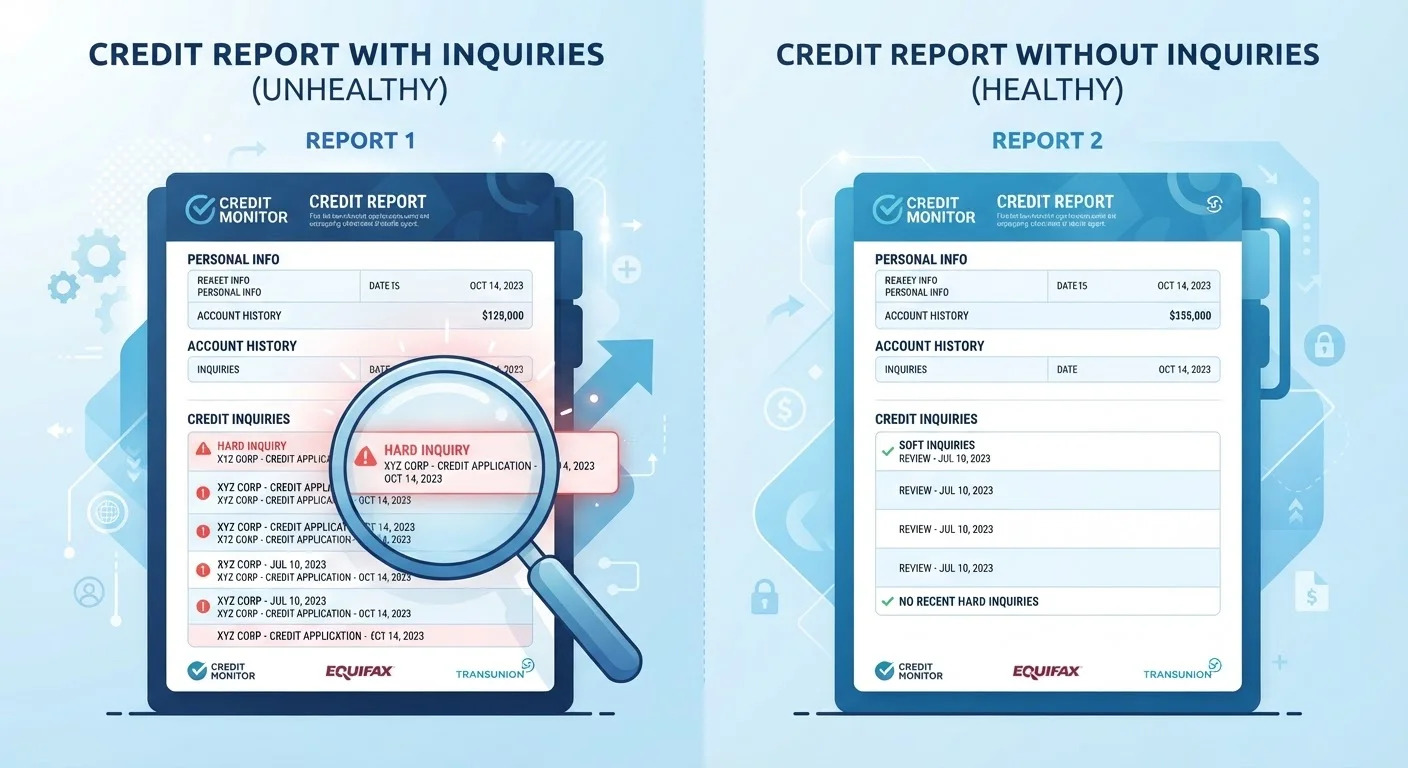
Option A
Hard Inquiry
The credit check that lenders — and scoring models — can see.
Best for: Understanding which applications trigger a visible mark on your credit report and how to time them strategically.
Option B
Soft Inquiry
The invisible credit check that has no effect on your score.
Best for: Background checks, prequalification offers, and self-monitoring that require no caution around timing.
What Makes a Hard Inquiry "Hard"?
A hard inquiry — sometimes called a hard pull — occurs when a lender or creditor reviews your credit report as part of a formal credit decision. Common triggers include applying for a mortgage, auto loan, personal loan, or credit card. The defining characteristic is that the lender is evaluating your creditworthiness in order to approve or deny credit.
Hard inquiries show up in the inquiries section of your credit report, which is visible to other lenders who pull your file. Each hard inquiry can reduce your credit score by a small number of points — typically fewer than five for most consumers, according to FICO — though the actual impact depends on the overall strength of your credit profile. Someone with a thin credit history or recent derogatory marks may feel a harder hit than someone with a long, solid record.
Hard inquiries remain on your credit report for two years. However, FICO scoring models only factor them into your score for approximately 12 months. After that, they lose scoring weight even though they remain visible on your report. See our full walkthrough of your credit report to understand where inquiries appear relative to other sections.
| Criterion | Hard Inquiry | Soft Inquiry |
|---|---|---|
| Triggered by | Formal credit application | Background checks, prequalification, self-checks |
| Affects credit score | Yes — small, temporary dip | No effect whatsoever |
| Visible to other lenders | Yes | No |
| Stays on report | Up to 2 years | Visible only to you |
| Scoring model weight | Counts for ~12 months | Never counted |
| Rate-shopping exception | Yes, for installment loans | Not applicable |
| Consumer control | You authorize when you apply | Often occurs without formal application |
What Makes a Soft Inquiry "Soft"?
A soft inquiry — or soft pull — happens when your credit report is accessed in a way that does not involve a formal lending decision tied to your application. Examples include an employer running a background check (with your permission), a credit card company prescreening you for a promotional offer, a landlord reviewing your file during a rental application, or you checking your own credit.
The critical distinction: soft inquiries are not visible to other lenders and have no effect on your credit score. You will see soft inquiries on your own report when you request it — they appear in a separate section — but they are not factored into any scoring model and cannot be seen by a creditor evaluating your application.
This makes soft inquiries completely safe to accumulate. Monitoring your credit regularly through a free service or pulling your report from AnnualCreditReport.com will never count against you. In fact, regular self-monitoring is one of the most straightforward ways to catch errors early. If you do spot something inaccurate, our guide on disputing errors on your credit report walks through the formal dispute process.
<5 pts
Typical score impact per hard inquiry
According to FICO, a single hard inquiry lowers most consumers' scores by fewer than five points, with the effect fading within 12 months.
45 days
Rate-shopping window under current FICO models
FICO's newer scoring models group mortgage, auto, and student loan inquiries made within 45 days into a single inquiry for scoring purposes.
2 years
Time hard inquiries remain on your report
Hard inquiries are visible on your credit report for two years but typically only influence your score for the first 12 months.
Rate Shopping: When Multiple Hard Inquiries Count as One
One of the most misunderstood rules in credit scoring is the rate-shopping exception. If you are comparing mortgage rates, auto loan offers, or student loan terms, you should not avoid applying out of fear of accumulating hard inquiries. Scoring models are designed to recognize rate-shopping behavior and treat it accordingly.
Under FICO's standard models, multiple inquiries for the same loan type made within a 45-day window are grouped and counted as a single inquiry. Older FICO versions use a 14-day window. VantageScore applies a similar 14-day de-duplication window. To learn how these two scoring frameworks differ more broadly, see FICO Score vs. VantageScore compared.
This exception applies to installment loan types like mortgages and auto loans — it does not apply to credit card applications, which are each counted separately. The practical takeaway: when you are shopping for a major loan, do so within a focused timeframe rather than spreading applications over several months. Before you start that process, review our credit readiness checklist to make sure your profile is in good shape first.
This article provides general financial education and is not personalized financial or credit advice. For guidance specific to your situation, consult a qualified financial professional.
The content on this site is for informational purposes only and is not a substitute for professional advice. Always consult a qualified professional for guidance specific to your situation.