

Option A
FICO Score
The long-established industry standard used by most lenders.
Best for: Consumers applying for mortgages, auto loans, or credit cards where lenders almost universally require a FICO Score.
Option B
VantageScore
The newer, more inclusive alternative developed by the credit bureaus.
Best for: Consumers with limited credit history who may benefit from VantageScore's ability to score thin files sooner.
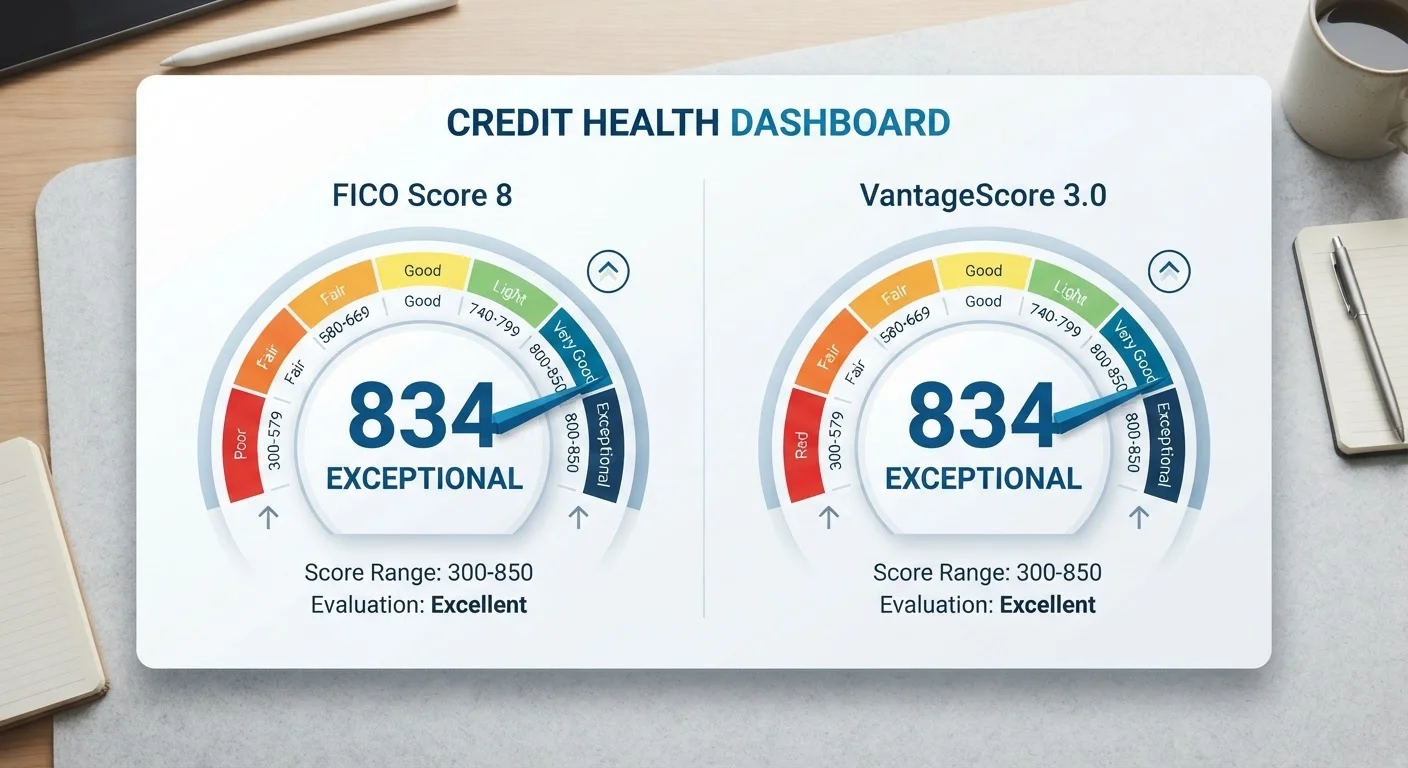
Two Models, One Goal
When a lender checks your creditworthiness, they turn to a credit score — a three-digit number that summarizes how reliably you've managed debt. But there isn't just one score. Two primary models dominate the landscape: FICO Score, developed by Fair Isaac Corporation, and VantageScore, created jointly by the three major credit bureaus — Equifax, Experian, and TransUnion.
Both models draw from the same underlying data in your credit report, and both produce scores on the 300–850 scale. But they calculate that number differently, which is why your FICO Score and VantageScore can diverge — sometimes by a meaningful margin. To understand why, it helps to know what a credit score actually measures before comparing how each model computes it.
How the Two Models Differ
The most significant differences between FICO and VantageScore come down to minimum scoring requirements, factor weighting, and how they handle certain credit behaviors.
| Criterion | FICO Score | VantageScore |
|---|---|---|
| Score Range | 300–850 | 300–850 |
| Minimum Credit History Required | 6 months | 1 month |
| Scoring Window | Activity in past 6 months | Activity in past 24 months |
| Created By | Fair Isaac Corporation | Equifax, Experian, TransUnion |
| Primary Lender Adoption | Very high (mortgages, auto, cards) | Growing (monitoring, fintechs) |
| Rate-Shopping Inquiry Window | 45 days (newer versions) | 14 days |
| Top Weighted Factor | Payment history (~35%) | Total credit usage (most influential) |
Scoring eligibility: FICO requires at least one account that is six months or older and at least one account reported in the past six months. VantageScore can generate a score with as little as one month of history and one account reported in the past two years — a meaningful advantage for credit newcomers.
Factor weighting: Both models prioritize the five core credit factors, but they weight them differently. FICO places the heaviest emphasis on payment history (approximately 35%) and credit utilization (approximately 30%). VantageScore combines payment history and credit age/mix into broader categories and weights total credit usage — including credit utilization — as its most influential factor.
Hard inquiries: Both models treat rate-shopping similarly, but the deduplication windows differ. Hard inquiries for mortgages and auto loans are typically grouped within a 45-day window under newer FICO versions; VantageScore uses a 14-day window.
Which Score Do Lenders Actually Use?
FICO holds a commanding lead in lender adoption. The vast majority of mortgage decisions in the United States rely on specific FICO Score versions — FICO 2, 4, and 5 are currently mandated for mortgage underwriting. Auto lenders and credit card issuers also lean heavily toward FICO.
90%+
Top U.S. lenders using FICO Scores
Fair Isaac Corporation has reported that the large majority of top U.S. lenders use FICO Scores in their credit decisions.
2,600+
Institutions using VantageScore
VantageScore has reported adoption by thousands of financial institutions, credit card issuers, and fintech platforms across the U.S.
VantageScore has grown in adoption and is used by many banks, credit unions, and fintech platforms — particularly for free credit monitoring tools and pre-qualification checks. However, for a high-stakes loan decision, the score a lender actually uses is almost certainly a FICO version.
This doesn't mean VantageScore is less accurate — it simply reflects market convention. For everyday credit monitoring and trend-tracking, either model provides useful feedback. For loan prep, focusing on your FICO Score gives you the clearest window into what lenders see.
Free Score Access Doesn't Mean FICO
Many free credit monitoring services — including those offered through banks and financial apps — display your VantageScore by default, not your FICO Score. Before a major loan application, check whether you can access your actual FICO Score through your lender, a credit card issuer that offers it, or directly through myFICO.com. Knowing which score you're looking at prevents surprises.
Same Habits, Better Scores on Both
Here's the practical takeaway: the behaviors that improve your FICO Score also improve your VantageScore. Paying on time, keeping balances low relative to your credit limits, and avoiding excessive new applications all push both scores upward. Differences between the models matter mainly in specific scenarios — like whether a thin credit file is scoreable at all.
If you're working on building your credit profile, don't get too caught up in tracking every point of divergence between the two. Focus on the fundamentals. Review your credit reports for errors, manage common credit misconceptions, and let consistent habits do the work over time.
This article is for general informational and educational purposes only and does not constitute personalized financial or credit advice. Consider consulting a licensed financial professional for guidance specific to your situation.
The content on this site is for informational purposes only and is not a substitute for professional advice. Always consult a qualified professional for guidance specific to your situation.