

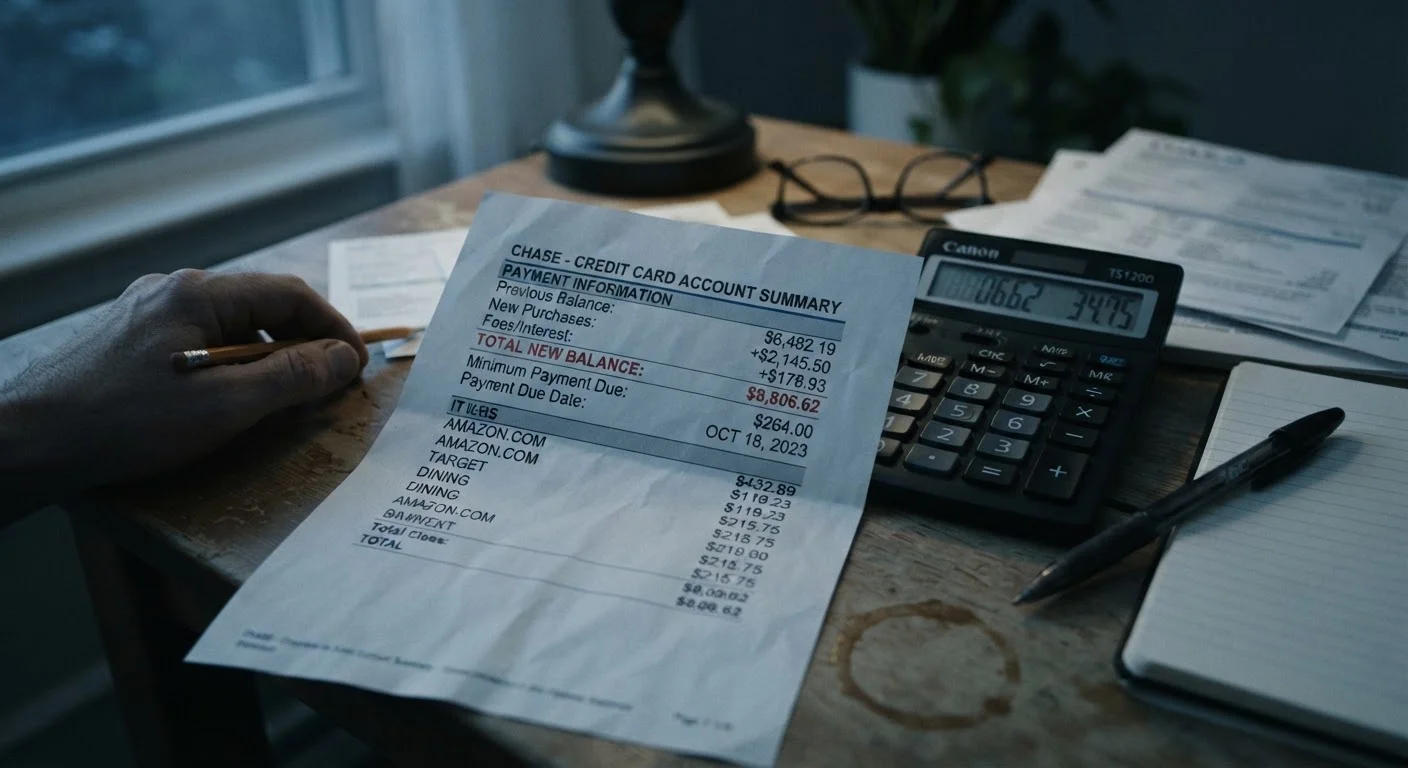
Why Credit Card Debt Feels Like Quicksand
Many people make steady payments on a credit card balance, only to check their statement weeks later and find the number barely moved. This isn't an accident — it's a predictable result of how credit card debt is structured. Three forces work against you simultaneously: compounding interest, minimum payment design, and layered fees. Understanding each one clearly is the foundation for breaking the cycle.
For a broader grounding in how debt works before diving in, see our guide to core debt concepts.
Paying only the minimum balance each month.
Why it happens: Card issuers set minimums low — often 1–2% of the balance — which feels manageable, so borrowers treat it as the default rather than the floor.
Underestimating how compounding interest accelerates the balance.
Why it happens: Most people think of interest as a flat charge, not realizing that unpaid interest gets added to the principal — and then interest is charged on that combined total in the next cycle.
Triggering avoidable fees that quietly inflate the balance.
Why it happens: Late fees, cash advance fees, and balance transfer fees are easy to overlook individually, but each one increases the principal on which interest compounds going forward.
Continuing to charge new purchases while trying to pay down the balance.
Why it happens: Without a firm plan, many people pay down the card during the month but charge new expenses back onto it, effectively running in place.
Prioritizing savings contributions over high-interest debt payoff.
Why it happens: Saving feels productive and building an emergency fund is genuinely important — so it can seem wise to do both simultaneously, even when carrying double-digit APR debt.
The Mechanics Working Against You — and How to Fight Back
Once you recognize the specific mistakes that keep people stuck, you can take deliberate steps to counteract them. The following section breaks down the most consequential errors borrowers make and offers concrete ways to change course.
~20%
Average credit card APR in recent years
Federal Reserve data has shown average credit card interest rates hovering near or above 20%, meaning balances grow quickly when unpaid.
10+ years
Time to pay off $5,000 at minimum payments
Financial education resources commonly illustrate that paying only the minimum on a mid-sized balance can extend repayment well beyond a decade.
$30+
Typical late fee per missed payment
Consumer Financial Protection Bureau data has documented late fees that compound the cost of an already-expensive balance.
If you're ready to choose a structured payoff approach, our comparison of the debt avalanche and debt snowball methods can help you find the right fit. And if you're trying to balance debt repayment with building savings at the same time, see our article on paying off debt while saving in parallel.
The Minimum Payment Trap Is by Design
Card issuers are required to disclose how long it will take to pay off your balance if you make only minimum payments — look for this on your monthly statement. If that number is five, ten, or fifteen years, it's a signal to adjust your payment strategy immediately. Treating the minimum as your target rather than your floor is one of the most expensive financial habits you can have.
To understand how APR affects your timeline in greater mathematical detail, our article on how interest rates shape your debt payoff timeline walks through the numbers clearly. And if you're weighing whether to use savings to eliminate a balance at once, consider reading the key trade-offs before dipping into savings first.
This article is for general informational purposes only and does not constitute personalized financial or legal advice. Please consult a qualified financial professional for guidance specific to your situation.
The content on this site is for informational purposes only and is not a substitute for professional advice. Always consult a qualified professional for guidance specific to your situation.