

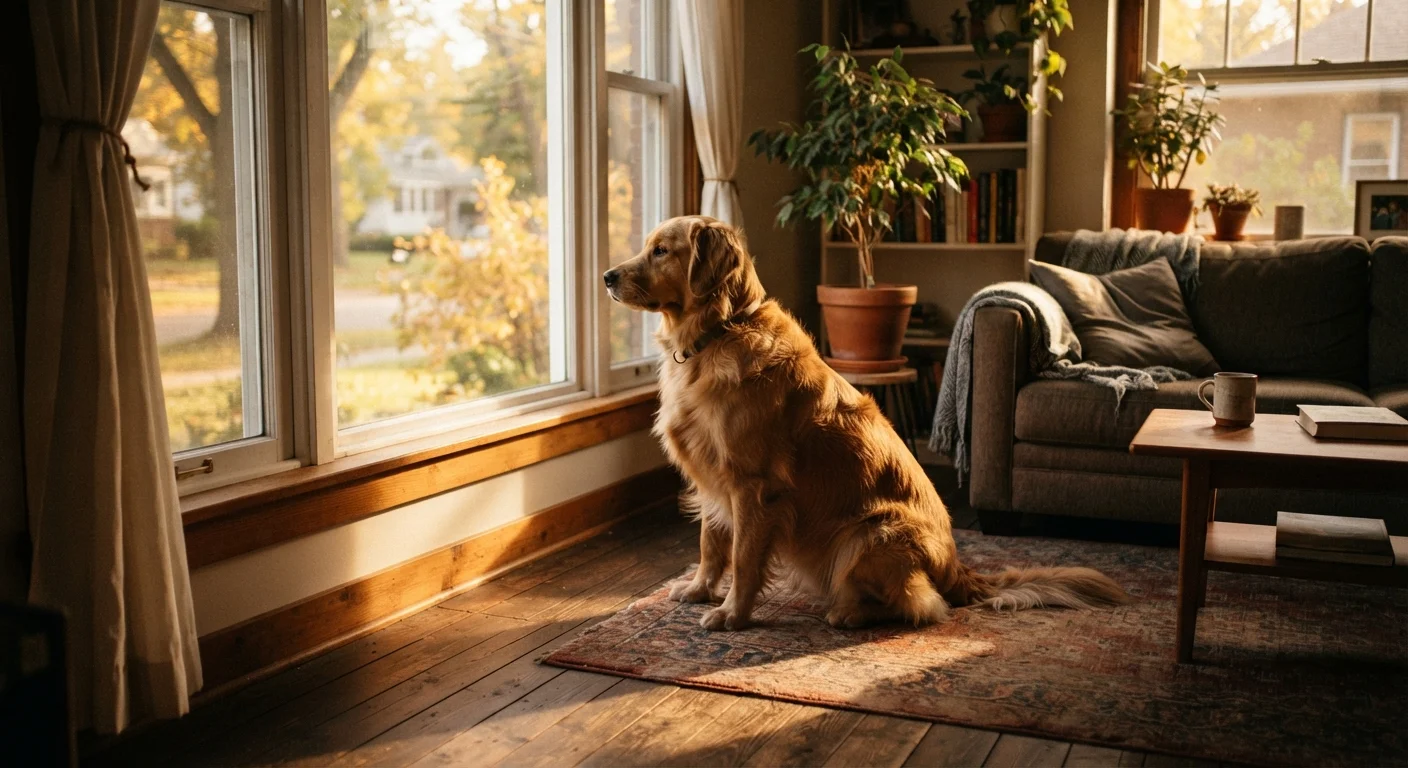
Your Pet Has a Mental Clock — and It's Remarkably Accurate
If your dog starts pacing at 5:15 p.m. every evening, or your cat meows insistently at 7 a.m. sharp, you're not imagining a pattern. Your pet genuinely knows what time it is — not by reading a clock, but by reading the world around them.
Animals navigate their days using a combination of their internal circadian rhythm (a biological 24-hour cycle that governs sleep, hunger, and alertness) and environmental cues called zeitgebers — a term meaning "time givers." These include changes in light, sounds in the neighborhood, household smells, and even your own behavior. Over time, pets learn to associate these cues with what comes next: a walk, a meal, a family member returning home.
Once that association is formed, anticipation sets in. And when anticipation goes unmet — when the expected event doesn't arrive on time — mild anxiety is a natural result. It's the behavioral equivalent of watching a pot that won't boil.
72%
Pet owners reporting some form of anxiety-related behavior
According to the American Pet Products Association, a large majority of dog owners observe behaviors consistent with anxiety in their pets, with routine disruptions frequently cited as a trigger.
~24 hrs
Length of a pet's internal circadian cycle
Like humans, domestic dogs and cats operate on a roughly 24-hour biological clock that regulates appetite, sleep, and alertness, making them highly sensitive to daily timing patterns.
2–4 weeks
Typical adjustment period for new routine changes
Veterinary behaviorists generally suggest allowing several weeks for pets to adapt to schedule shifts before expecting a significant reduction in anticipatory stress behaviors.
What the Anxiety Actually Looks Like
Time-based anxiety doesn't always look like obvious distress. The signs vary by species, individual temperament, and the strength of the routine association. Common signs include:
- Dogs: Pacing, whining, restlessness, excessive yawning, sitting by the door, or seeking attention more insistently than usual
- Cats: Persistent vocalization, rubbing against legs, knocking objects off surfaces, or becoming unusually clingy
- Small animals (rabbits, guinea pigs): Bar-chewing, repeated circling, or increased vocalizations around feeding time
The behavior tends to cluster in predictable windows: just before a regular feeding time, during the period you're normally away from home, or in the lead-up to a regular walk. If you notice the clock seems to set off your pet, you're likely seeing anticipatory anxiety in action.
Understanding what's normal for your specific animal is foundational. Our guide on what your pet's daily behavior is actually telling you can help you build a reliable baseline.
How Daily Structure Can Help
The good news: the same routine-sensitivity that causes this anxiety is also the solution to it. When your pet can reliably predict that something good is coming — and that prediction is consistently confirmed — the anticipatory stress has less reason to build.
Here's what consistent structure actually does:
- Reduces uncertainty. Predictability tells the nervous system that the environment is stable and safe. Unpredictable schedules keep pets in a mild, chronic state of alertness.
- Creates positive anchors. When feeding, walks, and play happen at consistent times, those times become associated with good outcomes rather than unresolved waiting.
- Gives anxious energy somewhere to go. A pet that knows a walk is coming at 6 p.m. can settle more easily than one that has no idea when activity will arrive.
Building this structure doesn't require rigid military scheduling — it means aiming for consistency within a reasonable window. Our article on building a morning routine that works for both you and your pet offers practical ways to anchor the start of your day for both of you.
Feeding consistency is especially powerful. For more on how meal timing affects your pet's behavior and wellbeing, see our comparison of feeding schedules vs. free feeding.
Shift Schedules Gradually, Not All at Once
If your daily schedule changes — a new work shift, a seasonal change in daylight, or a family transition — try adjusting your pet's feeding and activity times in small increments of 10 to 15 minutes every few days rather than all at once. This gives your pet's internal clock time to recalibrate without triggering a significant stress response. Abrupt changes are harder for most animals to absorb, particularly those who are already sensitive to routine.
When Routine Isn't Enough
Routine helps the majority of pets with mild time-based anxiety, but it isn't a cure-all. If your pet's anxiety is intense — involving destructive behavior, significant physical symptoms, or distress that doesn't ease even with consistent structure — that warrants a veterinary conversation.
A veterinarian can help rule out physical causes (pain, for instance, can amplify anxiety and is often concealed by animals — see our guide on signs your pet may be in pain). They can also refer you to a veterinary behaviorist if a more structured behavior modification plan is needed.
This article is general educational information about pet behavior and is not a substitute for veterinary advice tailored to your individual animal. When in doubt, consult a qualified veterinary professional.
Frequently Asked Questions
This is typically anticipatory anxiety tied to a learned association — for example, the time you usually return home or the time a walk normally happens. Dogs track daily patterns closely using environmental cues like light and sound. Consistent scheduling helps, but if pacing is intense or prolonged, consult your vet to rule out underlying causes.
Yes. Cats are creatures of habit and are sensitive to predictable routines around feeding, play, and owner presence. A cat that vocalizes or becomes clingy at a set time each day is likely responding to an ingrained schedule expectation. Shifts in routine — a changed work schedule, for instance — can trigger this.
They overlap but aren't identical. Separation anxiety is distress specifically tied to being left alone. Time-based anxiety is broader — a pet may show stress at 5 p.m. not because you've left, but because that's when something expected (a walk, dinner, your arrival) typically happens. The two can co-occur.
It can, especially in the short term. Abrupt changes in routine disrupt the behavioral predictions your pet has built up over time. Gradual schedule shifts — adjusting feeding or walk times by 15 minutes every few days — tend to be better tolerated than sudden changes.
If anxiety-related behavior is intense, escalating, interfering with eating or sleeping, or accompanied by physical symptoms like hair loss or digestive upset, schedule a veterinary visit. A vet can help distinguish routine-based anxiety from medical causes or more complex behavioral conditions.
Yes, structured enrichment — puzzle feeders, scheduled play sessions, training exercises — can redirect anxious energy and give pets a positive routine anchor. The key is consistency: enrichment offered at the same time each day becomes part of the calming routine itself.
The content on this site is for informational purposes only and is not a substitute for professional advice. Always consult a qualified professional for guidance specific to your situation.