

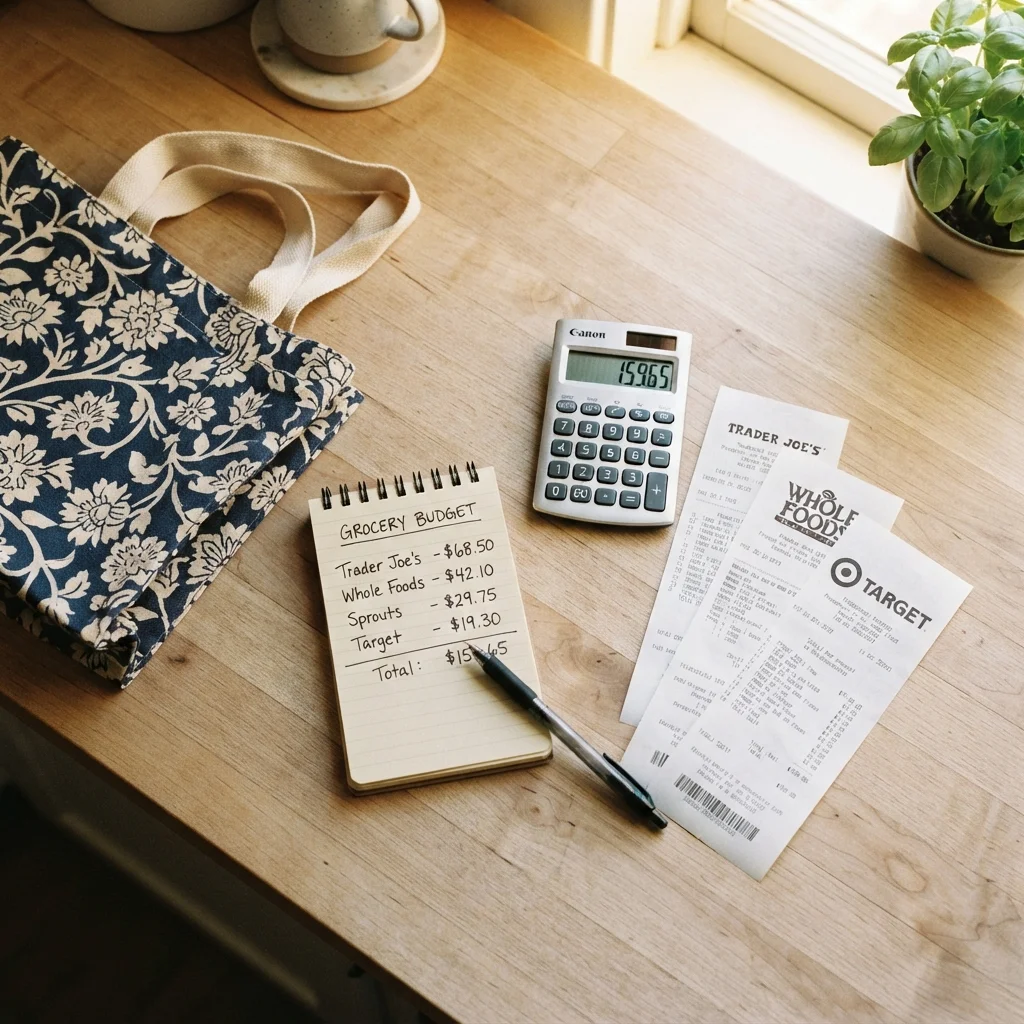
Why Most Grocery Budgets Break Down
Most people underestimate their grocery spending by a meaningful margin. They set a round number — $200, $400, $600 a month — based on intuition or guilt rather than evidence. That ceiling then either snaps under real-world pressure or generates constant low-grade anxiety every time they reach the register.
The problem isn't willpower. It's that the budget was never calibrated to actual behavior. A grocery budget that holds isn't necessarily the lowest possible number — it's the right number for your household size, eating habits, and local price environment. Understanding that distinction is the foundation of everything that follows.
This framework treats your food spending as a data problem first. Once you know what you're actually spending, you can make deliberate decisions about where to reduce, where to hold steady, and how to stay within a ceiling that reflects reality. For broader context on how food fits within a complete spending plan, the budget categories reference guide is a useful starting point.
What You'll Need Before You Start
Before setting any number, gather the inputs that will make your ceiling accurate.
What you will need
Bank or credit card statements
Used to pull actual grocery transaction data for the past 90 days.
Spreadsheet or budgeting app
Used to total spending by category and set a tracked ceiling.
A weekly shopping list template
Helps translate your budget ceiling into a concrete per-trip spending plan.
Unit price calculator (phone calculator is sufficient)
Used at the store to compare cost per ounce or serving across package sizes.
Step-by-Step: Building Your Grocery Budget
Follow these steps in order. Each one builds on the last — skipping ahead typically produces a budget that doesn't hold past the second week.
Pull your actual grocery spending for the last 90 days
Go through three months of statements and total every transaction at grocery stores, warehouse clubs, and any delivery services used primarily for food. Include household staples like cleaning supplies and toiletries only if you routinely buy them alongside groceries — the goal is accuracy, not artificial tidiness.
Average the three months to get a baseline monthly figure. If one month included a large one-time purchase (a holiday, a pantry restock), note that separately so it doesn't inflate your baseline.
Break spending into subcategories
Within your grocery total, identify how much went to each of these rough groupings: fresh produce, proteins, dairy and eggs, dry and canned goods, beverages, frozen foods, snacks, and prepared or deli items. You don't need perfect precision — a reasonable estimate for each category is enough to see the pattern.
This step reveals where your money is actually going. Most households find one or two categories that absorb a disproportionate share of the budget, often without conscious awareness. For ideas on building a nutritionally sound list that also works within a budget, see the guide on shopping on a tight budget without cutting nutrition.
Set a ceiling anchored to your baseline
Your initial ceiling should be no more than 10–15% below your 90-day baseline average. Larger cuts made without behavioral changes tend to fail within three to four weeks, which erodes confidence in the budgeting process itself.
If your baseline feels genuinely higher than your income can support, identify one or two subcategories where you have flexibility — prepared foods and specialty beverages are common candidates — and apply the reduction there specifically rather than across the board. A targeted cut is far easier to maintain than a blanket one.
Plan purchases before each shopping trip
A grocery budget exists on paper until you apply it at the store. Before each trip, write a list based on planned meals for the week and cross-reference it against what you already have at home. Assign a rough cost to each category on your list so you can do a mental check before checkout.
A structured pre-trip routine can meaningfully reduce unplanned spending. The pre-trip checklist walks through the specific steps worth building into your routine.
Review and adjust the ceiling quarterly
Food prices shift over time. Household composition changes. Seasons affect what's available and what it costs. Review your spending ceiling every three months against your actual receipts to confirm it still reflects your real situation. Adjust up or down based on evidence, not estimation.
A budget that gets updated regularly isn't a budget that's failing — it's one that's working. Static budgets that ignore changing conditions are the ones that quietly break down.
Track Store Layout to Spend Smarter
Most grocery stores place higher-margin items at eye level and near the entrance. Understanding how stores are physically organized can help you navigate more deliberately. The article on grocery store zoning explains what the layout signals and how to use it to your advantage.
Maintaining the Budget Week to Week
Setting a budget is a single afternoon of work. Keeping it requires a short weekly habit. Every week, compare what you spent against your ceiling and note any variance. Don't wait until the end of the month — small overruns are easy to correct early and hard to recover from late.
Two patterns typically emerge over the first two months: consistent overruns in specific subcategories (prepared foods, beverages, specialty items), and unpredictable spikes tied to one-off needs like hosting or restocking pantry staples. Separating these two patterns tells you whether you need a behavioral adjustment or simply a more accurate ceiling.
If you share expenses with a partner or roommate, budget maintenance works best when both parties have agreed on the number and understand the tradeoffs behind it. The article on budgeting as a household covers how to align on shared spending without friction.
Don't Treat Every Overrun as a Failure
A single week over budget is data, not a crisis. The question to ask is whether the overrun reflects a one-time circumstance or a recurring pattern. Recurring overruns in the same category almost always mean your ceiling needs adjustment — not that your discipline needs improvement. Reacting to every variance with stricter rules tends to make the budget harder to follow, not easier.
Once your grocery budget is stable, you may find you want to evaluate specific shopping strategies — like whether bulk buying actually saves money for your household — as a refinement rather than a fix.
The content on this site is for informational purposes only and is not a substitute for professional advice. Always consult a qualified professional for guidance specific to your situation.