

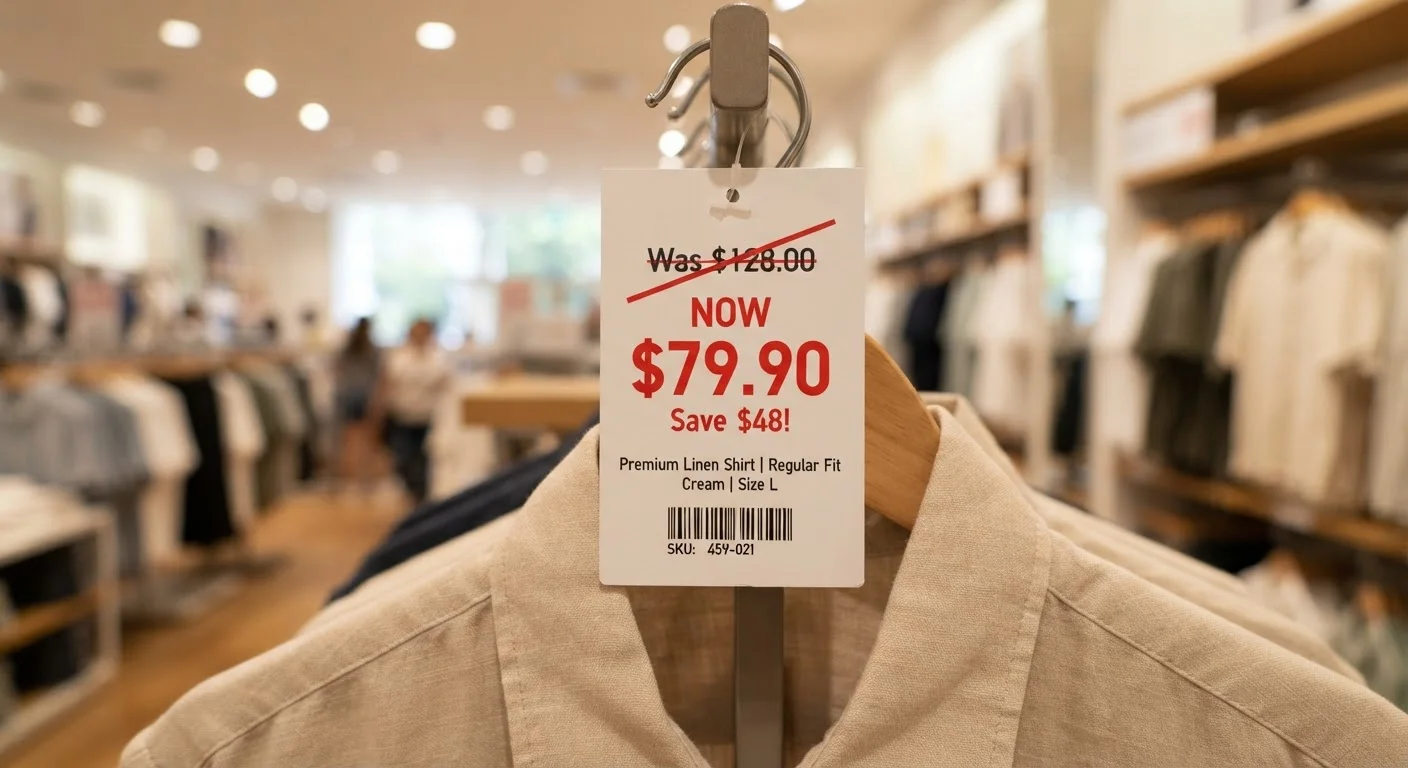
How a Number You Ignore Still Influences You
Walk through any retail environment and you'll spot the pattern immediately: a price crossed out in red, followed by a lower number in bold. The crossed-out figure is doing more psychological work than it might appear. Even when shoppers consciously dismiss it as a marketing gimmick, research in behavioral economics consistently shows that the first number encountered skews how people evaluate everything that follows.
This is the anchoring effect in action. Shoppers don't evaluate prices in a vacuum — they evaluate them relative to something. Retailers understand this, so they supply the comparison themselves. The anchor doesn't have to be accurate to be influential; it just has to be visible first.
“The anchor doesn't have to be accurate to be influential. Once a number is introduced into a negotiation or a decision, it tends to pull estimates and judgments toward it — even when people know it's arbitrary.”
— Dan Ariely, Behavioral economist and author of 'Predictably Irrational'
Where Anchor Prices Actually Come From
Retailers source anchor figures in several ways, and not all of them reflect genuine prior transactions. Common reference labels include:
- MSRP (Manufacturer's Suggested Retail Price): A price set by the manufacturer, often higher than what most stores ever charge.
- "Compare at" pricing: A figure meant to reflect what other retailers supposedly charge — but which can be difficult to verify independently.
- Former selling price: A price the item may have carried briefly, sometimes for just long enough to establish it as the "original."
- Keystone pricing: Some categories are priced at double wholesale to allow dramatic-looking markdowns.
None of these are inherently fraudulent, but they're worth understanding. Why "Sale Price" Isn't Always a Discount explores this further, including how manufactured urgency compounds the effect.
~60%
Shoppers influenced by reference price framing
Academic research in consumer behavior has repeatedly found that a majority of shoppers adjust their willingness to pay upward when a higher reference price is displayed alongside the selling price.
2–3x
Common keystone markup in apparel retail
Many apparel categories are traditionally priced at two to three times wholesale cost, creating structural room for large nominal markdowns that may not reflect genuine market value shifts.
Anchoring Beyond the Retail Aisle
Anchor pricing isn't limited to clothing racks or electronics displays. The same mechanism operates in subscription pricing (showing an annual fee next to a per-day equivalent), real estate (listing prices set high to anchor negotiation), and service industries where packages are tiered so the middle option feels reasonable by comparison.
Understanding that anchors are everywhere helps explain why the instinct to feel like you're "winning" a negotiation or a sale can sometimes work against your actual financial interests. The perception of savings and the reality of value are separate things — a distinction that The Real Difference Between Price and Value When You Shop covers in practical terms.
Practical Ways to Recalibrate Your Reference Point
The most effective way to neutralize an anchor is to replace it with a more reliable number before you evaluate the sale price.
Set Your Own Anchor Before You Shop
Before browsing a sale, look up what the item typically costs across several retailers and note that figure. When you encounter a promotional display, your pre-researched number becomes your anchor — not the store's. This simple step makes it easier to evaluate whether a discount represents genuine savings or just a favorable comparison to an inflated reference price.
- Research the typical selling price: Use price-tracking tools or check multiple retailers to establish what the item actually sells for most of the time.
- Ask what you'd pay without the crossed-out number: If you saw only the sale price with no reference figure, would you consider it fair? That question strips the anchor away.
- Compare product categories, not just prices: A product priced 40% below anchor may still be more expensive than a comparable alternative at no discount.
- Be skeptical of labels like "compare at": Unlike "was" pricing, "compare at" has no standard regulatory definition, giving retailers flexibility in how they apply it.
Anchoring works in part because our brains prefer shortcuts — and retailers are practiced at supplying them. Recognizing that the first number you see is a designed input, not neutral information, is the foundation of evaluating any price more clearly. For a broader look at common retail pricing beliefs that don't hold up to scrutiny, see Retail Pricing Myths That Many Shoppers Still Believe.
Frequently Asked Questions
Not always, but it can be. Anchor pricing is a legitimate framing technique, but when a retailer sets an artificially inflated "original" price that was never genuinely offered, it crosses into deceptive advertising. Regulators in several states have taken action against misleading reference pricing practices.
Check the item's price history using third-party price-tracking tools, and look at what comparable retailers charge for the same or similar product. If the "original" price is hard to find anywhere else, that's a signal it may not reflect actual market value.
Generally yes, with limits. U.S. Federal Trade Commission guidelines and several state laws require that reference prices reflect prices at which the product was actually sold in meaningful quantities. Purely fictitious reference prices can be considered deceptive trade practices.
No. Anchor pricing is common in e-commerce, subscription services, real estate, car dealerships, and even salary negotiations. Anytime a first number is introduced before a second one, anchoring dynamics are in play.
Anchor pricing uses a fixed reference number to shape perceived value, while dynamic pricing adjusts the actual selling price in real time based on demand, inventory, and other factors. The two tactics can appear simultaneously on the same product listing.
The content on this site is for informational purposes only and is not a substitute for professional advice. Always consult a qualified professional for guidance specific to your situation.