

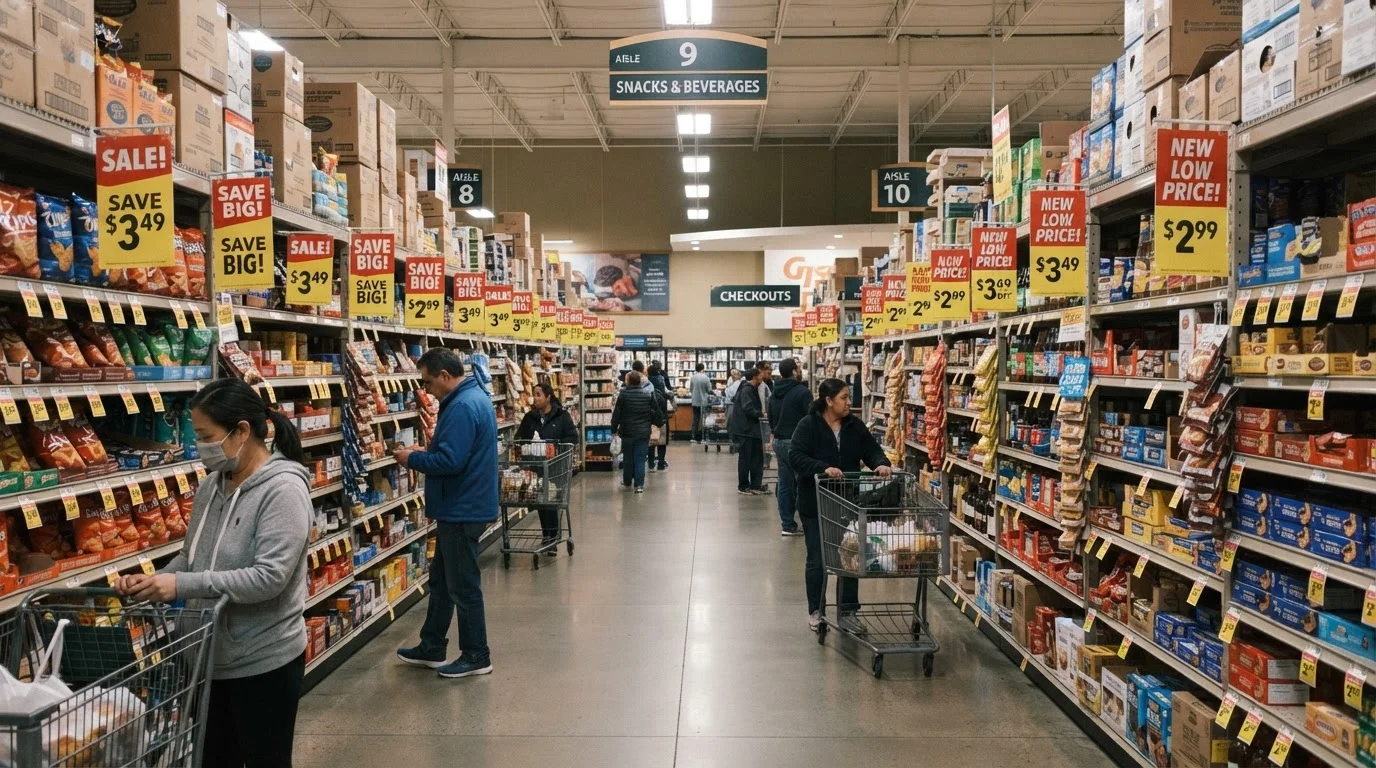
Why Retail Pricing Myths Persist
Retail pricing is a discipline unto itself. Stores employ pricing strategists, run A/B tests on shelf layouts, and spend considerable resources understanding how shoppers perceive value. Meanwhile, most consumers operate on rules of thumb picked up over years of shopping — rules that retailers know about and, in many cases, actively exploit.
This isn't about assigning bad faith to every discount sticker. It's about recognizing that the signals shoppers rely on — sale tags, clearance racks, bulk packaging — don't always mean what they appear to mean. Understanding a few core misconceptions can shift how you read a price tag entirely. For a deeper look at how reference pricing shapes your perception before you even compare products, see anchor pricing and the illusion of a deal.
Myth
If a price tag says 'Was $80, Now $49,' the item was genuinely sold at $80 before the sale.
Fact
Reference prices — the 'was' or 'original' figures — are sometimes set artificially high and may never have reflected actual transaction prices.
This practice, sometimes called anchor pricing or reference pricing, involves setting a high comparison figure to make the current price feel like a significant discount. Regulatory bodies in various states have challenged retailers over misleading reference pricing, but the practice remains common. Before assuming you're getting a deal, it's worth checking whether the item was recently sold at that original price — or whether the 'original' is largely a framing device. Why 'sale price' isn't always a discount breaks down this dynamic in detail.
Myth
Clearance means you're getting the lowest price the store will ever offer on that item.
Fact
Clearance pricing can still be marked down further, and clearance items occasionally appear at higher prices than their equivalent on other shelves.
Clearance sections exist to move inventory, not necessarily to offer rock-bottom prices. A clearance sticker signals that a product is being phased out — but the discount amount varies widely by retailer, category, and how long the item has been sitting. In some cases, a store brand alternative on a regular shelf may cost less than a name-brand clearance item. Understanding what clearance, markdown, and liquidation labels actually mean helps calibrate expectations. See clearance, markdown, and liquidation labels explained for a breakdown of each term.
Myth
Buying in bulk always saves money compared to buying smaller quantities.
Fact
Bulk purchases only save money when you use everything purchased before it expires, degrades, or goes to waste.
The per-unit math on bulk packaging often does favor the consumer — but only in theory. In practice, perishables spoil, cleaning products sit unused, and oversized quantities create storage problems. Waste offsets any per-unit savings quickly. Bulk buying makes sense for non-perishables you use consistently. For everything else, smaller quantities at a slightly higher per-unit cost may produce less total spending. Budget shopping strategies can help you build a practical framework for when bulk actually makes sense.
Myth
Store brands are lower quality than name brands because they cost less.
Fact
Store brands frequently match name-brand quality in ingredients, formulation, or manufacturing — sometimes coming from the same production lines.
Price differences between store brands and name brands often reflect marketing spend and brand equity, not product quality gaps. In categories like over-the-counter medications, pantry staples, and cleaning supplies, store brands routinely perform comparably to name brands in consumer tests. That said, results vary by category and product type. Store brands vs. name brands: what the research shows offers a category-by-category look at where generic labels hold up and where they fall short.
Myth
Prices ending in .99 are just a quirky convention with no real effect on shoppers.
Fact
Charm pricing — prices set just below a round number — is a documented psychological tactic that measurably influences how consumers perceive value.
The difference between $19.99 and $20.00 is one cent, but research in consumer behavior consistently shows that the former registers as meaningfully cheaper to most shoppers. The left digit changes, and that shift anchors the perceived price tier. Retailers use this deliberately across price points. Recognizing this pattern doesn't eliminate its effect, but it does create a moment of deliberate evaluation. Why $19.99 works better than $20.00 goes deeper on how this tactic operates.
What to Do With This Information
Knowing these myths exist is only the first step. The more actionable move is building habits that work around them. Checking unit prices — the cost per ounce, per sheet, or per serving — is one of the simplest tools available. Unit pricing is the shelf label math most shoppers ignore, and it cuts through bulk-deal confusion almost immediately.
Similarly, before shopping any major promotional event, it's worth reviewing what's actually driving those prices. Things worth knowing before you shop a big seasonal sale covers the fine print that often gets missed when urgency and sale signage dominate the experience.
Dynamic Pricing Can Change What You Pay
Online prices for the same item can shift based on time of day, browsing history, or demand signals — sometimes within hours. What you saw yesterday may not be today's price. Before completing a purchase, it's worth understanding how dynamic pricing works in everyday retail and what it means for the price you're actually offered.
Price alone rarely tells the full story of a purchase. Evaluating products before committing — rather than letting a discount drive the decision — is consistently more useful than chasing the lowest visible number. The Product Research hub offers practical frameworks for doing exactly that.
The content on this site is for informational purposes only and is not a substitute for professional advice. Always consult a qualified professional for guidance specific to your situation.