

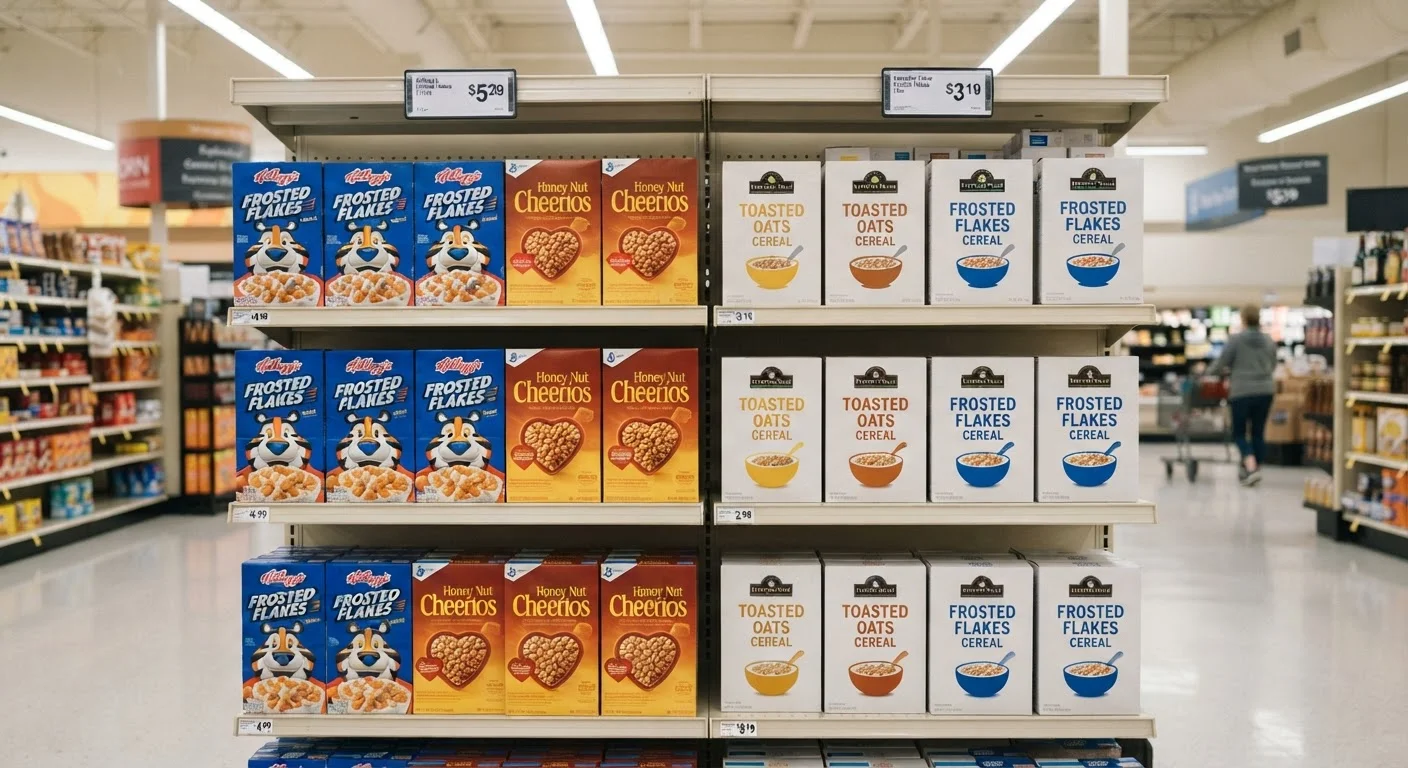
Option A
Name Brand Products
The established, heavily marketed choice with built-in consumer trust.
Best for: Categories where formulation complexity, consistency, or proprietary technology genuinely differentiates the product.
Option B
Store Brand Products
The streamlined, often equivalent alternative without the advertising premium.
Best for: Commodity categories where ingredients and performance standards are standardized across manufacturers.
Where the Price Gap Actually Comes From
The cost difference between a name brand and a store brand item rarely reflects a proportional difference in what's inside the package. A meaningful share of a name brand's retail price covers national advertising campaigns, celebrity endorsements, premium shelf placement fees, and branded packaging design — none of which affect the product's function or quality. Store brands skip most of that spending and pass the margin back toward the retailer and, often, the shopper.
In many product categories, the same manufacturing facilities produce both versions. Retailers contracting with established manufacturers to produce store brand equivalents is a documented, widespread practice in grocery — though individual arrangements aren't publicly disclosed for most products. This isn't a conspiracy theory; it's straightforward retail economics. Understanding this reality is a core part of cutting through retail pricing myths that many shoppers carry unchallenged for years.
| Criterion | Name Brand Products | Store Brand Products |
|---|---|---|
| Average price premium | 20–40% higher typical retail price | Lower — savings passed to buyer |
| OTC drug equivalence | FDA-regulated active ingredients | Same active ingredient required by law |
| Advertising spend in cost | Significant portion of price | Minimal to none |
| Manufacturing source | Brand-owned or contracted facilities | Often same facilities, varies by category |
| Blind test performance (commodity foods) | Identified correctly at chance levels | Frequently indistinguishable from name brand |
| Complex/specialty products | Proprietary R&D may add real value | May lag in verified clinical or technical categories |
| Brand accountability | Established national track record | Retailer-dependent; varies by chain |
What Independent Research Has Found
Consumer-facing research organizations and academic food science studies have repeatedly tested store brands against name brand equivalents across grocery and household categories. The consistent finding: in commodity-heavy categories — canned vegetables, flour, over-the-counter analgesics, paper products — shoppers in blind tests frequently cannot identify which product carries the name brand label. Differences in taste, texture, or performance either don't exist or fall within normal product variation.
OTC medications are the clearest-cut case. The FDA requires generic drugs to contain the same active ingredient at the same dosage as the brand-name product. A store brand ibuprofen labeled 200mg is, by regulation, the same active compound at the same concentration. The price difference is real; the functional difference is not.
~25%
Typical store brand grocery price discount vs. name brand
Industry analyses from grocery trade publications consistently estimate store brand items price 20–30% below comparable name brand products on average.
~80%
US consumers who buy store brands regularly
Consumer surveys from major retail research firms indicate the large majority of American shoppers purchase store brand items at least occasionally, regardless of income level.
Equal
Active ingredient standard: generic vs. brand OTC drugs
The FDA requires generic over-the-counter drugs to contain the same active ingredient at the same dosage as the reference brand-name product.
Where the research picture gets more nuanced is in categories that involve proprietary process, animal nutrition science, or complex formulations. This is worth keeping in mind when applying the same label-reading habits to something like pet food, where ingredient sourcing and nutritional adequacy statements carry real weight — a topic covered in depth in our guide on reading a pet food label without getting lost in the marketing.
Categories Where Each Option Holds Its Own
Store brands tend to perform at or near name brand parity in: basic pantry staples (salt, sugar, flour, rice), canned and frozen produce, dairy commodities, most cleaning supplies, and standard OTC medications. These categories involve minimal processing differentiation and strong regulatory floors that prevent quality from varying dramatically.
Name brands tend to retain a more defensible edge in: specialty or clinically validated health products, items where proprietary formulations are independently verified, and categories where customer service, return policies, or brand accountability matter as much as the product itself. Consumer electronics is a common example — the store brand equivalent of a complex device may cut costs in components that affect long-term reliability, not just packaging.
The honest approach isn't a blanket preference for either option. It's treating each category as its own question and using label information, independent reviews, and ingredient comparisons as your actual decision tools — not brand familiarity. Our broader framework for researching a product you know nothing about applies the same category-by-category logic across any unfamiliar purchase.
How to Make the Call Without Guessing
A few practical evaluation habits cut through brand noise consistently. First, compare ingredient lists directly — in regulated categories, the ingredients panel reveals what you're actually buying. Second, check whether a performance or safety standard governs the category (FDA approval for OTC drugs, USDA grades for certain food products) — if so, both products must meet the same floor. Third, use trustworthy research sources rather than packaging claims or brand reputation alone.
Finally, calibrate your own tolerance for experimentation. Switching a store brand into your cart on a low-stakes item — pasta sauce, dish soap, aluminum foil — costs little to test. If the result satisfies, you've identified a durable substitution. If it doesn't, you've spent a small amount to confirm that a name brand earns its premium in that specific category for your specific needs. That's informed shopping, not frugality ideology.
For a broader set of principles that hold across every product category, see product research done well.
The content on this site is for informational purposes only and is not a substitute for professional advice. Always consult a qualified professional for guidance specific to your situation.