

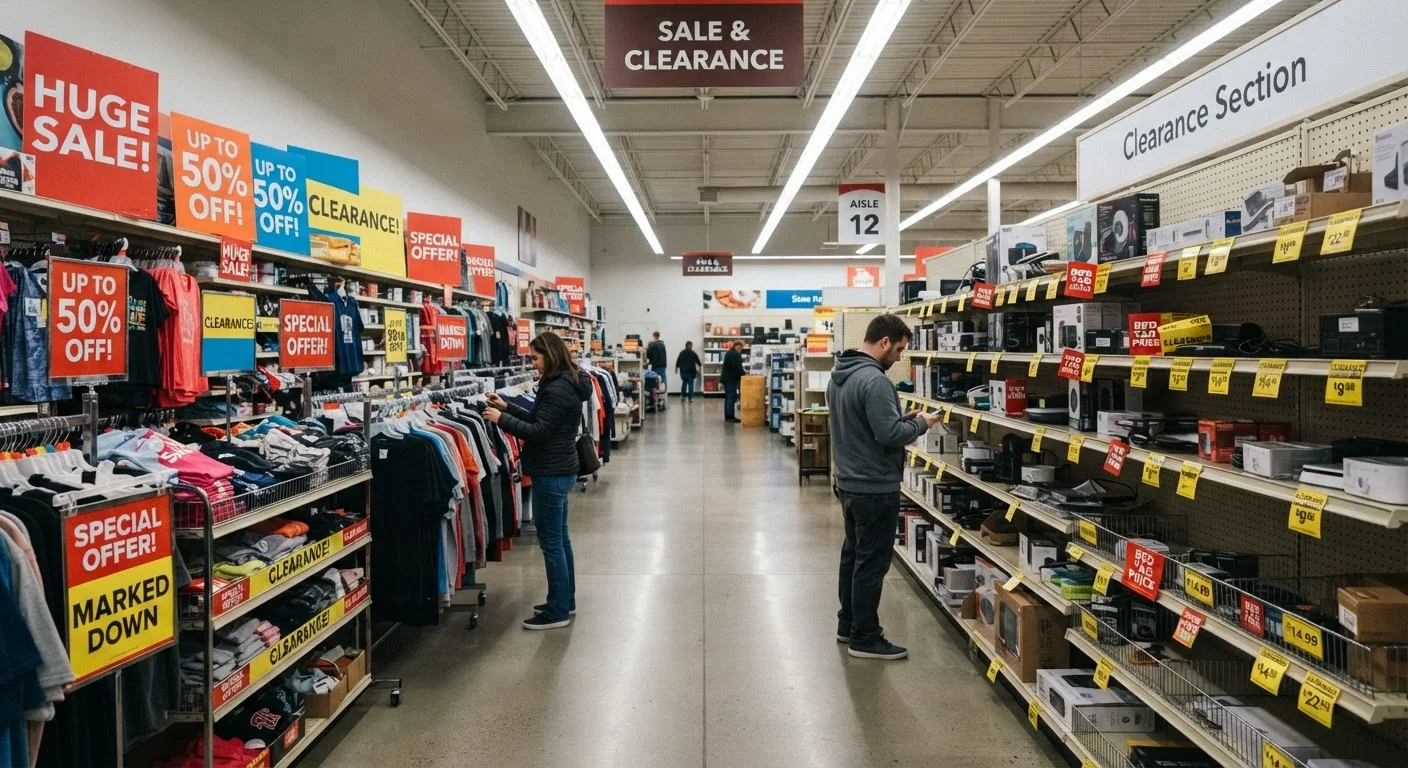
Option A
Sale
A temporary price reduction with a built-in expiration date.
Best for: Shoppers who want a discount on in-demand items that will remain available after the promotion ends.
Option B
Clearance
A permanent markdown designed to move inventory the store won't restock.
Best for: Shoppers comfortable buying whatever is left in limited sizes, colors, or quantities — often at steeper discounts.
The Core Difference: Temporary vs. Permanent
When a retailer puts an item on sale, it's running a time-limited promotion. The price drops for a defined window — a weekend, a holiday event, a loyalty member period — and then reverts. The product itself isn't going anywhere; it stays in the regular assortment and will be restocked after the promotion ends.
Clearance works differently. A clearance tag signals that the store has made a permanent decision: this item is being retired from the inventory. The price reduction isn't a promotion — it's a mechanism to move units the retailer no longer plans to reorder. Once clearance stock sells through, it's gone.
That distinction carries real practical weight. If you're shopping a sale and miss it, you can wait for the next one. If you pass on a clearance item, it may simply cease to exist in that store's inventory. As retail discount labels can mean very different things, understanding clearance versus a standard markdown puts you in a better position to decide whether to act now or wait.
| Criterion | Sale | Clearance |
|---|---|---|
| Duration | Temporary, time-limited | Permanent until stock is gone |
| Restocked after? | Yes, typically | No — inventory is being retired |
| Typical discount depth | Moderate (15–40%) | Deeper (30–75%+) |
| Selection availability | Full range usually available | Limited to remaining stock |
| Return policy | Standard store policy applies | Often restricted or final sale |
| Price may drop further? | Reverts to regular price after event | Can drop more as reset date nears |
| Signals about product | Still in active assortment | Being phased out of inventory |
What Clearance Actually Signals About a Product
Clearance placement is a business decision rooted in inventory management, not a commentary on product quality. Stores clear items for predictable reasons: a season is ending, a product line is being updated, a new model is arriving, or a category is being restructured. The item being marked down may be perfectly functional — it just no longer fits the store's forward-looking plan.
What this means for shoppers: clearance depth often increases over time. Retailers will drop prices further as a reset date approaches and remaining inventory hasn't moved. Clearance cycles follow predictable seasonal patterns, typically tied to quarterly inventory resets and seasonal transitions. If you can tolerate the risk that your size or color may sell out, waiting on clearance can yield a steeper discount — though there's no guarantee the item will still be there.
30–75%+
Typical clearance markdown range
Clearance discounts often deepen incrementally as stores approach inventory reset dates, making timing a meaningful factor for patient shoppers.
4x/year
Approximate frequency of major retail inventory resets
Most large retailers align clearance cycles with quarterly seasonal transitions, giving shoppers predictable windows to anticipate clearance events.
Return policies are also worth checking. Many retailers apply stricter or final-sale terms to clearance merchandise, which matters if there's any chance you'll need to exchange or return the item.
How Sales Are Structured — and Why 'Sale' Doesn't Always Mean a Real Discount
Promotional sales are planned events tied to the retail calendar — holidays, end-of-month pushes, category promotions. The discount is real in the sense that the register price is lower than the regular price. However, that reference price — the number the discount is calculated from — is worth scrutinizing. As reference pricing and anchor bias shape how shoppers perceive deals, a discount framed as "50% off" is only meaningful if the original price was a fair market price to begin with.
Sales are also generally shallower than clearance markdowns. A promotional discount of 20–30% is common; end-of-life clearance can reach 50–75% or more as stock dwindles. The trade-off is availability and restockability: sale items come back; clearance items don't.
When a Sale and Clearance Overlap
Some items appear on both a promotional sale and a clearance rack simultaneously — for example, a discontinued item that also falls within a storewide discount event. In that case, it's worth checking whether the discounts stack or whether only one applies. It's also a signal to act quickly: the item is both being retired and temporarily discounted, meaning stock is likely very limited. Several common retail pricing beliefs don't hold up under scrutiny, and assuming stacked discounts always apply is one of them.
For practical shopping decisions, major seasonal sales come with fine print worth reviewing before you shop — including restocking risk, reference price accuracy, and return window limitations that vary by retailer.
The content on this site is for informational purposes only and is not a substitute for professional advice. Always consult a qualified professional for guidance specific to your situation.