

Start here
Start With What You Actually Want
Next
Setting a Realistic Budget Before You Book Anything
Then
Building Your Booking Sequence
Almost there
Documents, Logistics, and Pre-Departure Prep
Final step
Packing and the Final Week Before You Leave
Start With What You Actually Want
Most first-time independent travelers open a search engine and type a destination before they've asked themselves a single meaningful question. That backwards approach leads to indecision, overspending, and trips that don't quite fit. A better starting point is a brief, honest audit of your own preferences.
Ask yourself three things: What kind of experience do I want (city exploration, nature, history, relaxation)? How much time do I realistically have? And who am I traveling with — or am I going alone? The answers narrow your options considerably before you've spent a minute researching destinations.
If you're going solo, solo travel has distinct freedoms and distinct responsibilities worth understanding upfront. If you're undecided between a city weekend or a road trip, matching your travel style to a trip format can clarify which suits you.
Once you have a general direction, research destinations that fit it — not the other way around. The Destinations Guide is a useful starting point for both US and international options.
Independent traveler
A traveler who plans and books all aspects of a trip themselves, without using a package tour or travel agent.
Itinerary
A planned schedule for your trip that outlines destinations, dates, transportation, and activities in sequence.
Travel advisory
An official government notice that rates the safety or entry conditions of a foreign destination for its citizens. US travelers can check these through the State Department.
Visa
Official permission granted by a foreign country allowing you to enter, stay, or transit through its borders for a defined period and purpose.
Contingency buffer
A portion of your travel budget set aside to cover unexpected costs like delays, medical needs, or unplanned expenses.
Booking sequence
The recommended order for making travel reservations: flights first, then accommodation, then activities — each step depends on the one before it.
Setting a Realistic Budget Before You Book Anything
Budget is the single most practical constraint in trip planning, yet many first-timers treat it as an afterthought. Establishing a rough total before you search for flights prevents you from falling in love with an option you can't afford.
A basic travel budget has four categories: transportation (flights or driving costs), accommodation, daily spending (food, activities, local transit), and a contingency buffer — typically 10–15% of your total estimate. Research average costs for your shortlisted destinations before committing to any of them.
For a deeper framework on keeping costs manageable across every planning stage, the budget travel guide covers destination selection through daily spending. The Travel on a Budget hub also surfaces practical strategies for stretching your dollars further.
Price-Check More Than One Destination
If your travel dates are flexible but your budget is fixed, compare transportation costs to two or three shortlisted destinations before committing. A modest difference in flight cost can meaningfully change how much you have available to spend once you arrive.
Building Your Booking Sequence
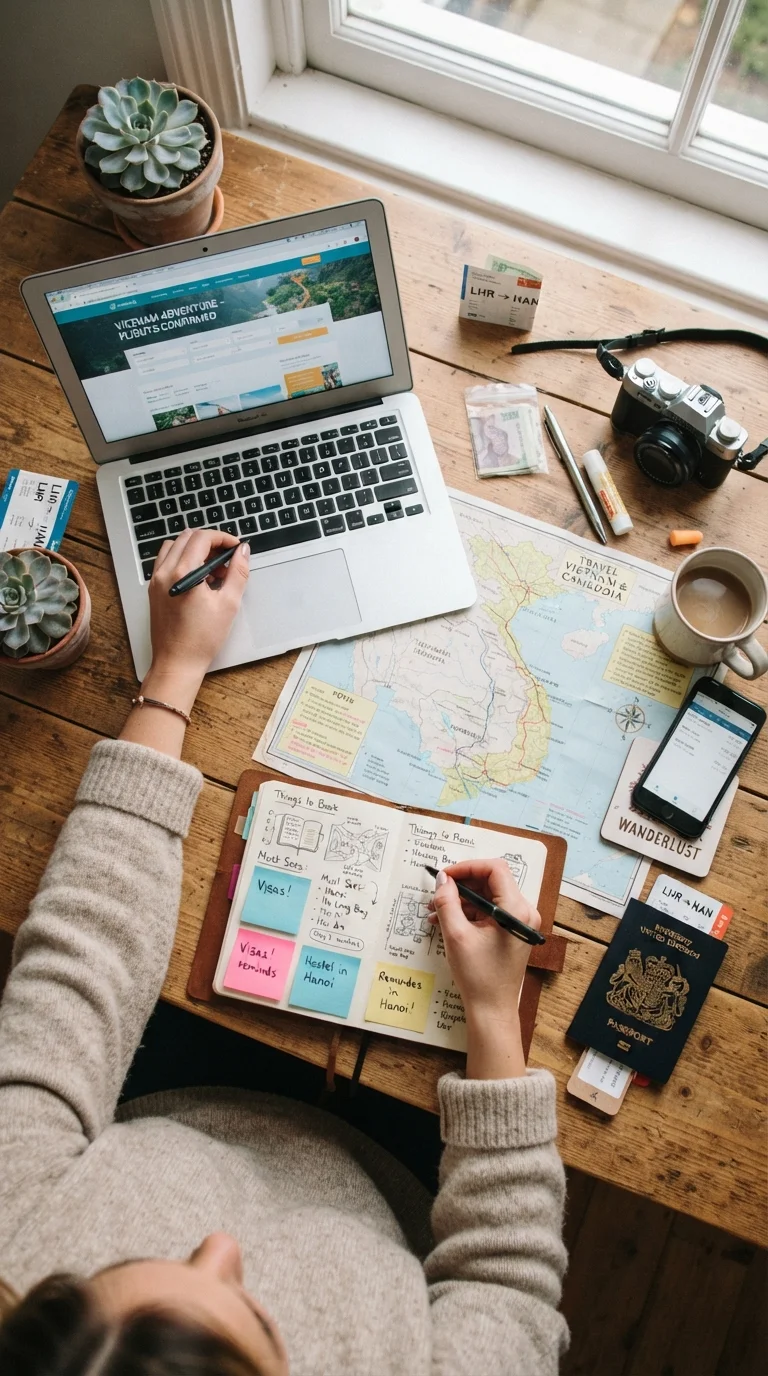
Booking order matters more than most first-timers realize. The standard sequence is: flights first, accommodation second, and activities or experiences last. This order exists because flights anchor your dates, accommodation availability depends on those dates, and activity planning only makes sense once you know where you'll be sleeping and for how long.
For international travel, check whether your destination requires a visa before you book anything — some visa applications take weeks to process. The first international trip guide walks through passport rules, visas, time zones, and currency in straightforward terms.
When comparing destinations abroad, Southeast Asia vs. Central America is a useful case study in how logistics, cost, and culture differ between two popular first-trip regions.
Keep your itinerary lean. Structured versus spontaneous planning each have real trade-offs — new travelers usually benefit from a middle ground.
Documents, Logistics, and Pre-Departure Prep
Documentation is the area where first-timers are most likely to get caught off guard. For any international trip, verify that your passport is valid for at least six months beyond your return date — many countries enforce this requirement at entry. Check entry requirements, vaccination rules, and travel advisories through the US State Department's official travel website. Do not rely on travel blogs or third-party summaries for this information; official sources are the only reliable reference.
Beyond the passport, make digital and physical copies of your key documents: passport photo page, travel insurance policy, accommodation confirmations, and any required visas. Store one set securely in cloud storage and leave a physical copy with a trusted contact at home.
Logistics to handle before departure include notifying your bank of travel dates (to avoid card blocks), confirming your phone plan covers your destination, and researching local transportation options at your destination. Steps experienced travelers never skip goes deeper on the pre-departure details most beginners overlook.
Always Verify Entry Requirements Officially
Visa rules, vaccination requirements, and border policies change without much notice. Never rely solely on travel blogs or booking platforms for this information. Check the official US State Department travel pages and the destination country's embassy or consulate website before finalizing your plans.
Packing and the Final Week Before You Leave
Packing is the most over-discussed and least complicated part of trip planning — but it deserves a clear system. Start with a list based on your destination's climate, your planned activities, and your trip length. Then cut it by roughly a third. First-time travelers almost universally overpack.
The final week before departure is when your planning comes together. Confirm all reservations, check in online for flights when available, charge portable devices, and do a final review of your documents. If you built a solid plan, this week should be low-stress verification, not last-minute scrambling.
For a complete view of how each planning phase connects — from first research to departure day — the anatomy of a well-planned trip explains why each step matters. When you're ready for a more detailed reference covering every stage, the complete reference guide covers booking sequences, documentation, packing, and contingency planning in full.
Independent travel is a skill that compounds. Your first trip will surface gaps in your process — note them, adjust, and your next trip will be smoother for it.
Frequently Asked Questions
For international trips, three to six months is a reasonable runway. Domestic travel can often be planned in four to eight weeks. Starting earlier gives you more flexibility on flights, accommodation options, and time to handle documentation like passport renewals.
Not necessarily. Most domestic trips and many international ones can be planned entirely on your own using publicly available tools. A travel agent may add value for complex multi-country itineraries or destinations with specialized logistics, but they are not required for straightforward travel.
At minimum, a valid US passport is required for most international destinations. Some countries also require a visa obtained in advance. Always verify current entry requirements through the US State Department's official travel website well before your departure date.
First-time travelers often benefit from a loose structure — confirmed accommodation and a rough daily outline — rather than fully spontaneous travel. This reduces decision fatigue without locking you into an exhausting schedule. You can always adjust once you arrive.
Travel insurance can cover unexpected costs from trip cancellations, medical emergencies abroad, or lost luggage. Whether it makes sense depends on your destination, trip cost, and existing coverage. Review your options carefully and consult the policy terms before purchasing.
Overpacking the itinerary. New travelers often try to maximize every hour, which leads to exhaustion and leaves no room for unexpected discoveries or delays. Building in unscheduled time consistently improves the travel experience.
The content on this site is for informational purposes only and is not a substitute for professional advice. Always consult a qualified professional for guidance specific to your situation.